Subsection 2.2.3 Equations of Mirror Lines

Learner Experience 2.2.4.

Work in groups
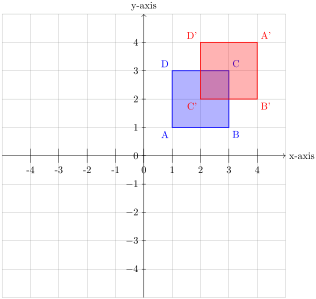
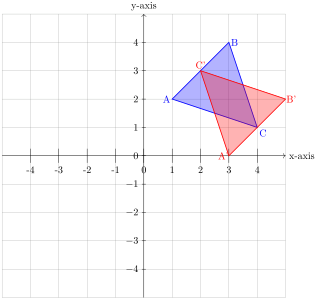
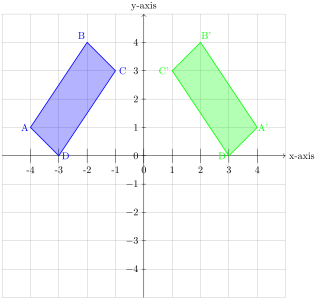
Determine the line of reflection that created the reflected image below.
Line of reflection
Copy the figure above on a graph paper
Fold your graph paper such that the points of the objects match with their respective images. Where does the fold line appear?

Key Takeaway 2.2.15.

  • You notice that the fold line appears exactly on the y-axis. Therefore, the line of reflection is the y-axis.
  • A line of reflection can be defined with an equation. From the activity, the equation of the line of reflection is \(x = 0.\)
In the activity above, you determined the line of reflection by folding the graph paper. However, there are other methods to determine the line of reflection. In the next example, you will determine the line of reflection using algebraic methods.
You will need to use the following properties of reflection:
  • The line of reflection is the perpendicular bisector of the line segment connecting a point and its image.
  • The distance from the object to the mirror line is the same as that of mirror line to the image.
You will also need to use the following properties of lines:
  • The gradient of a line is the change in y-coordinates divided by the change in x-coordinates.
  • The equation of a line can be expressed as
    \begin{equation*} y - y_1 = m (x - x_1) \end{equation*}
    where \((x_1,y_1)\) is a point on the line and \(m\) is the gradient of the line.

Five-Step Method for Finding the Equation of a Mirror Line.

Step Action
1 Identify corresponding pairs of object and image points.
2 Check if any point maps to itself β€” the mirror line passes through it.
3 Find the midpoint of a pair using \(\left(\frac{x_1+x_2}{2},\frac{y_1+y_2}{2}\right)\text{.}\)
4 Calculate the gradient of the segment joining the pair, then find the perpendicular gradient (\(m_\perp = -\frac{1}{m}\)).
5 Write the equation using point-slope form: \(y - y_1 = m(x - x_1)\text{.}\)

Common Mirror Lines.

Mirror Line Equation How to Recognise
y-axis \(x = 0\) x-coordinates change sign, y stays the same
x-axis \(y = 0\) y-coordinates change sign, x stays the same
Line \(y = x\) \(y = x\) Coordinates swap: \((a,b) \to (b,a)\)
Line \(y = -x\) \(y = -x\) Coordinates swap and change sign: \((a,b) \to (-b,-a)\)

Warning 2.2.16.

The mirror line is not the line connecting the object to its image β€” it bisects that line at right angles.

Example 2.2.17.

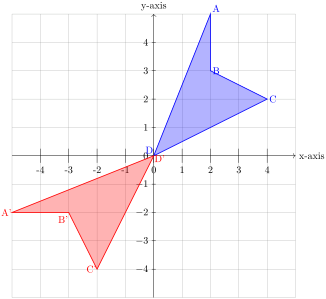
Determine the equation of the line of reflection.
Line of reflection
Solution.
The coordinates of \(D \text{ and } D'\) are at \((0,0),\) tells you that the line of reflection passes through \((0,0).\)
Connect point \(C \text{ to } C'\) with a line. The line of reflection is the perpendicular bisector of \(C \text{ and } C'.\)
From the properties of reflection, the distance from the object to the mirror line is the same as that of mirror line to the image. Therefore, the line of reflection passes through the midpoint of the line connecting \(C \text{ to } C'.\)
Coordinates for \(C \text{ is }(4,2)\) and that of \(C' \text{ is } (-2,-4).\) The mid point of line \(CC'\) is:
\begin{equation*} \left( \frac{4 + -2}{2},\frac{2 + -4}{2} \right) = (1,-1) \end{equation*}
Since you know that the line of reflection passes through \((0,0) \text{ and } (1,-1),\) the gradient of the reflection line is:
\begin{equation*} m = \frac{-1 - 0}{1 - 0} = -1 \end{equation*}
Therefore taking points \((x,y) \text { and } (1,-1),\) the equation of the line of reflection is :
\begin{equation*} y - y_1 = m (x - x_1) \end{equation*}
\begin{equation*} y - -1 = -1 (x - 1) \end{equation*}
\begin{equation*} y + 1 = -x + 1 \end{equation*}
\begin{equation*} y = -x \end{equation*}
Exploration 2.2.5. Changing Equations of Mirror Lines.

Manipulate the equation of the mirror line in the interactive below! Can you put in the answer from ExampleΒ 2.2.17 and see if the image matches the one in the example?

Instructions.

Enter different values for the slope (\(m\)) and y-intercept (\(c\)) in the input fields to see how the mirror line and reflected image change. You can use this to check your answer to ExampleΒ 2.2.17. You can also move around the blue polygonβ€”this could help for other exercises!
Figure 2.2.18. An interactive demonstration of reflection across a mirror line.

Example 2.2.19.

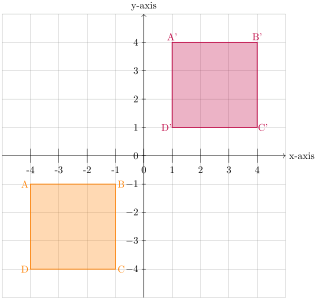
From the figure below, determine the equation of the line of reflection.
Solution.
The coordinates of \(A \text{ and } A'\) are \((1,1) \text{ and } (4,4),\) so the line of reflection is the perpendicular bisector of the segment joining these points.
The midpoint of \(AA'\) is:
\begin{equation*} \left( \frac{1 + 4}{2},\frac{1 + 4}{2} \right) = (2.5,2.5) \end{equation*}
The gradient of the segment \(AA'\) is
\begin{equation*} m_{AA'} = \frac{4 - 1}{4 - 1} = 1. \end{equation*}
The line of reflection is perpendicular to this segment, so its gradient is
\begin{equation*} m = -1. \end{equation*}
Using point \((2.5,2.5)\) and slope \(-1\text{,}\) the equation is:
\begin{equation*} y - 2.5 = -1(x - 2.5) \end{equation*}
\begin{equation*} y - 2.5 = -x + 2.5 \end{equation*}
\begin{equation*} y = -x + 5 \end{equation*}

Exercises Exercises

2.

The vertices of a triangle are \(A(1,2),\, B(3,4)\text{ and }C(5,4).\) The vertices of the image are \(A'(1,-2),\, B'(3,-4)\text{ and }C'(5,-4).\) Find the equation of the line of reflection.
Answer.
\(y = 0\)

3.

The vertices of a a letter \(V\) are \(P(-3,4),\,Q(-3,2)\text{ and }R(-1,2).\) The vertices of the image are \(P'(-1,2),\, Q'(-1,0)\text{ and }R'(1,0).\) Find the equation of the line of reflection.
Answer.
The line of reflection is the line \(y = x - 1.\)

4.

\(O(0,0)\) is the centre of a circle of radius \(2\,cm.\) If \(O'(2,0)\) is the reflection of the centre of the circle, find the equation of the line of reflection.
Answer.
The line of reflection is the vertical line \(x = 1.\)

5.

The vertices of a triangle are \(A(1,2),\, B(3,4)\text{ and }C(5,4).\) The vertices of the image are \(A'(-1,2),\, B'(-3,4)\text{ and }C'(-5,4).\) Find the equation of the line of reflection.
Answer.
The line of reflection is the y-axis and its equation is \(x = 0.\)

6.

The vertices of a triangle are \(A(1,2),\, B(3,4)\text{ and }C(5,4).\) The vertices of the image are \(A'(-1,-2),\, B'(-3,-4)\text{ and }C'(-5,-4).\) Find the equation of the line of reflection.
Answer.
The line of reflection is the line \(y = -x.\)