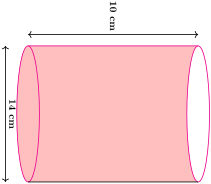
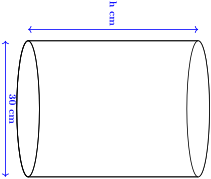
Subsection 2.8.3 (*) Volume of Cylinders

Learner Experience 2.8.3.

Work in groups:
Materials Needed: A cylinder-shaped container (e.g., a can or a water bottle), a measuring tape, water, and a measuring cup.
Instruction:
Form groups of \(2-3\) students.
  • Find the radius and height of the cylinder-shaped container (i.e. a can) using the measuring tape, in centimeters.
  • Pour water to fill the cylinder.
  • Transfer the water from the cylinder to the measuring cup and record the volume of water in milliliters (mL).
  • Calculate the volume of the cylinder using the formula \(V = \pi r^2 h\text{,}\) where \(r\) is the radius and \(h\) is the height. Use \(\pi = 3.14\text{.}\)
  • Compare your calculated volume with milliliters you measured (mL). Discuss any differences and possible reasons for them.

Key Takeaway 2.8.14.

The volume of a cylinder can be calculated using the formula
\begin{equation*} V = \pi r^2 h\text{,} \end{equation*}
where \(r\) is the radius of the circular base and \(h\) is the height of the cylinder.
This formula is just a special case of the volume formula for prisms (\(V = Fh\)), since the area of a circular base is given by \(F = \pi r^2\text{.}\)

Example 2.8.15.

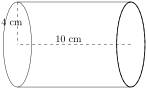
The cylinder below has a radius of 4 cm and a height of 10 cm. Use \(\pi = 3.142\)
Cylindrical prism
\begin{align*} V \amp = \text{Base Area }\times h \\ V \amp = \pi r^2 \times h\\ \amp = 3.142 \times (4)^2 \, \text{cm} \times 10\, \text{cm}\\ \amp = 502.65\, \text{cm}^3 \end{align*}

Example 2.8.16.

A pipe has a radius of 3 cm and a height of 15 cm. Find the volume of the pipe.
Solution.
\begin{align*} V \amp = \text{Base Area} \times h \\ V \amp = \pi r^2 \times h\\ \amp = 3.142 \times (3)^2 \, \text{cm} \times 15\, \text{cm}\\ \amp = 424.12\, \text{cm}^3 \end{align*}

Example 2.8.17.

Find the volume of the following cylinder using \(\pi = 3.142\text{.}\) Leave your answer (correct to 2 decimal place):
Solution.
Step 1: Find the area of the base
\begin{align*} \text {area of circle } = \amp \pi r^2 \\ = \amp \pi(8)^2\\ = \amp \pi 64\,\text{cm}^2\\ = \amp 3,142 \times 64\,\text{cm}^2 \\ = \amp 201.088 \,\text{cm}^2 \end{align*}
Step 2: Multiply the area of the base by the height of the solid to find the volume
\begin{align*} \text{Volume} = \amp \text{Base area} \times \text{height}\\ = \amp \pi r^2 \times h \\ = \amp201.088 \, \text{cm}^2 \times 20\, \text{cm} \\ = \amp 4021.76 \, \text{cm}^3 \end{align*}
The volume of the cylinder is \(4021.76 \, \text{cm}^3 \)
Example 2.8.18.

Mueni’s water tank has a radius of 7 m and a height of 20 m. Find the capacity of the water tank in litres.
Solution.
\begin{align*} V \amp = \text{Base Area} \times h \\ V \amp = \pi r^2 \times h\\ \amp = \frac{22}{7} \times (7)^2\, \text{m} \times 20 \, \text{m}\\ \amp = 3080\, \text{m}^3 \end{align*}
To convert from \(m^3 \) to litres we multiply by \(1000 \, L/\text{m}^3\)
\begin{align*} 1 \text{litre} \amp = 1000\, \text{m}^3 \\ \amp = 3080\, \text{m}^3 \times 1000\, \text{L/m}^3\\ \amp = 3,080,000 \, \text{ litres} \end{align*}

Exercises Exercises

Unless otherwise stated, use \(\pi = 3.14\) in all calculations.

1.

Alongside is a cross-sectional view of an open cylinder that has a radius of 7 cm and a height of 10 cm. Find its volume.
Solution.
Use \(V=\pi r^2 h\) with \(r=7\,\text{cm}\) and \(h=10\,\text{cm}\text{.}\)
\begin{align*} V \amp = \pi \times 7^2 \times 10 \\ \amp = \pi \times 49 \times 10 \\ \amp = 490\pi\,\text{cm}^3 \\ \amp \approx 3.14 \times 490 = 1538.6\,\text{cm}^3 \end{align*}

2.

Calculate the volume of a cylinder with radius \(6\,\text{cm}\) and height \(10\,\text{cm}\text{.}\) (Use \(\pi=3.14\text{.}\))
Solution.
Using \(V=\pi r^2 h\) we have
\begin{align*} V\amp=3.14\times 6^2 \times 10\\ \amp=3.14\times 36 \times 10\\ \amp=1130.4\,\text{cm}^3 \end{align*}

3.

A cylinder has diameter \(10\,\text{cm}\) and height \(12\,\text{cm}\text{.}\) Find its volume in terms of \(\pi\text{.}\)
Solution.
The radius is \(r=\tfrac{10}{2}=5\,\text{cm}\text{.}\) Using \(V=\pi r^2 h\text{:}\)
\begin{align*} V\amp=\pi\times 5^2 \times 12\\ \amp=\pi \times 25 \times 12\\ \amp=300\pi\,\text{cm}^3 \end{align*}

4.

A cylinder has a volume of \(1,570 \text{cm}^3\) and a diameter of 30 cm. Find its height.
Solution.
Radius \(r=\tfrac{30}{2}=15\,\text{cm}\text{.}\) Using \(V=\pi r^2 h\) we get
\begin{align*} h\amp=\dfrac{V}{\pi r^2} = \dfrac{1570}{3.14\times 15^2}\\ \amp=\dfrac{1570}{706.5}\\ \amp\approx 2.22\,\text{cm} \end{align*}

5.

A cylindrical water tank has a radius of 2 m and a height of 5 m. How many liters of water can it hold when full? (Use \(\pi = 3.14\text{,}\) remember that 1 cubic meter = 1000 liters)
Solution.
Using \(V=\pi r^2 h\) we have
\begin{align*} V \amp = \pi r^2 h \\ \amp = 3.14 \times (2)^2\, \text{m} \times 5\, \text{m} \\ \amp = 3.14 \times 4 \times 5\, \text{m}^3 \\ \amp = 62.8\, \text{m}^3 \end{align*}
To convert from \(\text{m}^3\) to litres we multiply by \(1000\,\text{L/m}^3\text{.}\)
\begin{align*} V = 62.8\, \text{m}^3 \times 1000\, \text{L/m}^3 \\ \amp = 62,800\, \text{litres} \end{align*}

6.

If the radius of a cylinder is doubled while keeping the height the same, by what factor does the volume increase?
Solution.
Let the original radius be \(r\) and height \(h\text{.}\) Original volume: \(V=\pi r^2 h\text{.}\)
If radius is doubled (\(r'=2r\)) then
\begin{align*} V' \amp = \pi (2r)^2 h = \pi \times 4r^2 h = 4\pi r^2 h \\ \amp = 4V \end{align*}
Therefore the volume increases by a factor of \(4\text{.}\)

7. A Harder Exercise.

A hollow cylindrical pipe has an outer radius of 8 cm, an inner radius of 6 cm, and a length of 100 cm. Find the volume of material used to make the pipe.
Solution.
The volume of material is the volume of the outer cylinder minus the inner cylinder: \(V=\pi(R^2-r^2)h\text{.}\)
Here \(R=8\,\text{cm}\text{,}\) \(r=6\,\text{cm}\) and \(h=100\,\text{cm}\text{.}\) So
\begin{align*} V \amp = \pi(8^2-6^2)\times 100\\ \amp = \pi(64-36)\times 100\\ \amp = \pi\times 28 \times 100\\ \amp = 2800\pi\,\text{cm}^3 \end{align*}
Using \(\pi=3.14\) (unless otherwise stated) gives
\begin{align*} V \amp \approx 3.14 \times 2800 = 8792\,\text{cm}^3 \end{align*}