Skip to main content
Contents
Search Book
Search Results:
No results.
Read aloud Readability settings Prev Up Next \(\newcommand{\N}{\mathbb N} \newcommand{\Z}{\mathbb Z} \newcommand{\Q}{\mathbb Q} \newcommand{\R}{\mathbb R}
\newcommand{\lt}{<}
\newcommand{\gt}{>}
\newcommand{\amp}{&}
\definecolor{fillinmathshade}{gray}{0.9}
\newcommand{\fillinmath}[1]{\mathchoice{\colorbox{fillinmathshade}{$\displaystyle \phantom{\,#1\,}$}}{\colorbox{fillinmathshade}{$\textstyle \phantom{\,#1\,}$}}{\colorbox{fillinmathshade}{$\scriptstyle \phantom{\,#1\,}$}}{\colorbox{fillinmathshade}{$\scriptscriptstyle\phantom{\,#1\,}$}}}
\)
Subsection 2.3.2 Centre and Angle of Rotation
Curriculum Alignment
Strand
2.0 Measurements and Geometry
Sub-Strand
Specific Learning Outcomes
Determine the centre and angle of rotation given an object and its image
Learner Experience 2.3.12 .
\(\textbf{ Work in pairs.}\)
\(\textbf{What you need:}\) Graph paper, a ruler, a protractor and a pencil
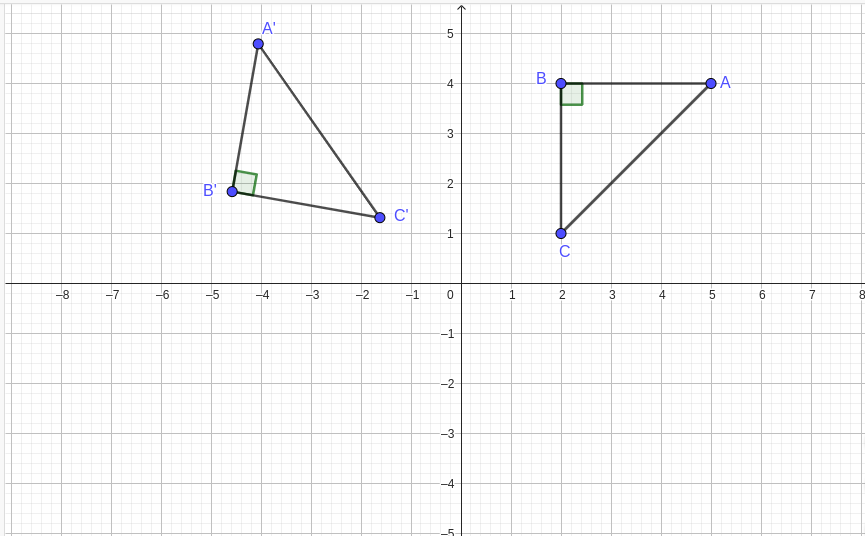
On a piece of graph paper draw triangle
\(ABC\) and its image
\(A'B'C'\) as shown in the figure below.
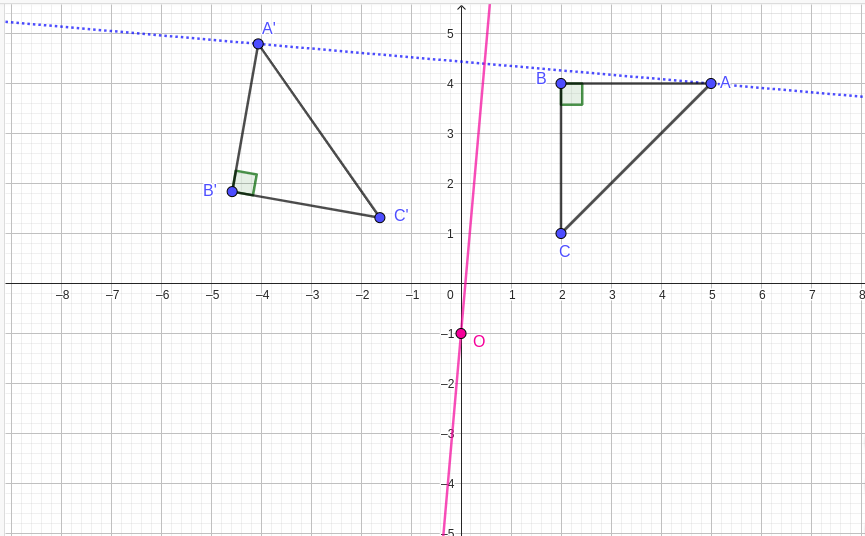
Join point
\(A\) to
\(A'\) and construct a perpendicular bisector to
\(AA'\) as shown below;
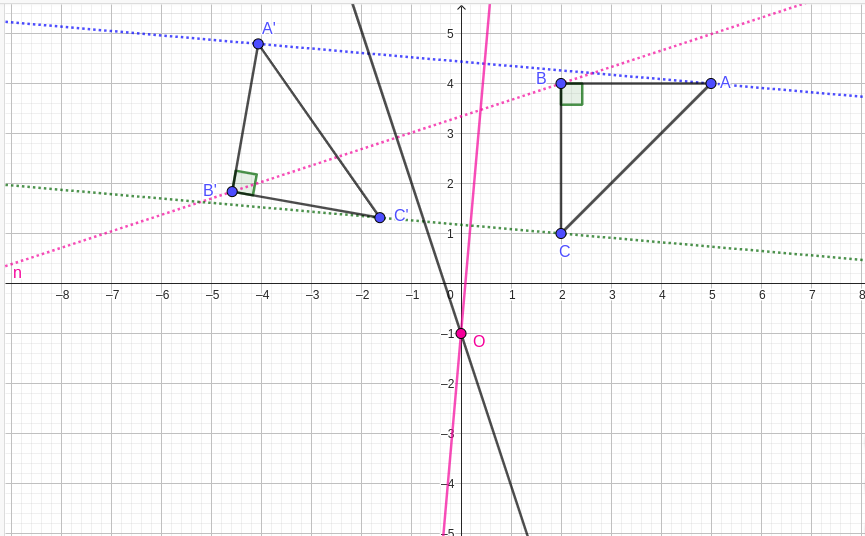
Similary Join point
\(B\) to
\(B'\) and
\(C\) to
\(C'\) and construct a perpendicular bisector to
\(BB'\) and
\(CC'\) as shown below;
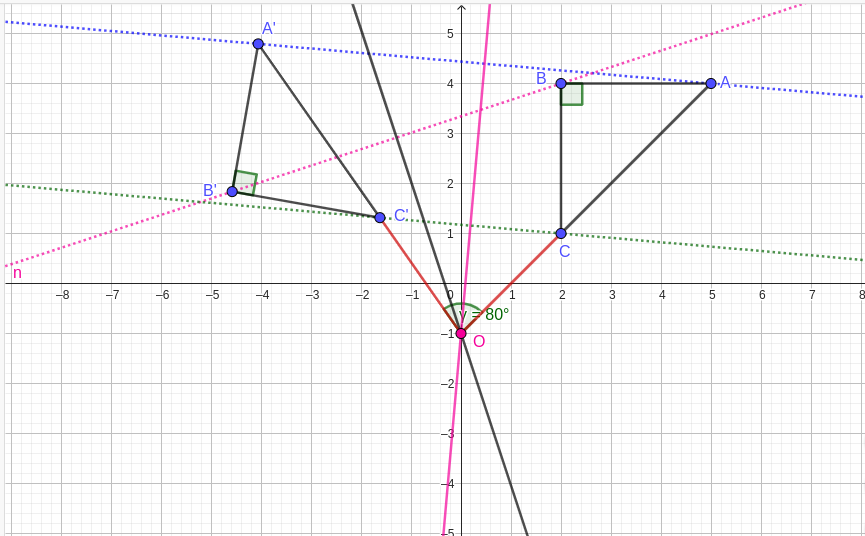
Now join point
\(O\) to
\(C'\) and
\(C\) and measusure
\(\angle\, COC'\)
Similary join point
\(O\) to
\(B'\) and
\(B\) and
\(O\) to
\(A'\) and
\(A\) and measusure
\(\angle\, BOB'\) and
\(\angle\,AOA'\text{.}\) What do you notice?
Share your work with other leaners in class
\(\textbf{Key Takeaway}\)
Triangle
\(A'B'C'\) is the image of triangle
\(ABC\) after a rotation.The centre and angle of rotation can be found by drawing the perpendicular bisectors of the lines between two sets of points,
\(C\) and
\(C'\) and
\(B\) and
\(B'\) or
\(A\) and
\(A'\)
The point where two perpendicular bisectors intersect is called
\(\textbf{the centre of rotation.}\) To find
\(\textbf{ the angle of rotation}\text{,}\) join
\(C'\) and
\(C\) to the centre of rotation and measure the angle between these lines.
\(\angle\, COC'=\) \(\angle\, BOB'=\) \(\angle\, AOA'\)
Instructions.
Use this interactive tool to follow the geometric construction steps for finding a center of rotation.
Click the checkboxes at the bottom left in order (from 1 to 5). Notice how the perpendicular bisector of the line joining corresponding points (
\(AA'\) ) and the perpendicular bisector of (
\(BB'\) ) perfectly intersect. That exact point of intersection is your centre of rotation!
Figure 2.3.13. Interactive Activity: Finding the Centre of Rotation
Example 2.3.14 .
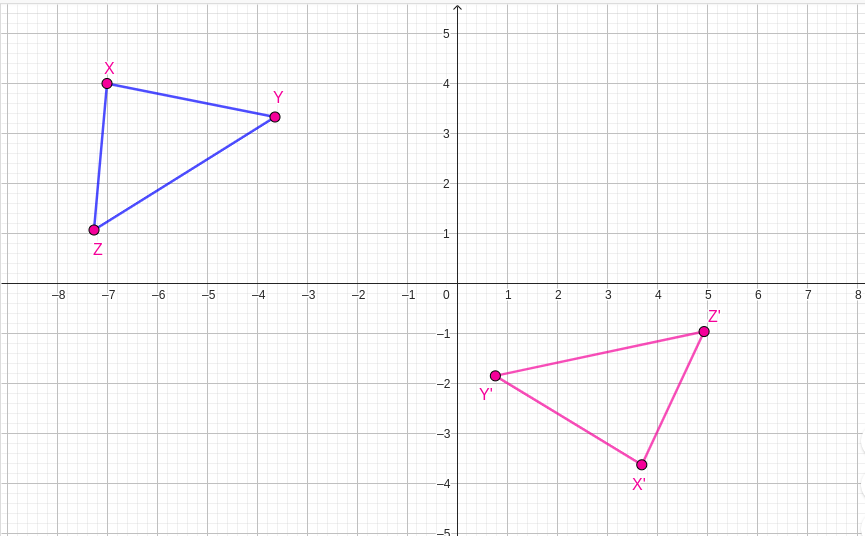
In the figures below, the triangle
\(X'Y'Z'\) is the image of triangle
\(XYZ\) after rotation. Find the centre and angle of rotation
Solution .
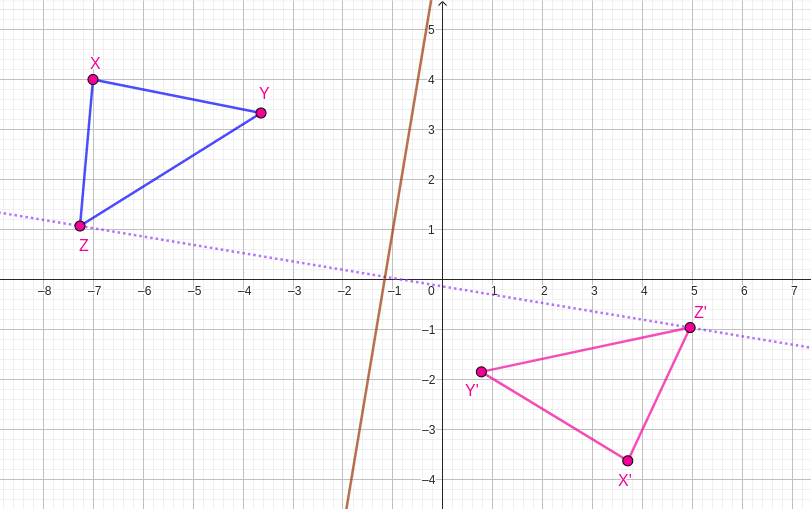
In order to determine the centre and angle of rotation we have to follow the following steps:
Join point
\(Z\) to
\(Z'\) and construct a perpendicular bisector to
\(ZZ''\) as shown below
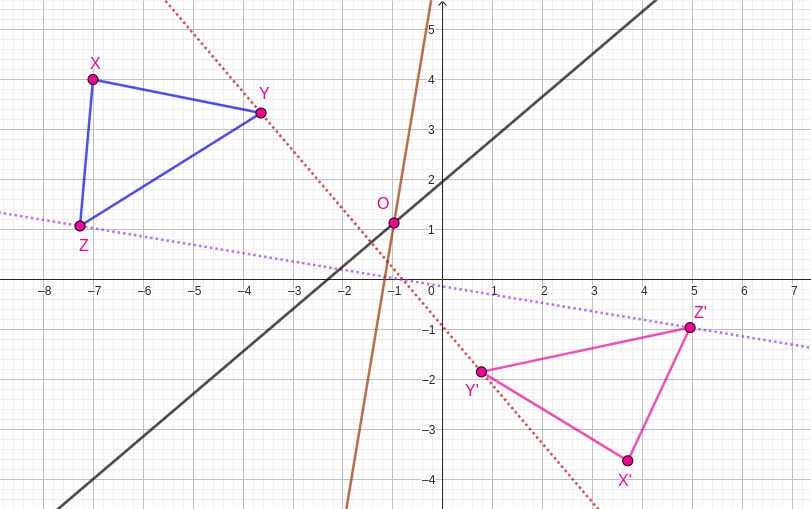
Also join point
\(Y\) to
\(Y'\) and construct a perpendicular bisector to
\(YY'\) as shown below. Mark the point of intersection of perpendicular bisectors
\(O\)
Similary you can join
\(X\) to
\(X'\) and construct a perpendicular bisector to
\(XX'\)
\(\textbf{Note}\) You can use only two points.
The point where perpendicular bisectors intersect is the centre of rotation.
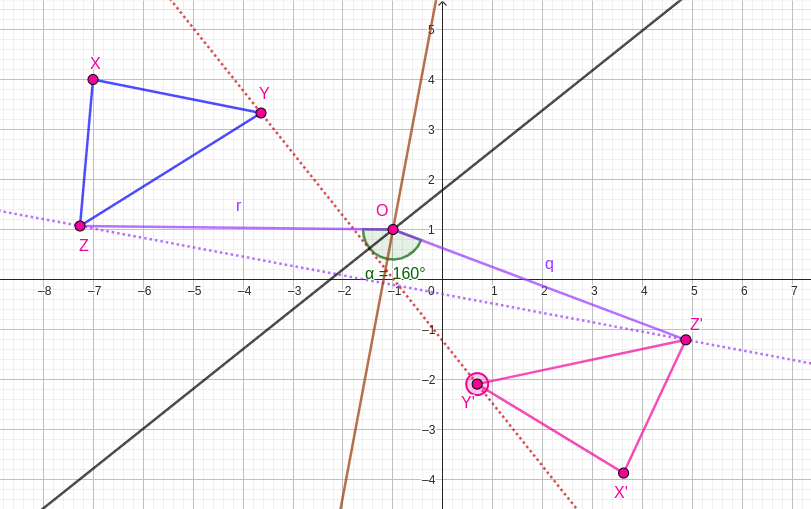
Now join
\(Z\) and
\(Z'\) to the centre of rotation
\(O\text{.}\) Measure
\(\angle, ZOZ'\) using a protractor.
Centre of rotation
\(=(-1,1)\)
Angle of rotation
\(=-160^\circ\) since rotation is done in a clockwise direction
Checkpoint 2.3.15 .
Checkpoint 2.3.16 .
Checkpoint 2.3.17 .
Checkpoint 2.3.18 .
Exercises Exercises
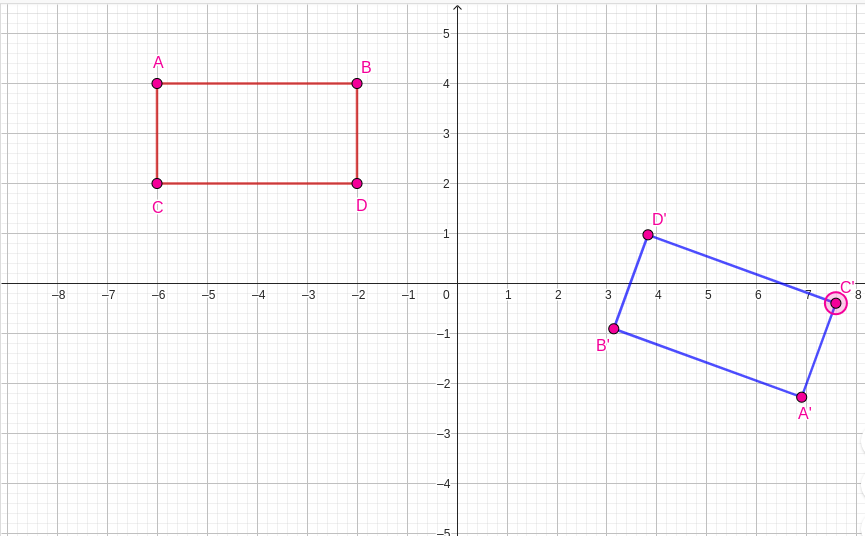
1. In the figure below, rectangle
\(A'B'C'D'\) is the image of rectangle
\(ABCD\) under a rotation, centre
\(O\)
By construction,find and label the centre
\(O\) of roration.
Determine the angle of rotation.
Answer .
\begin{tikzpicture}[scale=1] \draw[step=1cm,gray,very thin] (-2,-2) grid (8,6); \coordinate (A) at (0,0); \coordinate (B) at (4,0); \coordinate (C) at (4,3); \coordinate (D) at (0,3); \draw[blue,thick] (A) -- (B) -- (C) -- (D) -- cycle; \node[left] at (A) {A}; \node[right] at (B) {B}; \node[right] at (C) {C}; \node[left] at (D) {D}; % Rotated rectangle A’B’C’D’ \coordinate (Ap) at (2,2); \coordinate (Bp) at (5,3); \coordinate (Cp) at (5,6); \coordinate (Dp) at (2,5); \draw[red,thick] (Ap) -- (Bp) -- (Cp) -- (Dp) -- cycle; \node[left] at (Ap) {A’}; \node[right] at (Bp) {B’}; \node[right] at (Cp) {C’}; \node[left] at (Dp) {D’}; \draw[dashed] (A) -- (Ap); \draw[dashed] (B) -- (Bp); \path (A) -- (Ap) coordinate[midway] (M1); \path (B) -- (Bp) coordinate[midway] (M2); \draw[green,thick] (M1) ++(0,1.5) -- ++(0,-3); \draw[green,thick] (M2) ++(1,0) -- ++(-2,0); \coordinate (O) at (intersection of green line 1 and green line 2); % approximate \node[below right] at (O) {O}; \draw[dotted] (O) -- (A); \draw[dotted] (O) -- (Ap); \draw[->,orange,thick] (O) ++(0.5,0) arc[start angle=0,end angle=45,radius=0.5]; \node[orange,right] at (O) {$\theta$}; \end{tikzpicture}
\(\displaystyle 45^\circ\)