Subsection 2.6.2 Area of Sectors
Teacher Resource 2.6.9.
To assist your teaching, we have prepared lesson resources, aligned with this textbook and the CBC. The Lesson Plan links to syllabus learning outcomes and provides suggest time allocations. The Step-by-Step Guide provides more detailed guidance on how to teach the content, including suggested questions to ask learners, and possible answers.
Learner Experience 2.6.4.
\(\textbf{Work in groups}\)
What you require:
A graph paper and a razorblade or a pair of scissorβοΈ
-
Draw a circle of radius \(7 \, cm\) on a graph paper.
-
Cut out the circle along its boundary.
-
Mark the centre of the circle.
-
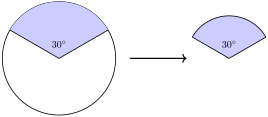
Measure an angle of \(30^\circ\) at the centre and cut out as shown.
-
Estimate the area by counting the number of squares enclosed by the arc and the two radii of the circle.
-
Express the angle of the sector (\(30^\circ\)) as a fraction of the angle at the centre of the circle (\(360^\circ\)).
-
Multiply the fraction obtained in (6) by the area of the circle.
-
Discuss and share the result with other groups.
Exploration 2.6.5. Exploring the Area of a Sector.
A sector is a portion of a circle formed by two radii and the arc between them. The size of a sector depends on two quantities: the radius of the circle and the central angle that defines the sector.
In this exploration, you will adjust the radius and the central angle using sliders. As you change these values, observe how the shaded sector changes and how its area relates to the area of the entire circle.
Before beginning, review the instructions below to understand how to use the interactive.
Instructions.
-
Use the
Radius (r)slider to change the size of the circle. -
Use the
Angle (ΞΈ)slider to adjust the central angle of the sector. -
Observe how the shaded sector changes as the angle increases or decreases.
-
Look at the calculation panel below the diagram. It shows:
-
The area of the full circle,
-
The fraction of the circle represented by the angle \(\theta/360\text{,}\) and
-
The resulting sector area.
-
-
Notice how the sector area changes when either the radius or the angle changes.
Use the interactive to explore the following questions:
-
Set the angle to about \(90^\circ\text{.}\) What fraction of the circle does this sector represent? Compare the sector area with the full circle area shown in the panel.
-
Keep the radius fixed and increase the angle gradually from \(30^\circ\) to \(180^\circ\text{.}\) How does the sector area change? What pattern do you notice?
-
Set the angle to \(360^\circ\text{.}\) What does the sector become? What does the sector area equal in this case?
-
Fix the angle at \(60^\circ\text{.}\) Now increase the radius. How does changing the radius affect the sector area?
-
Compare two sectors with the same radius but different angles. How does the ratio \(\theta/360\) relate to the size of the sector?
-
Based on your observations, write a formula for the area of a sector in terms of the radius \(r\) and the angle \(\theta\text{.}\) How does your formula match the calculation shown in the panel?
Key Takeaway 2.6.11.
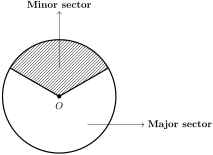
A sector is a region bounded by two radii and an arc.
Minor sector is one whose area is less than a half of the area of the circle.
Major sector is onewhose area is greater than a half of the area of the circle.
See the figure below;
The Area of a Sector
\begin{align*}
\text{Area of a Sector}=\amp \frac{\theta}{360} \times \pi r^2
\end{align*}
where:
-
\(\theta\) is in degrees,
-
\(r\) is the radius of the circle,
-
\(\displaystyle \pi \,β \,3.142\, \text{or} \, \frac{22}{7}.\)
Example 2.6.12.
Find the area of a sector of a circle of radius \(7 \,cm\) if the angle subtended at the centre is \(90^\circ\text{.}\)
Solution.
The values given are, \(\theta=90^\circ \, , \, r= 7\,cm\)
\(\text{Area}= \frac{\theta}{360} \times \pi r^2\)
\begin{align*}
\text{Area}=\amp \frac{90}{360} \times \frac{22}{7} \times ( 7^2)\\
=\amp \frac{1}{4} \times \frac{22}{7} \times 49 \\
=\amp \frac{1}{4} \times 22 \times 7\\
=\amp 38.5 \,cm^2
\end{align*}
Example 2.6.13.
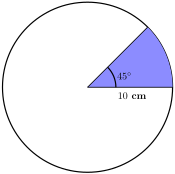
Find the area of a sector of a circle shown below;(use \(\pi=3.142\))
Example 2.6.14.
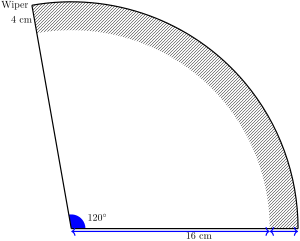
The shaded region in the figure below shows the area swept out on a flat windscreen by a wiper. Calculate the area of this region.
Solution.
The area of the rigion is goten by subtracting the \(\textbf{Area of the smaller sector}\) from \(\textbf{Area of the larger sector}\) .
Use \(\text{Area}= \frac{\theta}{360} \times \pi r^2\)
\(\textbf{Area of the larger sector}\)
\begin{align*}
R= \amp 16\,cm + 4\,cm \\
= \amp 20\,cm
\end{align*}
\begin{align*}
\theta= \amp 120^\circ
\end{align*}
\begin{align*}
A=\amp \frac{120}{360} \times \frac{22}{7} \times 20^2 \\
=\amp \frac{1}{3} \times \frac{22}{7} \times 400\\
=\amp 419.047619 \,cm^2
\end{align*}
\(\textbf{Area of the smaller sector}\)
\begin{align*}
r= \amp 16\,cm
\end{align*}
\begin{align*}
\theta= \amp 120^\circ
\end{align*}
\begin{align*}
A=\amp \frac{120}{360} \times \frac{22}{7} \times 16^2 \\
=\amp \frac{1}{3} \times \frac{22}{7} \times 256\\
=\amp 268.19047 \,cm^2
\end{align*}
Therefore,
\begin{align*}
\text{Area of the region}=\amp \textbf{Area of the larger sector} -\textbf{Area of the smaller sector}\\
=\amp 419.047619 \,cm^2- 268.19047 \,cm^2\\
=\amp 150.85714\,cm^2
\end{align*}
Exercises Exercises
1.
A sector of a circle of radius \(r\)is subtended at the centre by an angle of \(\theta\text{.}\) Calculate the area of the sector if:
-
\(\displaystyle r=10\,m ,\quad \theta=264^\circ\)
-
\(\displaystyle r=8.4\,cm ,\quad \theta=40^\circ\)
-
\(\displaystyle r=1.4\,cm ,\quad \theta=80^\circ\)
2.
The area of a sector of a circle is \(154 \,cm^2\) . Find the radius of the circle if the angle subtended at the centre is \(140^\circ\text{.}\) (Take \(\pi= \frac{22}{7}\))
3.
A goat is tethered at the corner of a fenced rectangular grazing field. If the length of the rope is \(21 \,m\text{,}\) what is its grazing area?
4.
Shown below is a sector of a circle, with radius \(x\,cm\)
5.
A sector has an angle of \(\frac{\pi}{3}\) radians and a radius of \(8 \,cm\text{.}\) Find its area.