Skip to main content
Contents
Search Book
Search Results:
No results.
Read aloud Readability settings Prev Up Next \(\newcommand{\N}{\mathbb N} \newcommand{\Z}{\mathbb Z} \newcommand{\Q}{\mathbb Q} \newcommand{\R}{\mathbb R}
\newcommand{\lt}{<}
\newcommand{\gt}{>}
\newcommand{\amp}{&}
\definecolor{fillinmathshade}{gray}{0.9}
\newcommand{\fillinmath}[1]{\mathchoice{\colorbox{fillinmathshade}{$\displaystyle \phantom{\,#1\,}$}}{\colorbox{fillinmathshade}{$\textstyle \phantom{\,#1\,}$}}{\colorbox{fillinmathshade}{$\scriptstyle \phantom{\,#1\,}$}}{\colorbox{fillinmathshade}{$\scriptscriptstyle\phantom{\,#1\,}$}}}
\)
Subsection 2.3.3 Rotating Objects
Curriculum Alignment
Strand
2.0 Measurements and Geometry
Sub-Strand
Specific Learning Outcomes
Rotation is a transformation that turns a figure about a fixed point. The fixed point is called the
centre of rotation .
Rotations can be clockwise or anticlockwise and are measured in degrees.
Learner Experience 2.3.19 .
Work in groups: Form groups of
\(2\) or
\(3\) students.
Materials: Graph paper, ruler, protractor and tracing paper.
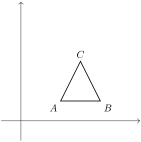
Draw triangle
\(ABC\) with coordinates
\(A(2,1), B(4,1), C(3,3)\text{.}\)
Rotate the triangle \(90^\circ\) anticlockwise about the origin.
Rotate the same triangle \(180^\circ\) about the origin.
Measure the distance from the origin to one vertex before and after rotation. What do you observe?
Compare original and image coordinates. Can you identify a pattern?
Instructions.
Use this interactive tool to discover the rules for rotating coordinates on a Cartesian plane.
Change the Angle: Drag the slider at the bottom to rotate triangle ABC by 0°, 90°, 180°, or 270°.
Observe the Coordinates: Watch the text at the top left of the graph. It dynamically updates to show how the coordinates of vertices A, B, and C map to their new positions A’, B’, and C’.
Test Your Own Shapes: Drag the vertices A, B, and C to create a new triangle and see if the coordinate rules you discovered still hold true!
Figure 2.3.20. Interactive Activity: Coordinate Rules for Rotation
Example 2.3.22 .
Rotate point
\(P(3,2)\) through
\(90^\circ\) anticlockwise about the origin.
Solution .
Rule:
\((x,y) \rightarrow (-y,x)\)
\((3,2) \rightarrow (-2,3)\)
Example 2.3.23 .
Rotate triangle with vertices
\(A(1,2), B(3,2), C(2,4)\) through
\(180^\circ\) about the origin.
Solution .
Rule:
\((x,y) \rightarrow (-x,-y)\)
\(A'(-1,-2), B'(-3,-2), C'(-2,-4)\)
Example 2.3.24 .
Point
\(Q(1,4)\) is mapped to
\(Q'(-4,1)\text{.}\) Determine the angle and direction of rotation.
Solution .
Since
\((x,y) \rightarrow (-y,x)\text{,}\) the rotation is
\(90^\circ\) anticlockwise about the origin.
Checkpoint 2.3.25 .
Exercises Exercises
1. Rotate point
\(A(5,-2)\) through
\(90^\circ\) clockwise about the origin.
Answer .
\((5,-2) \rightarrow (-2,-5)\)
2. Rotate quadrilateral
\(A(2,1), B(4,1), C(4,3), D(2,3)\) * through
\(270^\circ\) anticlockwise about the origin.
Answer .
\(A'(1,-2), B'(1,-4), C'(3,-4), D'(3,-2)\)
3. A point
\(R(3,-1)\) is mapped to
\(R'(-3,1)\text{.}\) Determine the angle of rotation.
Answer .
\(180^\circ\) about the origin.
4. A triangular logo is rotated
\(90^\circ\) anticlockwise about a fixed point. State two properties that remain unchanged.
Answer .
i) Side lengths remain the same.
ii) Distance from the centre remains constant.
5. A windmill blade rotates
\(120^\circ\) every second. Through how many degrees does it rotate in
\(5\) seconds?
6. A point
\(P(x,y)\) is rotated
\(180^\circ\) about the origin. Write the coordinates of the image.
7. A triangular sign is rotated about a point and appears upside down. What angle of rotation has likely occurred?
8. A windmill blade has its tip at point
\((3,1)\) on a coordinate grid. The windmill rotates
\(90^\circ\) anticlockwise about the origin.
(a) Find the new coordinates of the blade tip.
(b) Explain why the length of the blade does not change after rotation.
Answer .
Rule for
\(90^\circ\) anticlockwise:
\((x,y) \rightarrow (-y,x)\)
\((3,1) \rightarrow (-1,3)\)
(b) Rotation preserves distance from the centre. The blade length remains constant because rotation is an isometry.
9. A square playground has vertices
\(A(1,1), B(4,1), C(4,4), D(1,4)\text{.}\) The playground design is rotated
\(180^\circ\) about the origin in a digital plan.
(a) Determine the coordinates of the new vertices. (b) What happens to the orientation of the square after rotation?
Answer .
Rule for
\(180^\circ\) rotation:
\((x,y) \rightarrow (-x,-y)\)
\(A'(-1,-1), B'(-4,-1), C'(-4,-4), D'(-1,-4)\)
(b) The square remains the same size and shape, but its position is reversed through the origin.
10. A triangular road sign with vertices
\(P(2,1), Q(3,3), R(1,3)\) is rotated about the origin and maps to
\(P'(-1,2), Q'(-3,3), R'(-3,1)\text{.}\)
(a) Determine the angle and direction of rotation. (b) State the coordinate rule used.
Answer .
\((2,1) \rightarrow (-1,2)\)
\((x,y) \rightarrow (-y,x)\)
(a) The rotation is
\(90^\circ\) anticlockwise about the origin.
(b) Rule:
\((x,y) \rightarrow (-y,x)\text{.}\)