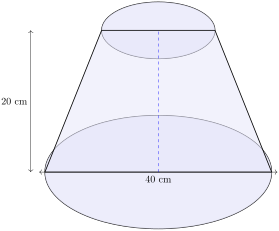
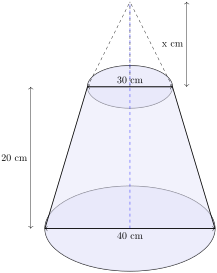
Complete the cone from which the bucket is made, by adding a smaller cone of height
\(x \)cm.
From the cocept of similarity and enlargement;
\(\frac{R}{r} = \frac{H}{h}\) and
\(\frac{H-h}{R-r} = \frac{h}{r}\)
\begin{align*}
\frac{x}{15} = \amp\frac {x + 20 \text{cm} }{20 \text{cm}}\\
20 x = \amp 15x \text{cm} + 300 \text{cm}\\
300 \text{cm} = \amp 20 x - 15 x \\
300 \text{cm} = \amp 5x\\
60 \text{cm} = \amp x
\end{align*}
Surface area of a frustrum = Area of curved surface of bigger cone - Area of curved surface of snaller cone
\(\pi RL - \pi rl\)
\begin{align*}
\text{Surface area (Large)} = \amp \frac {22}{7} \times 20 \text{cm} \times \sqrt{80^2 + 20^2} \\
= \amp 5183.33 \text{cm}\\
\text{Surface area (small)} = \amp \frac {22}{7} \times 15 \text{cm} \times \sqrt{60^2 + 15^2} \\
= \amp 2915.62 \text{cm} \\
\text{Differences in the Surface areas} = \amp 5183.33 \text{cm} - 2915.62 \text{cm}\\
= \amp 2267.71 \text{cm}^2
\end{align*}