Subsection 2.6.6 Area of a Part of a Circle in Real-Life

Learner Experience 2.6.13.

Work in Groups
What you need
What to do
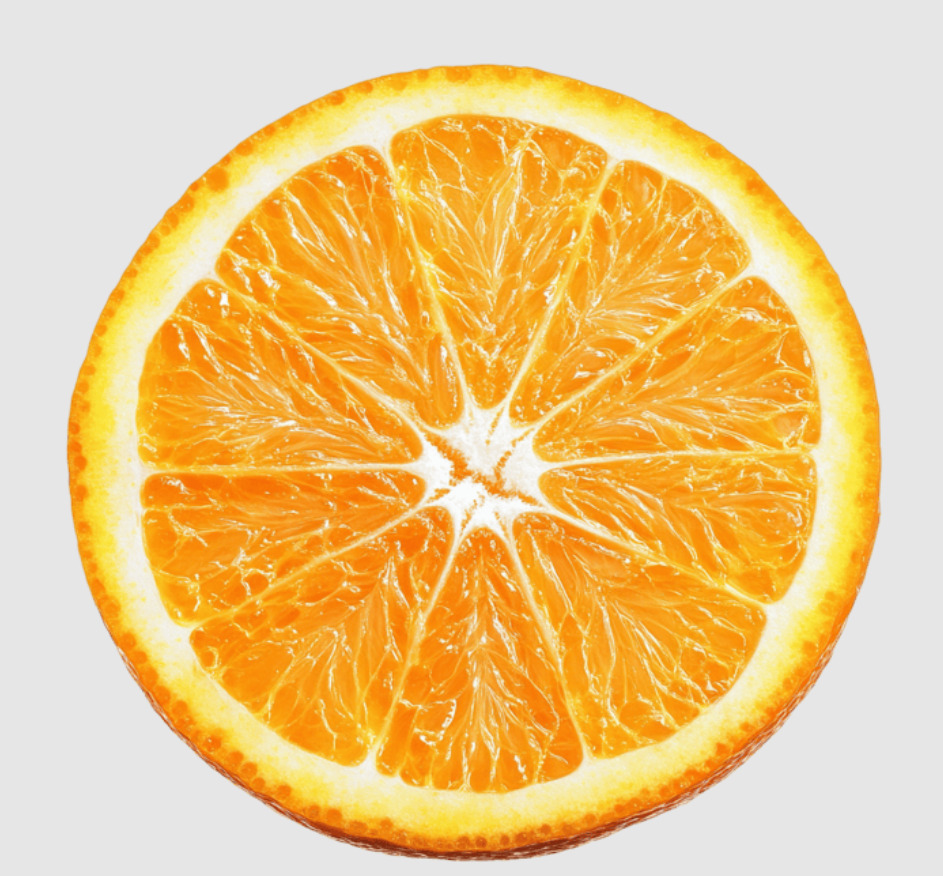
  • Cut the orange into two equal halves, crossectionally, to obtain an image like the one shown.
    Image showing a crossectional cut of an orange,.
  • From the crossectional cuts, slice them crossectionally to obtain 5 slices of the orange, each slice being a part of a circle.
  • Take a slice, measure the internal (the radius from the center to where the juice sac ends) and external (radius from the center to the exocarp) radius of the slices using a ruler and record the measurement.
  • Repeat the whole process for the other slices.
  • From the measurements you have recorded, calculate the area of each annulus.
  • Using the formula :
    \begin{align*} A_\text{annulus} = \amp A_\text{outer circle} - A_\text{inner circle} \\ = \amp \pi R^2 - \pi r^2 \\ = \amp \pi (R^2 - r^2) \end{align*}
  • Share your results with your classmates and compare your answers.

Key Takeaway 2.6.38.

Area of part of a circle refers to calculating the area of sectors, segments, or annuli. Real-life applications include:
  1. Bakers: Calculate pizza slice area to determine portion sizes
  2. Pastry chefs: Calculate cake slice area for serving
  3. Fruit sellers: Calculate orange or watermelon slice area for pricing
  4. Engineers: Design washers, gears, and mechanical parts
  5. Telecommunications: Model overlapping signal coverage areas
Shape Formula Real-Life Example
Sector \(A = \frac{\theta}{360} \times \pi r^2\) Pizza slice, cake slice
Annulus \(A = \pi (R^2 - r^2)\) Washer, orange slice, ring
Segment \(A = A_\text{sector} - A_\text{triangle}\) Signal overlap, window design

Sector: Pizza Slicing.

A sector is a "pie-shaped" region bounded by two radii and an arc. When a pizza is sliced into equal pieces, each slice is a sector
Formula: \(A_\text{sector} = \frac{\theta}{360} \times \pi r^2\)
Where \(\theta\) is the central angle in degrees and \(r\) is the radius.
Key insight: The fraction \(\frac{\theta}{360}\) represents what portion of the full circle the sector occupies.

Annulus: Metal Washers and Orange Slices.

An annulus is a ring-shaped region between two concentric circles (circles with the same center).
Formula: \(A_\text{annulus} = \pi(R^2 - r^2) = \pi R^2 - \pi r^2\)
Where \(R\) is the outer radius and \(r\) is the inner radius.
Key insight: Subtract the inner "hole" area from the outer circle area to get the ring area.
Applications: Metal washers distribute load in bolts/nuts; orange slices have edible ring between juice sac and peel.

Segment: Signal Coverage Overlap.

A segment is a region bounded by a chord and an arc. It is calculated by subtracting the triangle area from the sector area.
Formula: \(A_\text{segment} = A_\text{sector} - A_\text{triangle}\)
Where \(A_\text{sector} = \frac{\theta}{360} \times \pi r^2\) and \(A_\text{triangle} = \frac{1}{2}r^2\sin(\theta)\)
Key insight: The segment is the "leftover" area after removing the triangle from the sector.
Applications: Overlapping signal ranges from towers, architectural window designs.

Choosing the Right Formula.

Sector: When the region is bounded by two radii and an arc (pizza slice, cake slice)
Annulus: When the region is a ring between two circles (washer, orange slice)
Segment: When the region is bounded by a chord and an arc (signal overlap, window)

Scaffolding Strategies.

Address common challenges revealed during the anchor activity:
Emphasize visual identification: sector = pie slice, annulus = ring, segment = chord region
Use diagrams to show which formula applies to which shape
Connect formulas to subtraction logic (annulus and segment both involve subtraction)
Provide formula reference chart for quick lookup
Use real objects (pizza, washer, orange) to reinforce concepts
Area of part of a circle refers to calculating the area of a sector, segment or annulus. This is important in real-life because it can be used to calculate the area of a slice of pizza by a baker, the area of a slice of cake by a pastry chef, the area of a slice of orange by a fruit seller, the area of a slice of watermelon by a farmer and many more.
Some of the real life applications of calculating the area of a part of a circle include:

Slicing a pizza.

image showing a pizza sliced into 8 pieces.
One of the most common applications of calculating the area of a part of a circle is slicing a pizza. A pizza is usually sliced into equal pieces, and the area of each slice can be calculated using the formula for the area of a sector. This helps in determining how much pizza each person gets and can also be used to calculate the total area of the pizza.

Example 2.6.39.

A pizza has a radius of \(12\) inches and is sliced into 8 equal pieces. Calculate the area of each slice of pizza.
Solution.
To calculate the area of each slice of pizza, we can use the formula for the area of a sector:
\begin{align*} A_\text{sector} = \amp \frac{\theta}{360} \times \pi r^2 \end{align*}
where \(\theta\) is the central angle of the sector and \(r\) is the radius of the circle. Since the pizza is sliced into 8 equal pieces, each slice corresponds to a central angle of \(\theta = \frac{360}{8} = 45^\circ\text{.}\) The radius of the pizza is given as \(r = 12\) inches. Substituting these values into the formula, we get:
\begin{align*} A_\text{sector} = \amp \frac{45}{360} \times \pi (12)^2 \\ = \amp \frac{1}{8} \times \pi (144) \\ = \amp 18\times \frac{22}{7} \\ = \amp 56.57 \text{in}^2 \end{align*}

Designing a metal washer.

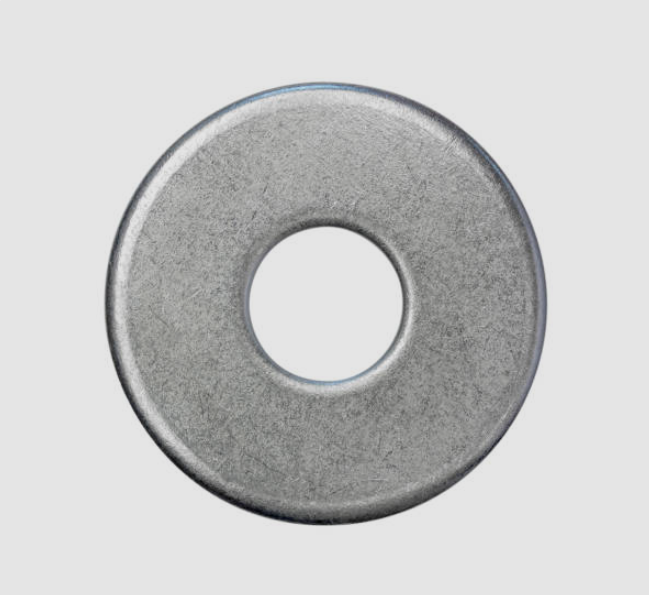
image showing a washer.
Another application of calculating the area of a part of a circle is designing a metal washer. A washer is a thin, flat ring used to distribute the load of a threaded fastener, such as a bolt or nut. The area of the washer can be calculated using the formula for the area of an annulus, which helps in determining the amount of material needed to make the washer and its strength.

Example 2.6.40.

A metal washer has an outer radius of \(5\) cm and an inner radius of \(2\) cm. Calculate the area of the washer.
Solution.
To calculate the area of the washer, we can use the formula for the area of an annulus:
\begin{align*} A_\text{annulus} = \amp A_\text{outer circle} - A_\text{inner circle} \\ = \amp \pi R^2 - \pi r^2 \\ = \amp \pi (R^2 - r^2) \end{align*}
where \(R\) is the outer radius and \(r\) is the inner radius. Given that the outer radius is \(R = 5\) cm and the inner radius is \(r = 2\) cm, we can substitute these values into the formula:
\begin{align*} A_\text{annulus} = \amp \pi (5^2 - 2^2) \\ = \amp \frac{22}{7} (25 - 4) \\ = \amp 21\frac{22}{7} \\ = \amp 66 \text{cm}^2 \end{align*}
Therefore, the area of the washer is \(21\text{cm}^2\)

Modelling overlapping signal ranges of tower.

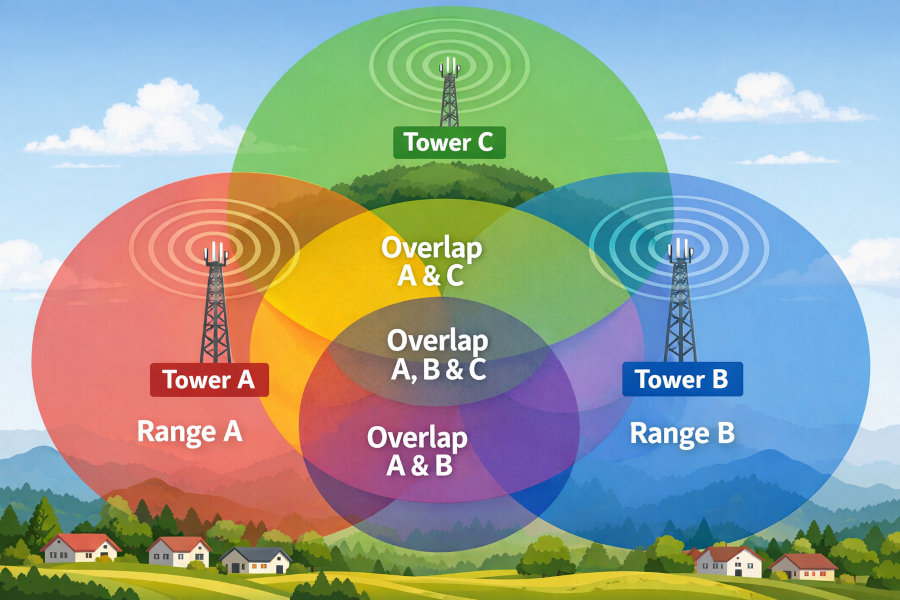
image showing towers with overlapping signal ranges.
Another application of calculating the area of a part of a circle is modelling overlapping signal ranges of towers. When two or more towers are located close to each other, their signal ranges may overlap, creating an area where the signals from both towers can be received. The area of this overlap can be calculated using the formula for the area of a segment of a circle, which helps in determining the strength and coverage of the signals in that area.

Example 2.6.41.

Two towers have signal ranges that overlap. The radius of the signal range of the first tower is \(10\) km and the radius of the signal range of the second tower is \(8\) km. The central angle of the overlapping area is \(60^\circ\text{.}\) Calculate the area of the overlapping signal range.
Solution.
To calculate the area of the overlapping signal range, we can use the formula for the area of a segment of a circle:
\begin{align*} A_\text{segment} = \amp A_\text{sector} - A_\text{triangle} \end{align*}
where \(A_\text{sector}\) is the area of the sector formed by the central angle and \(A_\text{triangle}\) is the area of the triangle formed by the two radii and the chord of the segment. The area of the sector can be calculated using the formula:
\begin{align*} A_\text{sector} = \amp \frac{\theta}{360} \times \pi r^2 \end{align*}
where \(\theta\) is the central angle and \(r\) is the radius of the circle. Substituting the given values, we get:
\begin{align*} A_\text{sector} = \amp \frac{60}{360} \times \pi (10)^2 \\ = \amp \frac{1}{6} \times \pi (100) \\ = \amp 16.67\pi \end{align*}
The area of the triangle can be calculated using the formula:
\begin{align*} A_\text{triangle} = \amp \frac{1}{2} r^2 \sin(\theta) \end{align*}
Substituting the given values, we get:
\begin{align*} A_\text{triangle} = \amp \frac{1}{2} (10)^2 \sin(60^\circ) \\ = \amp 50 \times \frac{\sqrt{3}}{2} \\ = \amp 25\sqrt{3} \\ = 43.30\text{km}^2 \end{align*}
Finally, we can calculate the area of the segment by subtracting the area of the triangle from the area of the sector:
\begin{align*} A_\text{segment} = \amp A_\text{sector} - A_\text{triangle} \\ = \amp 16.67\pi - 25\sqrt{3} \\ = \amp 52.36 - 43.30 \\ = \amp 9.06 \text{km}^2 \end{align*}
Therefore, the area of the overlapping signal range is \(9.06 \text{km}^2\text{.}\)
Exercises Exercises

1.

A circular garden has a radius of \(10\) meters. A circular path with a width of \(2\) meters surrounds the garden. Calculate the area of the path.
Answer.
To calculate the area of the path, we can use the formula for the area of an annulus:
\begin{align*} A_\text{annulus} = \amp A_\text{outer circle} - A_\text{inner circle} \\ = \amp \pi R^2 - \pi r^2 \\ = \amp \pi (R^2 - r^2) \end{align*}
where \(R\) is the outer radius and \(r\) is the inner radius. The inner radius of the garden is given as \(r = 10\) meters, and the width of the path is \(2\) meters, so the outer radius is \(R = 10 + 2 = 12\) meters. Substituting these values into the formula, we get:
\begin{align*} A_\text{annulus} = \amp \pi (12^2 - 10^2) \\ = \amp \frac{22}{7} (144 - 100) \\ = \amp 138.29 \text{m}^2 \end{align*}
Therefore, the area of the path is \(138.29 \text{m}^2\)

2.

A circular swimming pool has a radius of \(8\) meters. A circular deck with a width of \(3\) meters surrounds the pool. Calculate the area of the deck.
Answer.
To calculate the area of the deck, we can use the formula for the area of an annulus:
\begin{align*} A_\text{annulus} = \amp A_\text{outer circle} - A_\text{inner circle} \\ = \amp \pi R^2 - \pi r^2 \\ = \amp \pi (R^2 - r^2) \end{align*}
where \(R\) is the outer radius and \(r\) is the inner radius. The inner radius of the pool is given as \(r = 8\) meters, and the width of the deck is \(3\) meters, so the outer radius is \(R = 8 + 3 = 11\) meters. Substituting these values into the formula, we get:
\begin{align*} A_\text{annulus} = \amp \pi (11^2 - 8^2) \\ = \amp \pi (121 - 64) \\ = \amp 57 \times \ \frac{22}{7} \\ = \amp 179.14 \text{m}^2 \end{align*}
Therefore, the area of the deck is \(179.14 \text{m}^2\text{.}\)

3.

A pizza has a radius of \(14\) inches and is sliced into 10 equal pieces. Calculate the area of each slice of pizza.
Answer.
To calculate the area of each slice of pizza, we can use the formula for the area of a sector:
\begin{align*} A_\text{sector} = \amp \frac{\theta}{360} \times \pi r^2 \end{align*}
where \(\theta\) is the central angle of the sector and \(r\) is the radius of the circle. Since the pizza is sliced into 10 equal pieces, each slice corresponds to a central angle of \(\theta = \frac{360}{10} = 36^\circ\text{.}\) The radius of the pizza is given as \(r = 14\) inches. Substituting these values into the formula, we get:
\begin{align*} A_\text{sector} = \amp \frac{36}{360} \times \ \frac{22}{7} (14)^2 \\ = \amp \frac{1}{10} \times \ \frac{22}{7} (196) \\ = \amp 61.6 \text{in}^2 \end{align*}
Therefore, the area of each slice of pizza is \(61.6 \text{in}^2\)

4.

A washer has an outer radius of \(6\) cm and an inner radius of \(3\) cm. Calculate the area of the washer.
Answer.
To calculate the area of the washer, we can use the formula for the area of an annulus:
\begin{align*} A_\text{annulus} = \amp A_\text{outer circle} - A_\text{inner circle} \\ = \amp \pi R^2 - \pi r^2 \\ = \amp \pi (R^2 - r^2) \end{align*}
where \(R\) is the outer radius and \(r\) is the inner radius. Given that the outer radius is \(R = 6\) cm and the inner radius is \(r = 3\) cm, we can substitute these values into the formula:
\begin{align*} A_\text{annulus} = \amp \frac{22}{7} (6^2 - 3^2) \\ = \amp \ \frac{22}{7} (36 - 9) \\ = \amp 84.85 \text{cm}^2 \end{align*}
Therefore, the area of the washer is \(84.85 \text{cm}^2\text{.}\)

5.

An architect is designing a window that is in the shape of a segment of a circle. The radius of the circle is \(5\) meters and the central angle of the segment is \(60^\circ\text{.}\) Calculate the area of the window.
Answer.
To calculate the area of the window, we can use the formula for the area of a segment of a circle:
\begin{align*} A_\text{segment} = \amp A_\text{sector} - A_\text{triangle} \end{align*}
where \(A_\text{sector}\) is the area of the sector formed by the central angle and \(A_\text{triangle}\) is the area of the triangle formed by the two radii and the chord of the segment. The area of the sector can be calculated using the formula:
\begin{align*} A_\text{sector} = \amp \frac{\theta}{360} \times \pi r^2 \end{align*}
where \(\theta\) is the central angle and \(r\) is the radius of the circle. Substituting the given values, we get:
\begin{align*} A_\text{sector} = \amp \frac{60}{360} \times \pi (5)^2 \\ = \amp \frac{1}{6} \times \frac{22}{7} (25) \\ = \amp 13.09 \text{m}^2 \end{align*}
The area of the triangle can be calculated using the formula:
\begin{align*} A_\text{triangle} = \amp \frac{1}{2} r^2 \sin(\theta) \end{align*}
Substituting the given values, we get:
\begin{align*} A_\text{triangle} = \amp \frac{1}{2} (5)^2 \sin(60^\circ) \\ = \amp \frac{1}{2} (25) \times \frac{\sqrt{3}}{2} \\ = \amp \frac{25\sqrt{3}}{4} \\ \amp 10.83 \text{m}^2 \end{align*}
Finally, we can calculate the area of the segment by subtracting the area of the triangle from the area of the sector:
\begin{align*} A_\text{segment} = \amp A_\text{sector} - A_\text{triangle} \\ = \amp \ 13.09 - \frac{25\sqrt{3}}{4} \\ = \amp \ 13.09 - 10.83 \\ = \amp 2.26 \text{m}^2 \end{align*}