Subsection 2.6.3 Area of Annular Sectors

Learner Experience 2.6.6.

\(\textbf{Work in groups}\)
What you require;
  1. Take two circular cutouts of different sizes but with the same center.
  2. Use a protractor to mark the same central angle \(\theta\) on both circles.
  3. Cut out the corresponding sectors from both circles.
  4. Place the smaller sector on the larger one and observe the remaining shape.
  5. Measure and calculate the area of each sector using the formula and compare with your actual cutout.
  6. Discuss with other groups how to get the area of the figure you have formed.
\(\textbf{Extended Activity}\)

Learner Experience 2.6.7.

\(\textbf{Work in groups}\)
Materials Needed:
  1. Find the dimensions of the following;
    The length of the wiper blade.
    The pivot point to the base of the wiper blade.
    The angle \(\theta\) is the angle through which the wiper moves.
  2. Use the formula:
    \begin{align*} A= \amp \frac{\theta}{360} \times \pi(R^2-r^2) \end{align*}
    to calculate the area cleaned by the wiper.
  3. Ask students in your group to observe whether the wiper covers all parts of the windshield equally.

Exploration 2.6.8. Exploring the Area of an Annular Sector.

In this exploration, you will adjust three quantities: the outer radius, the inner radius, and the central angle. Observe how these values affect the shaded region and the calculated area of the annular sector.
Before beginning, review the instructions below to understand how to interact with the diagram.

Instructions.

  1. Use the slider labeled Outer Radius (R) to change the size of the larger circle.
  2. Use the slider labeled Inner Radius (r) to change the size of the inner circle.
  3. Use the slider labeled Central Angle (ΞΈ) to adjust the size of the angle that forms the sector.
  4. Observe the shaded region between the two arcs. This region is the annular sector.
  5. Look at the calculation panel below the diagram. It shows:
    • The area of the full annulus,
    • The fraction of the circle determined by the angle \(\theta/360\text{,}\) and
    • The resulting area of the annular sector.
Use the interactive to investigate the following questions:
  1. Set the central angle to about \(90^\circ\text{.}\) What fraction of the full annulus does the shaded region represent?
  2. Keep the radii fixed and increase the central angle from \(30^\circ\) to \(180^\circ\text{.}\) How does the shaded region change? What happens to the calculated area?
  3. Fix the central angle and increase the outer radius while keeping the inner radius the same. How does this affect the size of the annular sector?
  4. Keep the outer radius fixed and increase the inner radius. What happens to the thickness of the ring and the area of the annular sector?
  5. Try making the inner radius very small. What does the shaded region begin to resemble? How does this relate to the area of a regular sector of a circle?
  6. Based on your observations, how could you write a formula for the area of an annular sector using the outer radius \(R\text{,}\) the inner radius \(r\text{,}\) and the angle \(\theta\text{?}\)
  7. Compare the area of the annular sector with the area of the entire annulus. How does the ratio \(\theta/360\) determine the portion of the annulus that is shaded?
Figure 2.6.18. Interactive: Investigating the Area of an Annular Sector

Key Takeaway 2.6.19.

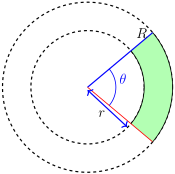
An \(\textbf{annular sector}\) is the region enclosed between two concentric sectors of a circle with different radii but the same central angle. It is similar to a sector but with a smaller sector removed from a larger one.
Having the knowledge of the area of a sector and the area of an annulus it is very easy to identify the area of an annular sector.
\(\textbf{Area of an annular sector}\)
Area of an annular sector is:
\begin{equation*} A=\frac{\theta}{360} \times \pi(R^2-r^2) \end{equation*}

Example 2.6.20.

A wind turbine blade sweeps through a central angle of \(140^\circ\text{.}\) The length of the blade is \(50\, m\text{,}\) and the inner radius (distance from the pivot to the base of the blade) is \(10\, m\text{.}\) Find the swept area.
Solution.
The learger radius (\(R\)) \(=50\,m\)
The inner radius (\(r\)) \(=10\,m\)
Angle subtended \(=140^\circ\)
\begin{align*} A= \amp \frac {140}{360} \times \pi (50^2-10^2)\\ = \amp \frac{7}{18} \times \frac{22}{7} (2\,500-100) \\ =\amp \frac{7}{18} \times \frac{22}{7} \times 2\,400\\ = \amp 2933.333333 \\ β‰ˆ\amp 2\,933.3 \,m^2 \end{align*}
The turbine sweeps an area of approximately \(2\,933.3 \,m^2\text{.}\)

Example 2.6.21.

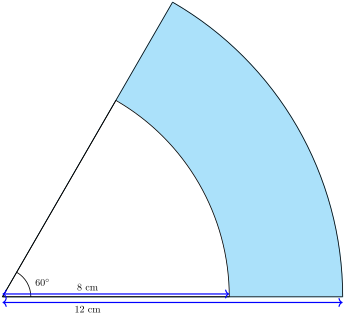
Find the area of the annular sector shown below. (Use \(\pi= 3.142\))
Solution.
\(A= \frac{\theta}{360} \times \pi(R^2-r^2)\)
\begin{align*} A=\amp \frac{60}{360} \times \pi(12^2-8^2) \\ =\amp \frac{60}{360} \times 3.142 (144-64)\\ =\amp \frac{1}{6} \times 3.142\times 80 \\ =\amp \frac{1}{3} \times 3.142 \times 40\\ = \amp 41.89333333 \\ β‰ˆ\amp 41.89\,cm^2 \end{align*}

Exercises Exercises

1.

A clock’s minute hand moves \(150^\circ \) in \(25\) minutes. The minute hand is \(15 \,cm\) long, and the inner radius is \(5 \,cm\) Calculate the cleaned area.

2.

A windshield wiper moves through \(110^\circ\text{.}\) The blade is \(45 \,cm\) long, and the pivot distance is \(15\, cm\text{.}\) Calculate the cleaned area.

3.

A circular table has a decorative border that is \(10\, cm\) wide. The border covers a central angle of \(120^\circ\text{,}\) and the outer radius is \(40\, cm\text{.}\) Find the area of the border.

4.

A mechanical arm sweeps through \(180Β°\text{.}\) The outer radius is \(8\, m\text{,}\) and the inner radius is \(2 \,m\text{.}\) Determine the area covered.
5.

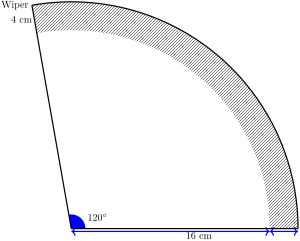
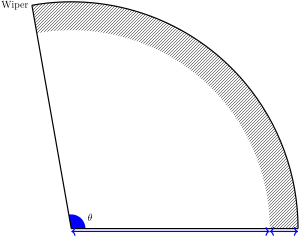
The shaded region in the figure below shows the area swept out on a flat windscreen by a wiper. Calculate the area of this region.