Subsection 1.3.4 Quadratic Equations

A quadratic equation is an equation of the form \(ax^2 + bx + c = 0\text{,}\) where \(a\text{,}\) \(b\text{,}\) and \(c\) are constants, and \(a \neq 0\text{.}\) The solutions to a quadratic equation are called the roots of the equation.

Subsubsection 1.3.4.1 Formation of Quadratic Equations

Learner Experience 1.3.12.

Work in Groups.
  1. Start by forming a quadratic equation using given roots.
  2. Write your equation in factorized form.
  3. Swap your equation with another group, solve it and find the roots.
After completing the task, discuss these questions with the class:
Finally, each group will share their quadratic equation and the method used with the class.
Any equation of the form \(ax^2 + bx + c = 0\) where \(a, b \, \text{and} \, c\) are constants and \(a \neq 0\) is known as a quadratic equation. In this section, solutions of quadratic equations using the factor method is discussed.
To solve a quadratic equation by factorisation, we aim to rewrite the quadratic equation in the form of:
\begin{align*} (x+p)(x+q) \amp = 0 \end{align*}
where \(p\) and \(q\) are numbers that, when multiplied, give the product \(c\) (the constant term), and when added, give the sum \(b\) (the coefficient of the middle term).
To solve a quadratic eaquation, first ensure the equations is in the form;
\begin{equation*} ax^2 + bx + c = 0. \end{equation*}
if not in the form rearrange, so that all terms are on one side of the equation and the equation equals zero.
Factor the quadratic expression:
  • Look for two numbers that when multiplied give \(a \times c\) (the coefficient of \(x^2\))
  • And, when added give \(b\) (the coefficient of the middle term).
    • If the quadratic has a leading coefficient \(a = 1\text{,}\) you only need to find two numbers that multiply to \(c\) and add to \(b\text{.}\)
    • If \(a \neq 1\text{,}\) find two numbers that multiply to \(a \times c\) and add to \(b\text{.}\)
Rewrite the middle term using these two numbers and factor by grouping, which you will have a quadratic of the form:
\begin{equation*} (x+p)(x+q) = 0 \end{equation*}

Key Takeaway 1.3.56.

What is a Quadratic Equation?
Any equation of the form \(ax^2 + bx + c = 0\) where a, b, and c are constants and \(a \neq 0\) is known as a quadratic equation.
The Factorised Form:
To solve or form a quadratic equation by factorisation, we aim to write it in the form:
\begin{align*} (x+p)(x+q) \amp = 0 \end{align*}
Where p and q are numbers that:
  • When multiplied, give the product \(ac\) (the constant term)
  • When added, give the sum \(b\) (the coefficient of the middle term)
The Zero Product Property:
If \((x + p)(x + q) = 0\text{,}\) then either:
  • \(\displaystyle x + p = 0 \rightarrow x =- p\)
  • \(\displaystyle x + q = 0 \rightarrow x = - q\)
Forming Equations from Roots:
If the roots are x = r and x = s, then:
  • The factors are \((x - r) and (x - s)\)
  • The equation is (x - r)(x - s) = 0
  • Expanded: \(x^2 - (r + s)x + rs = 0\)
Factoring Methods:
Depending on the coefficients, you may need to:
  • Find two numbers that multiply to \(c\) and add to \(b\) (if \(a = 1\))
  • Find two numbers that multiply to \(a \times c\) and add to \(b\text{,}\) then factor by grouping (if \(a \neq 1\))
  • Always check for common factors first (e.g., \(6x^2 + 12x = 6x(x + 2)\))
Remember: The equation must equal zero! Always rearrange to get \(ax^2 + bx + c = 0\)before factorising

Example 1.3.57.

Solve
\begin{equation*} x^2 + 6x + 8 = 0 \end{equation*}
Solution.
Factoring the left hand side (L.H.S) of the equation.
\begin{equation*} x^2 + 6x + 8 = 0 \end{equation*}
The factors are \(2 \, \text {and} 4\text{.}\)
\begin{align*} \amp x^2 + 2x + 4x + 8 = 0 \end{align*}
Now create common factors
\begin{align*} \amp x(x + 2) + 4(x + 2) = 0 \end{align*}
Grouping them together we have:
\begin{align*} \amp (x + 2) + (x + 4) = 0 \end{align*}

Example 1.3.58.

Form a quadratic expression using the factoring method.
\begin{equation*} 6x^2 + 12x \end{equation*}
Solution.
To form a quadratic expression using the factoring method, first set the expression equal to \(0\) to form a quadratic equation:
\begin{align*} 6x^2 + 12x \amp = 0 \end{align*}
Remove the common factor out and form a bracket:
\begin{align*} 6x(x + 2) \amp = 0 \end{align*}
Thus, the factored form of expression \(6x^2 + 12x\) is;
\begin{align*} 6x(x + 2) \amp = 0 \end{align*}

Exercises Exercises

1.
Form quadratic expression using the following expressions.
  1. \(\displaystyle (x + 4)(x + 5)\)
  2. \(\displaystyle (x + 3)^2\)
  3. \(\displaystyle 4x^2 + 8x\)
  4. \(\displaystyle 3x^2 + 6x\)
  5. \(\displaystyle (p - q)(p - q)\)
  6. \(\displaystyle (ax + b)(2ax - 3b)\)
  7. \(\displaystyle (x - 8)(x + 8)\)
  8. \(\displaystyle (4 - 2x)(\frac{1}{2}x + 3)\)
  9. \(\displaystyle (5dx + 3d)(2dx - 4d)\)
  10. \(\displaystyle (\frac{1}{2} + x)^2\)
  11. \(\displaystyle (\frac{1}{8} + \frac{1}{x})^2\)
Solution.
  1. To form a quadratic expression from the given expression, expand by multiplying terms in the first bracket with those in the second. Arrange as:
    \begin{align*} (x+4)(x+5) \amp = x(x+5) +4(x+5)\\ \amp = x^2 + 5x + 4x + 20\\ \amp = x^2 + 9x + 20 \end{align*}
  2. To form a quadratic expression from the given expression,first consider that this expression is a perfect square and for this reason the bracket is multiplied by twice itself. Arrange as:
    \begin{align*} (x+3)^2 \amp = x(x+3) +3(x+3)\\ \amp = x^2 + 3x + 3x + 9\\ \amp = x^2 + 6x + 9 \end{align*}
  3. To form a quadratic expression from the given expression,First make the equation to be equal to \(0\) then write it as:
    \begin{align*} 4x^2 + 8x \amp = 0\\ 4x(x + 2x) \amp = 0 \end{align*}
  4. To form a quadratic expression from the given expression,First make the equation to be equal to \(0\) then write it as:
    \begin{align*} 3x^2 + 6x \amp = 0\\ 3x(x + 2) \amp = 0 \end{align*}
  5. To form aquadratic expression, multiply the terms in the first bracket with those in the second bracket.
    \begin{align*} (p-q)(p-q) \amp = p(p-q) - q(p-q)\\ \amp = p^2 - pq - pq + q^2 \\ \amp = p^2 - 2pq + q^2 \end{align*}
  6. To form aquadratic expression, multiply the terms in the first bracket with those in the second bracket.
    \begin{align*} (ax + b)(2ax - 3b) \amp = ax(2ax - 3b) + b(2ax - 3b)\\ \amp = 2a^2x^2 - 3abx + 2abx - 3b^2 \\ \amp = 2a^2x^2 - abx - 3b^2 \end{align*}
  7. To form aquadratic expression, multiply the terms in the first bracket with those in the second bracket.
    \begin{align*} (x - 8) (x + 8) \amp = x(x + 8) - 8(x + 8)\\ \amp = x^2 + 8x - 8x - 64 \\ \amp = x^2 - 64 \end{align*}
  8. To form aquadratic expression, multiply the terms in the first bracket with those in the second bracket.
    \begin{align*} (4 - 2x) (\frac{1}{2}x + 3) \amp = 4(\frac{1}{2}x + 3) - 2x(\frac{1}{2}x + 3)\\ \amp = 2x + 12 - x^2 - 6x \\ \amp = - x^2 - 4x + 12 \end{align*}
  9. To form aquadratic expression, multiply the terms in the first bracket with those in the second bracket.
    \begin{align*} (5dx + 3d)(2dx - 4d) \amp = 5dx(2dx - 4d) + 3d(2dx - 4d)\\ \amp = 10d^2x^2 - 20d^2x + 6d^2x - 12d^2 \\ \amp = 10d^2x^2 - 14d^2x - 12d^2 \end{align*}
  10. To form aquadratic expression, multiply the bracket by twice itself because it is a perfect square.
    \begin{align*} (\frac{1}{2} + x)^2 \amp = (\frac{1}{2} + x)(\frac{1}{2} + x) \\ \amp = \frac{1}{2}(\frac{1}{2} + x) + x(\frac{1}{2} + x)\\ \amp = \frac{1}{4} + \frac{1}{2}x + \frac{1}{2}x + x^2 \\ \amp = x^2 + x + \frac{1}{4} \end{align*}
  11. To form aquadratic expression, multiply the bracket by twice itself because it is a perfect square.
    \begin{align*} (\frac{1}{8} + \frac{1}{x})^2 \amp = (\frac{1}{8} + \frac{1}{x})(\frac{1}{8} + \frac{1}{x}) \\ \amp = \frac{1}{8}(\frac{1}{8} + \frac{1}{x}) + \frac{1}{x}(\frac{1}{8} + \frac{1}{x})\\ \amp = \frac{1}{64} + \frac{1}{8x} + \frac{1}{8x} + \frac{1}{x^2} \\ \amp = \frac{1}{x^2} + \frac{1}{4x} + \frac{1}{64} \end{align*}

Subsubsection 1.3.4.2 Solving Quadratic Equations

Learner Experience 1.3.13.

Work in Groups.
Find the roots of the equation using factorization.
  1. \(x^2 - 5x + 6 = 0\text{.}\)
  2. \(x^2 + 7x + 10 = 0\text{.}\)
After solving the equations, discuss the following:
  • What steps did you follow in factorizing the quadratic equation?
  • How do the roots relate to the factors of the quadratic equation?
  • Did any group use a different method to factorize the equation? Compare approaches.
Finally, each group will share their solved quadratic equations and the methods they used infront of the classroom.
In our previous sections we have discussed the form of a quadratic expression, identities and quadratic equations; how to form quadratic equations and differentiate between an expression and equation
In this section we are going to learn about solving the factored equation, we are going to continue from the point where we form factored equation
Numbers that satisfy an equation (its solutions) are called the roots of the equation.
Once you have factored the quadratic into the form;
\begin{align*} (x+p)(x+q) \amp = 0 \end{align*}
Set each factor equal to zero and solve for \(x\text{:}\)
\begin{align*} (x + p) \amp = 0 \end{align*}
\begin{align*} \text{or} \amp \end{align*}
\begin{align*} (x + q) \amp = 0 \end{align*}
Solving these will give the two solutions for \(x\text{.}\)

Example 1.3.62.

Solve
\begin{align*} x^2 + 5x + 6 \amp = 0 \end{align*}
Solution.
Look for two numbers that if multiplied by \(6\) and when added up gives \(5\)
These numbers are \(2\) and \(3.\) So we can write the equation as:
\begin{align*} x^2 + 2x + 3x + 6 \amp = 0 \end{align*}
Finding a common factor we have:
\begin{align*} x(x + 2) + 3(x + 2) \amp = 0 \end{align*}
Grouping we have th factors of the equation as:
\begin{align*} (x +2) (x + 3) \amp = 0 \end{align*}
Setting each factor equal to zero (0).
\begin{equation*} x + 2 = 0 \end{equation*}
\begin{equation*} \text{or} \end{equation*}
\begin{equation*} x + 3 = 0 \end{equation*}
Solving for \(x.\)
\begin{equation*} x = -2 \end{equation*}
\begin{equation*} \text{or} \end{equation*}
\begin{equation*} x = -3 \end{equation*}
Thus, the solutions to the quadratic equation \(x^+5x+6=0\) are;
\begin{equation*} x = (-2) \, \text {and} \, x = (-3). \end{equation*}

Example 1.3.63.

Solve,
\begin{align*} 6x^2 + 13x + 6 \amp = 0 \end{align*}
Solution.
We need 2 numbers to form factors, which when;
These numbers are \(9\) and \(4.\) So rewrite the middle part.
\begin{align*} 6x^2 + 9x + 4x + 6 \amp = 0 \end{align*}
Grouping the factors:
\begin{align*} (6x^2 + 9x) + (4x + 6) \amp = 0 \end{align*}
Factor each group:
\begin{align*} 3x(2x + 3) + 2(2x + 3) \amp = 0 \end{align*}
\(\,\)
\begin{align*} (2x+3)(3x+2) \amp = 0 \end{align*}
Set each factor eaqual to zero:
\begin{equation*} 2x + 3 = 0 \end{equation*}
\begin{equation*} \text{or} \end{equation*}
\begin{equation*} 3x + 2 = 0 \end{equation*}
Solving for \(x.\)
\begin{equation*} x = -\frac{3}{2} \end{equation*}
\begin{equation*} \text{or} \end{equation*}
\begin{equation*} x = -\frac{2}{3} \end{equation*}
Thus, the solutions to \(6x^2 +13x+6=0\) are:
\begin{equation*} x = -\frac{3}{2} \, \text{and} \, x = -\frac{2}{3} \end{equation*}

Exercises Exercise

1.
Solve the quadratic equation by factorisation.
  1. \(\displaystyle x^2 + 7x + 10 = 0\)
  2. \(\displaystyle x^2 - 5x + 6 = 0\)
  3. \(\displaystyle x^2 + 3x - 4 = 0\)
  4. \(\displaystyle 2x^2 + 9x + 7 = 0\)
  5. \(\displaystyle x^2 - 6x + 8 = 0\)
Answer.
  1. \(\displaystyle x = -5 \, \text{and} \, x = -2.\)
  2. \(\displaystyle x = 2 \, \text{and} \, x = 3.\)
  3. \(\displaystyle x = 1 \, \text{and} \, x = -4.\)
  4. \(\displaystyle x = -1 \, \text{and} \, x = -\frac{7}{2}.\)
  5. \(\displaystyle x = 2 \, \text{and} \, x = 4.\)
2.
A car’s speed is represented by a quadratic equation:
\begin{align*} 4x^2 - 16x + 15 \amp = 0 \text{.} \end{align*}
Find the possible values of x representing time.
Answer.
\(x = 1 \, \text{and} \, x = \frac{15}{4}.\)
3.
The sum of a number and its square is \(42\text{.}\) Form a quadratic equation and solve it to find the number.
Answer.
Let the number be \(x.\) Then the equation can be written as:
\begin{align*} x^2 + x - 42 \amp = 0 \end{align*}
Solving this gives: \(x = 6 \, \text{and} \, x = -7.\)
4.
Solve the quadratic equation:
\begin{align*} 3x^2 - 14x + 8 \amp = 0 \end{align*}
Answer.
\(x = 2 \, \text{and} \, x = \frac{4}{3}.\)
5.
A garden’s area is 56 square meters, and its length is 4 meters more than its width. Form and solve a quadratic equation to find the dimensions of the garden.
Answer.
Let the width of the garden be \(x\) meters. Then the length can be expressed as \(x + 4\) meters. The area of the garden can be represented by the equation:
\begin{align*} x(x + 4) \amp = 56 \end{align*}
Expanding this gives:
\begin{align*} x^2 + 4x - 56 \amp = 0 \end{align*}
Solving this quadratic equation yields: \(x = 7 \, \text{and} \, x = -8.\) Since dimensions cannot be negative, the width of the garden is \(7\) meters and the length is \(11\) meters.

Subsubsection 1.3.4.3 Quadratic Equations in Real-Life

Quadratic equations are a type of mathematical equation that can be used to describe many different real-life situations. Whether you’re throwing a ball in the air, trying to maximize the area of a garden, or calculating profits for a business, quadratic equations can help solve problems that involve relationships with squared terms.
In this section, we will learn how to recognize real-life situations that can be modeled by quadratic equations, how to set them up, and how to solve them step by step.
A quadratic equation is an equation that can be written in the form:
\begin{equation*} ax^2 + bx + c = 0 \end{equation*}
where,
Quadratic equations show up in many situations, especially when something is changing in a way that involves squares (like height, area, or profit).
Lets take a look at some of the situations Quadratic Equations is involved in real life situations.
\(1. \, Projectile \, Motion (Throwing \, a \, Ball).\)
projectile
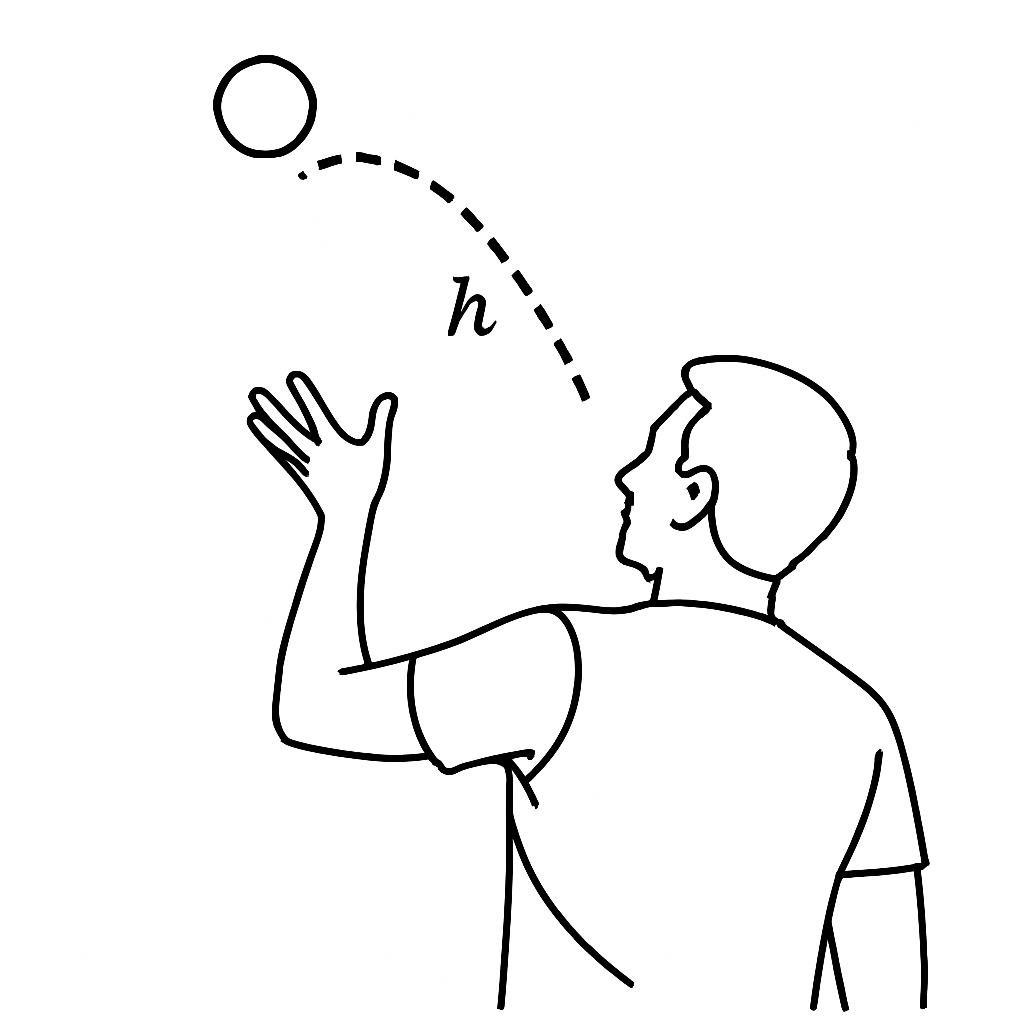
One of the most common real-life situations for quadratic equations is projectile motion, such as when you throw a ball in the air. The height of the ball over time can be described by a quadratic equation.

Learner Experience 1.3.14.

Work in Groups. Each group receives a different real-life scenario:
Scenario Cards:
  1. Projectile Motion: A ball is thrown upward from the ground with an initial velocity of \(20 m/s\text{.}\) Its height after \(t\) seconds is \(h(t) = 20t - 5t^2\text{.}\) When does the ball hit the ground?
  2. Area Problem: A farmer wants to fence a rectangular garden using \(60\) meters of fencing. What dimensions give the maximum area?
  3. Business Profit: A company’s profit is \(P(x) = βˆ’2x^2 + 40x - 150\text{,}\) where \(x\) is the number of items sold. How many items must be sold to break even?
  4. Falling Object: A stone is dropped from a \(45\)> meter cliff. Its height is \(h(t) = 45 - 5t^2\)>. When does it hit the ground?
Group Tasks:
  1. Identify the quadratic equation in your scenario
  2. What does each variable represent?
  3. Try to solve the problem
  4. What does your answer mean in real life?
Discussion Questions:
  1. What makes these problems "quadratic"?
  2. Why do some answers need to be rejected (negative time, negative length)?
  3. What patterns do you notice across different scenarios?

Key Takeaway 1.3.67.

What are Real-Life Quadratics?
Quadratic equations can describe many real-life situations:
Throwing a ball in the air (projectile motion)
Maximizing the area of a garden (optimization)
Calculating profits for a business (economics)
Objects falling under gravity (physics)
The Standard Form:
A quadratic equation has the form: \(ax^2 + bx + c = 0\text{,}\) where:
\(a, b,\) and \(c\) are real numbers (constants)
\(x\) is the unknown variable
\(a \neq 0\) (if \(a = 0\text{,}\) it’s not quadratic)
Common Real-Life Applications:
Application Typical Equation Form What We Find
Projectile Motion \(h(t) = -5t^2 + v_ot + h_o\) Time to hit ground, max height
Area Problems \(A = x(\frac{p}{2}- x)\) Dimensions for max area
Profit / Revenue \(P(x) = ax^2 + bx + c\) Break-even point, max profit
Problem-Solving Steps:
1. Read the problem and identify what’s being asked
2. Define variables (what does x represent?)
3. Set up the quadratic equation
4. Solve using factorisation, quadratic formula, or completing the square
5. Interpret the answer in context (reject impossible values)
Remember: Always check if your answer makes sense! Negative time or negative lengths are usually not valid in real-life problems

Example 1.3.68.

A rock is dropped from a height of \(50\) meters. Its height above the ground at time \(t\) is given by
\begin{equation*} h(t) = 5t^2 + 50. \end{equation*}
Use factorization to determine how long it will take for the rock to reach the ground.
Solution.
The height of the rock above the ground is given by:
\begin{equation*} h(t) = -5t^2 + 50 \end{equation*}
To find when the rock reaches the ground, set \(h(t) = 0\text{:}\)
\begin{equation*} -5t^2 + 50 = 0 \end{equation*}
Simplify the equation:
\begin{equation*} -5t^2 = -50 \end{equation*}
\begin{equation*} t^2 = 10 \end{equation*}
Solve for \(t\text{:}\)
\begin{equation*} t = \pm \sqrt{10} \end{equation*}
Since time cannot be negative, \(t = \sqrt{10}\text{.}\)
Therefore, the rock will take approximately \(\sqrt{10} \approx 3.16\) seconds to reach the ground.
\(2. \, Maximizing \, Area \, (Optimization \, Problem).\)
Quadratic equations are also used in optimization problems. These are problems where you want to maximize or minimize something, like the area of a garden.

Example 1.3.69.

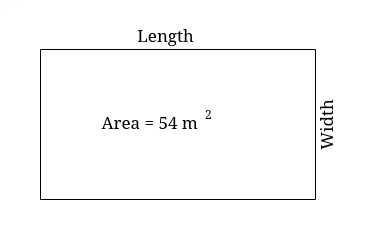
The length of a rectangle is \(3\) meters more than its width. If the area of the rectangle is \(54\) square meters, find the dimensions of the rectangle by factoring the quadratic equation.
optimization problems
Solution.
Let the width of the rectangle be \(x\text{.}\) Then the length is \(x + 3\text{.}\)
The area of the rectangle is given by:
\begin{equation*} x(x + 3) = 54 \end{equation*}
Expand and rearrange into standard quadratic form:
\begin{equation*} x^2 + 3x - 54 = 0 \end{equation*}
Factorize the quadratic equation:
\begin{equation*} (x + 9)(x - 6) = 0 \end{equation*}
Solve for \(x\text{:}\)
\begin{equation*} x = -9 \, \text{or} \, x = 6 \end{equation*}
Since width cannot be negative, \(x = 6\text{.}\)
The dimensions of the rectangle are:
\begin{equation*} \text{Width} = 6 \, \text{meters}, \, \text{Length} = 6 + 3 = 9 \, \text{meters}. \end{equation*}
Since the width cannot be negative, the width is \(6\) meters, and lenght is \(6 + 3 = 9\) meters.
\(3. Business \, Applications (Profit \, Function)\)
Businesses often use quadratic equations to model their profit. For example, the profit a company makes from selling a product can be modeled by a quadratic equation.

Example 1.3.70.

A company’s profit \(P(x)\) from selling \(x\) units of a product is given by the equation:
\begin{equation*} P(x) = -x^2 + 15x - 50 \end{equation*}
Find how many units the company needs to sell to have no profit (i.e., when the profit is zero).
Solution.
To find when the company has no profit, set \(P(x) = 0\text{:}\)
\begin{equation*} -x^2 + 20x - 50 = 0 \end{equation*}
Multiply through by \(-1\) to simplify:
\begin{equation*} x^2 - 20x + 50 = 0 \end{equation*}
Factorize the quadratic equation:
\begin{equation*} (x - 10)(x - 5) = 0 \end{equation*}
Solve for \(x\text{:}\)
\begin{equation*} x = 10 or x = 5 \end{equation*}
Therefore, the company will have no profit when it sells either \(5\) units or \(10\) units.

Exercises Exercises

1.
A stone is thrown into the air from a height of \(4\) meters with an initial velocity of \(8\) meters per second. The height of the stone at time \(t\) is given by:
\begin{equation*} h(t) = -5t^2 + 8t + 4 \end{equation*}
Find when the stone reaches the ground.
Answer.
To find when the stone reaches the ground, set \(h(t) = 0\text{:}\)
\begin{equation*} -5t^2 + 8t + 4 = 0 \end{equation*}
Multiply through by \(-1\) to simplify:
\begin{equation*} 5t^2 - 8t - 4 = 0 \end{equation*}
Factorize the quadratic equation:
\begin{equation*} (5t + 2)(t - 2) = 0 \end{equation*}
Solve for \(t\text{:}\)
\begin{equation*} t = -\frac{2}{5} \, \text{or} \, t = 2 \end{equation*}
Since time cannot be negative, the stone will reach the ground after \(2\) seconds.
2.
A farmer has \(200\) meters of fencing. He wants to build a rectangular garden. The length is \(50\) meters longer than the width. What should the dimensions be to maximize the area?
Answer.
Let the width of the garden be \(x\text{.}\) Then the length is \(x + 50\text{.}\) The perimeter of the rectangle is given by:
\begin{equation*} 2(x + (x + 50)) = 200 \end{equation*}
Simplify and solve for \(x\text{:}\)
\begin{equation*} 4x + 100 = 200 \end{equation*}
\begin{equation*} 4x = 100 \end{equation*}
\begin{equation*} x = 25 \end{equation*}
Therefore, the width of the garden should be \(25\) meters, and the length should be \(25 + 50 = 75\) meters to maximize the area.
3.
A school’s profit function is given by:
\begin{equation*} P(x) = -x^2 + 30x - 100 \end{equation*}
Find the number of units the company must sell to achieve zero profit.
Answer.
To find when the company has zero profit, set \(P(x) = 0\text{:}\)
\begin{equation*} -x^2 + 30x - 100 = 0 \end{equation*}
Multiply through by \(-1\) to simplify:
\begin{equation*} x^2 - 30x + 100 = 0 \end{equation*}
Factorize the quadratic equation:
\begin{equation*} (x - 20)(x - 10) = 0 \end{equation*}
Solve for \(x\text{:}\)
\begin{equation*} x = 20 \, \text{or} \, x = 10 \end{equation*}
Therefore, the company will have zero profit when it sells either \(10\) units or \(20\) units.
4.
A water fountain shoots water into the air, and its height at any time \(t\) (in seconds) is given by the equation:
\begin{equation*} h(t) = -4.9t^2 + 15t + 2 \end{equation*}
Find the time it will take for the water to return to the ground (i.e., when \(h(t)=0\)).
Answer.
To find when the water returns to the ground, set \(h(t) = 0\text{:}\)
\begin{equation*} -4.9t^2 + 15t + 2 = 0 \end{equation*}
Multiply through by \(-1\) to simplify:
\begin{equation*} 4.9t^2 - 15t - 2 = 0 \end{equation*}
Factorize the quadratic equation:
\begin{equation*} (4.9t + 1)(t - \frac{2}{4.9}) = 0 \end{equation*}
Solve for \(t\text{:}\)
\begin{equation*} t = -\frac{1}{4.9} \, \text{or} \, t = \frac{2}{4.9} \end{equation*}
Since time cannot be negative, the water will return to the ground after approximately \(\frac{2}{4.9} \approx 0.41\) seconds.
5.
Solve the following quadratic equation:
\begin{equation*} x^2 - 7x + 12 = 0 \end{equation*}
Find the value of \(x.\)
Answer.
Factorize the quadratic equation:
\begin{equation*} (x - 3)(x - 4) = 0 \end{equation*}
Solve for \(x\text{:}\)
\begin{equation*} x = 3 \, \text{or} \, x = 4 \end{equation*}
Therefore, the values of \(x\) that satisfy the equation are \(3\) and \(4.\)
6.
A company finds that the revenue \(R(x)\) it generates from selling \(x\) units of a product is given by the quadratic equation:
\begin{equation*} R(x) = 2x^2 + 40x \end{equation*}
Find the number of units \(x\) that the company needs to sell to maximize its revenue.
Answer.
To find the number of units that maximizes revenue, we can use the formula for the vertex of a parabola given by a quadratic equation in the form \(ax^2 + bx + c\text{,}\) which is \(x = -\frac{b}{2a}\text{.}\) In this case, \(a = 2\) and \(b = 40\text{.}\) Substitute these values into the formula:
\begin{equation*} x = -\frac{40}{2 \cdot 2} = -\frac{40}{4} = -10 \end{equation*}
Since the number of units cannot be negative, we need to check the behavior of the quadratic function to determine if it opens upwards or downwards. Since \(a > 0\text{,}\) the fuction opens upwards, meaning that the vertex represents a minimum point. Therefore, there is no maximum revenue in this case, and the company can increase its revenue indefinitely by selling more units.
7.
The path of a car is represented by the quadratic equation
\begin{equation*} y = 2x^2 - 8x, \end{equation*}
where \(x\) represents time in seconds and \(y\) represents the car’s position. Find the time when the car reaches its starting position by factorizing the equation.
Answer.
To find when the car reaches its starting position, set \(y = 0\text{:}\)
\begin{equation*} 2x^2 - 8x = 0 \end{equation*}
Factorize the equation:
\begin{equation*} 2x(x - 4) = 0 \end{equation*}
Solve for \(x\text{:}\)
\begin{equation*} x = 0 \, \text{or} \, x = 4 \end{equation*}
Therefore, the car reaches its starting position at \(0\) seconds and again at \(4\) seconds.