To assist your teaching, we have prepared lesson resources, aligned with this textbook and the CBC. The Lesson Plan links to syllabus learning outcomes and provides suggest time allocations. The Step-by-Step Guide provides more detailed guidance on how to teach the content, including suggested questions to ask learners, and possible answers.
From Point \(O\text{,}\) move \(3\) units to the right along the \(x\) axis and \(4\) units upward in the \(y\) axis. Mark this new position as Point \(A\text{.}\)
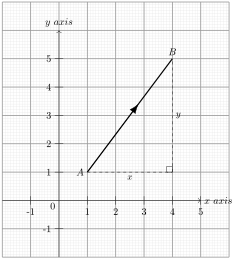
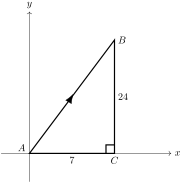
The magnitude of \(\overrightarrow{AB}\) in Figure 2.9.38 can be denoted as \(|\mathbf{AB}|\text{.}\) The magnitude of \(\overrightarrow{AB}\) represents the distance between point \(\text{A}\) and point \(\text{B}\text{.}\)
We can represent the components of \(\overrightarrow{AB}\) as \(\begin{pmatrix} x \\ y \end{pmatrix}\text{,}\) where \(x\) represents the horizontal displacement and \(y\) represents the vertical displacement.
The magnitude of a vector is always positive since \(x\) and \(y\) components are squared, resulting in \(x^2\) and \(y^2\text{,}\) both of which are non-negative.