Subsection 2.7.3 (*) Surface Area of Cylinders

A cylinder is a type of prism with circular faces at either ends. Jars, water tanks, and pipes are examples of cylinders. The surface area of a cylinder can be found by calculating the area of the two circular faces and the area of the curved face, as we will explore.

Learner Experience 2.7.4.

\(\textbf{Work in groups}\)
\(\textbf{What you require:}\) A pair of scissor and a piece of paper.
  1. Make a paper made of a cylinder.
  2. Measure and record the the length of the model.
  3. Open the model as illustrated below.
  4. Fold one circular end into two equal parts as shown;
  5. Measure and recod the diameter.
  6. Calculate the circumference of the circular end.
  7. Rotate the width of the rectangular part with the diameter of the circular part.
  8. Find the area of the rectangular part.
  9. Find the area of the circular ends.
  10. Find the surface area of the cylinder.
  11. Discuss and share your answer with other groups

Key Takeaway 2.7.20.

The total surface area of a cylinder of radius \(r\) and height \(h\text{,}\) is given by the sum of the areas of the two circular faces and the curved face. The circular faces each have area \(\pi r^2\text{.}\) The curved face has height \(h\) and width \(2\pi r\) (the circumference of the circular face). Thus,
\begin{align*} \textbf{Surface Area} \amp = 2\pi r^2+2\pi r h \\ \amp = 2\pi r(r+h) \end{align*}
Note: A cylinder is always considered closed, unless it is specified that it is open.

Example 2.7.21.

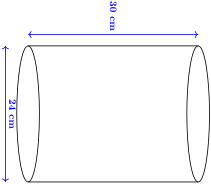
Calculate the surface area of the cylinder shown. Give your answer in terms of \(\pi\text{.}\)
Solution.
Given that, \(h=30\,\text{cm} \quad \text{and} \quad d=24\,\text{cm}\)
We first get the radius of the cylinder which is given by,
\begin{align*} r\amp =\frac{d}{2} \\ \amp = \frac{24}{2} \\ \amp = 12\,\text{cm} \end{align*}
Therefore,
\begin{align*} \text{Surface area}\amp = 2\pi r^2+2\pi r h\\ \amp = 2\pi r(r+h)\\ \amp = 2 \times \pi \times 12\,\text{cm}\,(12\,\text{cm}+30\,\text{cm} ) \\ \amp = 2 \times \pi \times 12\,\text{cm}\,\times 42\,\text{cm} \\ \amp = 1,008 \pi \,\text{cm}^2 \end{align*}
The surface area of the above cylinder is \(3\,168 \,\text{cm}^2\)

Example 2.7.22.

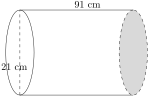
The figure below shows a cylinder with diameter 21 cm and height 91 cm. Calculate the surface area of the cylinder to two decimal places. (Use \(\pi=3.14\))
Cylindrical prism
Solution.
Given that, \(h=91\,\text{cm} \quad \text{and} \quad d=21\,\text{cm}\)
We first get the radius of the cylinder which is given by,
\begin{align*} r\amp =\frac{d}{2} \\ \amp = \frac{21}{2} \\ \amp = 10.5\,\text{cm} \end{align*}
Therefore,
\begin{align*} \text{Surface area}\amp = 2\pi r(r+h)\\ \amp = 2 \times \pi \times 10.5 \,\text{cm}(10.5\,\text{cm}+91\,\text{cm})\\ \amp = 2 \times 3.14 \times 10.5 \,\text{cm} \times 101.5 \,\text{cm}\\ \amp = 6692.91\,\text{cm}^2 \end{align*}
The surface area of the cylinder is \(6\,692.91\,\text{cm}^2\)

Open Cylinders.

An open cylinder, is a cylinder where the top is open. It means that you will only have one circle instead of two.
Therefore, to calculate the surface area of the cylinder you add the area of the curved surface and the circle.
An open cylinder has a curved surface and one circular face.
Therefore,
\begin{align*} \textbf{Surface area of an open cylinder } \amp = \pi r^2 +2 \pi rh \\ \amp = \pi r (r+2h) \end{align*}

Example 2.7.23.

An open cylindrical cotainer has a height of \(12\,\text{cm}\) and a diameter of \(2\,\text{cm}\text{.}\) What is the surface area of the outer surfaces of the container? (\(\, \pi = 3.142\))
Solution.
You are given the height and diameter of the container to be \(h=12\,\text{cm} \, \text{and} \, d=2\,\text{cm}\)
You first identify the radius of the container that is,
\begin{align*} r\amp = \frac{2}{2} \\ \amp = 1 \,\text{cm} \end{align*}
Therefore,
\begin{align*} \text{surface area}\amp = \pi r (r+2h)\\ \amp = 3.142 1(1+2 \times 12) \\ \amp = 3.142 1(1+24) \,\text{cm}\\ \amp = 3.142 \times 25 \,\text{cm}\\ \amp = 78.55\, \text{cm}^2 \end{align*}
Therefore, surface area of the outer container is \(= 78.55\,m^2\text{.}\)

Example 2.7.24.

Ekadeli filled an open cylindrical bucket with water. The internal diameter of the bucket was \(32.4 \,\text{cm}\) and the internal height was \(35 \,\text{cm}\text{.}\) Calculate the area of the bucket that was in contact with the water. Write the answer correct to \(\textbf{1 decimal place}\text{.}\) (\(\textbf{Use} \, \pi =\frac{22}{7}\))
Solution.
The open cylindrical bucket has a diameter and height of \(d=32.4\,\text{cm} \quad \text{and} \quad h=35\,\text{cm}\text{.}\)
You first calculate the radius of the cylindrical bucket which is,
\begin{align*} r\amp = \frac{d}{2} \\ \amp = \frac{32.4}{2}\\ \amp = 16.2 \,\text{cm} \end{align*}
Therefore,
\begin{align*} \text{Surface area} \amp = \pi r (r+2h) \\ \amp = \frac{22}{7} \times 16.2 \,\text{cm} \times (16.2\,\text{cm}+2\times 35\,\text{cm}) \\ \amp = \frac{22}{7} \times 16.2 \,\text{cm}\times (16.2\,\text{cm}+70\,\text{cm})\\ \amp = \frac{22}{7} \times 16.2 \,\text{cm}\times 86.2 \,\text{cm} \\ \amp = 4388.81142857\,\text{cm}^2 \end{align*}
The surface area \(= 4388.8\,\text{cm}^2\)

Exercises Exercises

1.

Calculate the surface area of unsharpened circular pencil in the shape of a cylinder whose radius is \(0.2\,\text{m}\) and height is height is \(1.4\,\text{m}\text{.}\) (\(\textbf{Use}\, \pi=3.142\))
Solution.
Given that, \(h=1.4\,\text{m}\) and \(r=0.2\,\text{m}\)
Therefore,
\begin{align*} \text{Surface area}\amp = 2\pi r(r+h)\\ \amp = 2 \times 3.142 \times 0.2 \,\text{m}(0.2\,\text{m}+1.4\,\text{m})\\ \amp = 2 \times 3.142 \times 0.2 \,\text{m} \times 1.6 \,\text{m}\\ \amp = 2.01088\,\text{m}^2 \end{align*}
Therefore, surface area \(= 2.01088\,\text{m}^2\)

2.

The surface area of an open jar is \(594\,\text{cm}^2\text{.}\) The radius of the jar is \(7\,\text{cm}\text{.}\) calculate the height of the jar. (\(\textbf{Use} \, \pi =3.142\)).
Solution.
You are given,
\(\textbf{Surface are}=594\,\text{cm}^2\)
\(r=7\,cm\)
\(h=\text{?}\)
To find the height of the jar we substitute the above values in the formula below.
\begin{align*} \text{Surface area}\amp = \pi r (r+2h) \\ 594\,\text{cm}^2\amp = \frac{22}{7} \times 7\,\text{cm} (7\,\text{cm} +2\times h)\\ \frac{594}{22}\amp = 7\,\text{cm} +2\times h\\ (27 - 7)\, \text{cm} \amp = 2 \times h \\ 20\, \text{cm} \amp = 2 \times h\\ \frac{20}{2}\, \text{cm}\amp = h\\ h\amp = 10 \,\text{cm} \end{align*}
The height of the jar \(= 10 \,\text{cm }\)

3.

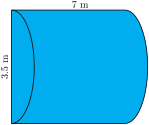
The figure below shows the roof of a motorbike shade. The roof is painted on the outer curved surface and the two semi-circle faces. Calculate the surface area of the part of roof that is painted, to two decimal places. (Use \(\pi=3.14\)).
Solution.
Given that the diameter of the semicircle (top) is \(3.5\,\text{m}\) and the height (length) is \(7\,\text{m}\text{.}\)
The radius of the semicircular ends is
\begin{align*} r\amp=\frac{d}{2} \\ \amp=\frac{3.5}{2} \\ \amp=1.75\,\text{m} \end{align*}
The painted part is a half-cylinder: its curved surface is half the curved surface of a full cylinder and the two ends are two semicircles (which together make one full circle).
\begin{align*} \text{Painted area}\amp=\pi r h + \; 2\times\left(\tfrac{1}{2}\pi r^2\right) \\ \amp=\pi r h + \pi r^2\\ \amp=\pi r(r+h) \end{align*}
Substituting \(\pi=3.14\text{,}\) \(r=1.75\,\text{m}\) and \(h=7\,\text{m}\) gives
\begin{align*} \text{Painted area}\amp=3.14\times1.75\times(1.75+7)\\ \amp=3.14\times1.75\times8.75\\ \amp=48.08125\,\text{m}^2 \end{align*}
To two decimal places, the painted area is \(48.08\,\text{m}^2\text{.}\)
4.

A cylinder has radius \(r\) and its height is twice the radius. Express the surface area of the cylinder in terms of \(r\text{.}\)
Solution.
Using the formula for the surface area of a closed cylinder,
\begin{align*} \text{Surface area} \amp= 2\pi r(r+h) \end{align*}
Substitute \(h=2r\text{:}\)
\begin{align*} \text{Surface area} \amp= 2\pi r(r+2r)\\ \amp= 2\pi r(3r)\\ \amp= 6\pi r^2 \end{align*}

5.

The surface area of a closed cylinder is given as \(18\pi\,\text{cm}^2\text{.}\) If the radius of the cylinder is \(2\,\text{cm}\text{,}\) find the height \(h\) of the cylinder.
Solution.
Use the surface area formula for a closed cylinder: \(\text{SA}=2\pi r(r+h)\text{.}\)
Substitute \(\text{SA}=18\pi\) and \(r=2\text{:}\)
\begin{align*} 18\pi\amp=2\pi\times 2\,(2+h)\\ 18\pi\amp=4\pi(2+h) \end{align*}
Divide both sides by \(\pi\) and simplify:
\begin{align*} 18\amp=4(2+h)\\ 18\amp=8+4h\\ 18-8\amp=4h\\ 10\amp=4h\\ h\amp=\tfrac{10}{4}=2.5 \end{align*}
Therefore, the height of the cylinder is \(h=2.5\,\text{cm}\text{.}\)

6.

Calculate the surface area of a closed cylinder with radius \(5\,\text{cm}\) and height \(10\,\text{cm}\text{.}\) (Use \(\pi=3.14\text{.}\))
Solution.
\begin{align*} \text{SA}=2\pi r(r+h)\\ \amp=2\times 3.14 \times 5\,(5+10)\\ \amp=2\times 3.14 \times 5 \times 15\\ \amp=471\,\text{cm}^2 \end{align*}

7.

An open cylinder (one base) has radius \(4\,\text{cm}\) and height \(8\,\text{cm}\text{.}\) Find the surface area of the outer surfaces. (Use \(\pi=3.14\text{.}\))
Solution.
For an open cylinder, \(\text{SA}=\pi r^2 + 2\pi r h\text{.}\)
\begin{align*} \text{SA}=3.14\times 4^2 + 2\times 3.14\times 4\times 8\\ \amp=3.14\times 16 + 2\times 3.14\times 32\\ \amp=50.24 + 200.96\\ \amp=251.2\,\text{cm}^2 \end{align*}

8.

The surface area of a closed cylinder is \(100\pi\) and its height is \(5\text{.}\) Find the radius \(r\text{.}\)
Solution.
Use \(\text{SA}=2\pi r(r+h)\text{.}\) Divide both sides by \(\pi\text{:}\)
\begin{gather*} 100 = 2r(r+5)\\ 100 = 2r^2 + 10r\\ 2r^2 +10r -100 =0\\ r^2 +5r -50 =0 \end{gather*}
The quadratic factors as \((r+10)(r-5)=0\text{.}\) Hence \(r=5\) (rejecting the negative root).

9.

A cylinder has diameter \(14\,\text{cm}\) and height \(7\,\text{cm}\text{.}\) Find its surface area in terms of \(\pi\text{.}\)
Solution.
The radius is \(r=\tfrac{14}{2}=7\,\text{cm}\text{.}\) Using \(\text{SA}=2\pi r(r+h)\text{:}\)
\begin{gather*} \text{SA}=2\pi \times 7(7+7)=2\pi\times 7\times 14=196\pi\,\text{cm}^2 \end{gather*}