Subsection 2.8.6 Volume of Frustums

Learner Experience 2.8.6.

Frustum Volume Lab
Use a bucket-shaped container to model a frustum and measure how much water it holdsβ€”connecting real-world experience with the math behind volume.
  1. \(\textbf{ Materials Needed:}\)
    πŸ”Ή Calculator
    πŸ”Ή Rulers or measuring tapes
    πŸ”Ή Water and a measuring jug (optional but powerful visual!)
    πŸ”Ή Real plastic buckets, measuring cups, or flowerpots (frustum-shaped)
    πŸ”Ή Worksheets for dimensions and calculations
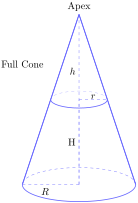
  2. πŸ”Ή Review the volume formula of a cone and note that the frustum is a cone with the top sliced off.
    πŸ”Ή Observe real-life frustums: buckets, lampshades, party hats cut short, flower pots, juice glasses, etc.
  3. Students work in pairs or small groups. They measure:
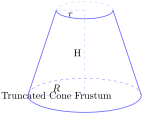
    Diameter (then radius) of top opening: \(\textbf{R}\)
    Diameter (then radius) of bottom: \(\textbf{r}\)
    Height of the container: \(\textbf{h}\)
    Measure and record the dimensions label the top radius R and bottom radius r and the height h in your worksheet and record all measurements in cm..
  4. Fill the bucket with water and pour it into a measuring jug to find it’s actual volume in liters. Then calvulate using the formula and find the volume’s capacity in liters.

Key Takeaway 2.8.36.

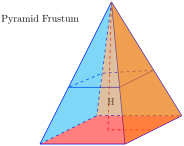
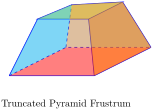
A frustum is a cone or pyramid is cut parallel to its base, removing the top portion. This results in a truncated shape with two parallel bases one smaller than the other e.g a lampshade
\(\textbf{Types of frustums}\)

Example 2.8.37.

A frustum of a cone has a top radius of 4 cm, a bottom radius of 8 cm, and a height of 10 cm.
a. Find the slant height of the frustum.
b. Find the volume of the frustum.
Solution.
Using the Pythagoras theorem, the slant height \(\ell\) is given by:
\begin{align*} \ell = \amp \sqrt{8^2 + 10^2}\\ = \amp 12.80 \, \text{cm} \end{align*}
Slant height \(\ell = 12.80\, \text{cm}\)
Finding the volume. \(V = \frac{1}{3}\pi h (r^2+ R^2 + Rr)\)
\begin{align*} V = \amp \frac{1}{3} \times \frac{22}{7} \times 10\, \text{cm} \times (4^2 + 8^2 + (8\times 4))\, \text{cm} \\ = \amp \frac {22}{21} \times 10\, \text{cm} \times (16\, \text{cm}+64\, \text{cm}+32\, \text{cm}) \\ = \amp \frac{220}{21} \times 112\, \text{cm}^2\\ = \amp 1173.33 \, \text{cm}^3 \end{align*}
Example 2.8.38.

A rectangular pyramid has a base measuring \(18\) cm by \(12\) cm and a vertical height of \(15\) cm. The pyramid is cut by a plane parallel to the base so that the top face of the remaining frustum measures \(6\) cm by \(4\) cm.
Find the volume of the frustum.
Solution.
Base area of the large pyramid:
\(A_1 = 18 \times 12 = 216 \;\text{cm}^2\)
Base area of the top face:
\(A_2 = 6 \times 4 = 24 \;\text{cm}^2\)
Since the cut is parallel to the base, the small pyramid removed is similar to the original pyramid.
Linear scale factor:
\(\frac{6}{18} = \frac{4}{12} = \frac{1}{3}\)
Height of the small pyramid:
\(\frac{1}{3} \times 15 = 5 \;\text{cm}\)
Height of the frustum:
\(15 - 5 = 10 \;\text{cm}\)
Volume of a rectangular frustum:
\begin{align*} V = \amp \frac{h}{3} \left(A_1 + A_2 + \sqrt{A_1 A_2} \right)\\ = \amp \frac{10}{3} \left(216 + 24 + \sqrt{216 \times 24} \right)\\ = \amp \frac{10}{3} (216 + 24 + 72)\\ = \amp \frac{10}{3} (312) = 1040 \;\text{cm}^3 \end{align*}
Therefore, the volume of the frustum is \(1040 \;\text{cm}^3\text{.}\)

Exercises Exercises

1.

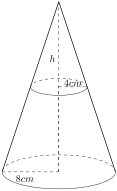
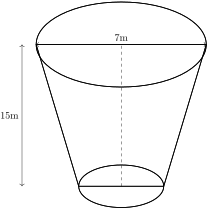
Shell petrol station has the shape of an inverted right circular cone of the radius \(7\) m and height \(15\) m dug underground in the shape of the figure shown below. Calculate the volume of petrol it holds when full in litre.
Answer.
\(769,690 \;\text{litres}\)

2.

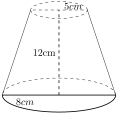
A frustum of a cone has a base radius of \(8\) cm, a top radius of \(5\) cm, and a height of \(12\) cm. Find its volume.
Answer.
\(1621.06\;\text{cm}^3\)

3.

A square pyramid is cut into a frustum, where the original height was \(18\) cm, and the truncated top part has a height of \(6\) cm. The base side length is \(12\) cm, and the top side length is \(6\) cm. Find the volume of the frustum.
Answer.
\(792 \;\text{cm}^3\)

4.

A frustum of a cone has a volume of \(900\) cm \(^3\text{,}\) a base radius of \(10\) cm, and a top radius of \(6\) cm. Find its height.
Answer.
\(4.39 \;\text{cm}\)

5.

An A improvised jerrycan shaped like a frustum of a cone with a top radius of \(20\) cm, a bottom radius of \(15\) cm, and a height of \(30\) cm. How many liters of water can the bucket hold?
Answer.
\(29.1 \;\text{L}\)