Subsection 2.4.6 Angles of Elevation and Depression

If an architect knows how far away she is from a building, how can she determine its height? By calculating the angle of elevation from her position to the top of the building, she can use trigonometry to find the height. This angle is how far her head must tilt from eye-level to look up at the building.
Similarly, if she wants to determine the depth of a well, she can calculate the angle of depression, which is how far her head must tilt from eye-level to look down into the well. Both angles of elevation and depression are crucial in various real-life applications, such as architecture, navigation, and surveying.

Subsubsection 2.4.6.1 Angles of Elevation

Learner Experience 2.4.14.

\(\textbf{Work in groups}\)
What you require:
  1. Find a tall object around your surroundings, e.g. a tree, building, flagpole, etc.
  2. Measure the distance from the base of the object to your position. Record this distance.
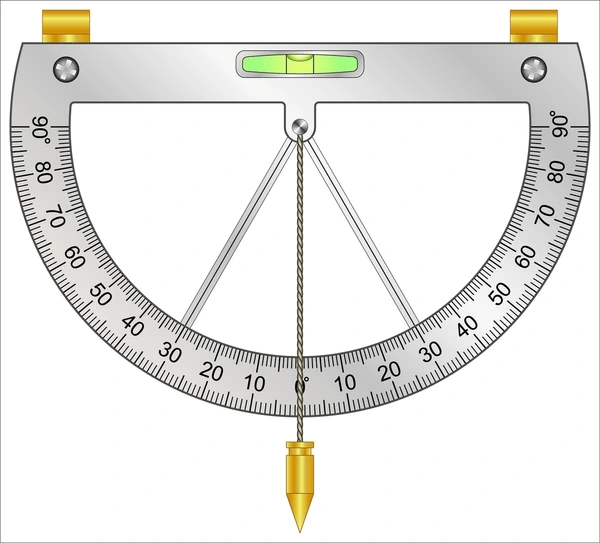
  3. Use your clinometer to measure the angle of elevation from your eye level to the top of the object. Record the angle.
  4. Draw a right triangle representing the situation. Label the distance you measured, the angle of elevation, and the unknown height of the object.
  5. Decide which trigonometric ratio (sine, cosine, or tangent) you need to use to find the height.
  6. Use the appropriate trigonometric ratio and the measured distance and angle to calculate the height of the object. Show your work
  7. Write down your calculated height. Compare your result with your partner’s or other groups’ results. Discuss any differences.
    NO Object Observed (e.g tree) Distance from Base (meters) Angle of Elevation (degrees) Calculation (Show Work) Calculated Height (meters)
    \(1\)
    2
    \(3\)

Exploration 2.4.15. Understanding Angle of Elevation.

The angle of elevation is the angle formed between the horizontal line of sight from an observer’s eye and the direct line of sight to an object located higher than the observer.
It is measured by starting at the horizontal plane and tilting the eye upward. Use the interactive tool below and follow the guiding steps below to explore how distance and height affect this key trigonometric angle.
Instructions.
Use this simulation to investigate real-world applications of trigonometry:
  • Establish the Right Triangle: Notice the dashed lines. Where is the right-angle located in this real-world scenario? How are the terms "Horizontal" and "Height" related to "Adjacent" and "Opposite" sides?
  • Move the Observer: Drag the observer’s eye (the blue point \(P\)) horizontally along the ground line. As you get closer to the object, what happens to the height of the object? Remember the angle is fixed by the slider.
  • Adjust the Angle: While holding the observer in one place, use the slider to increase the angle \(\theta\text{.}\) How does changing the angle affect the final height calculation?
  • The Role of Tangent: Look at the trigonometric data. How do we use the tangent function to solve this problem if we know how far away the object is (\(d\)) and the angle of elevation (\(\theta\))?
Figure 2.4.57. Interactive: Observer and Tall Object illustrating Angle of Elevation

Key Takeaway 2.4.58.

A clinometer (or inclinometer) is a tool used to measure the angle of elevation (looking up) and the angle of depression (looking down).
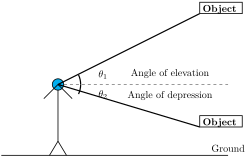
The figure below shows a person standing on the ground, looking at an object at the top. This forms an angle of elevation. When looking down from a higher point, it forms an angle of depression.
The dashed line is the horizontal line.
  • Angle of Elevation: The angle measured upward from a horizontal line to an object above.
  • Angle of Depression: The angle measured downward from a horizontal line to an object below.

Example 2.4.59.

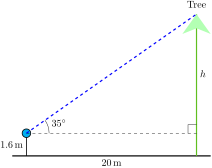
A person stands \(20\,\text{m}\) away from a tree. The angle of elevation from their eyes (\(1.6\,\text{m}\) above the ground) to the top of the tree is \(35^\circ\text{.}\) Find the height of the tree.
Solution.
Consider the sketch below:
Use \(\tan\,\theta\text{:}\)
\begin{align*} \tan\,35^\circ \amp = \frac{h}{20} \\ h \amp = 20 \times \tan\,35^\circ \\ \amp = 20 \times 0.7002 \\ \amp = 14.00\,\text{m} \end{align*}
Total height of tree = \(h + 1.6 = 14.00 + 1.6 = 15.6\,\text{m}\text{.}\)

Example 2.4.60.

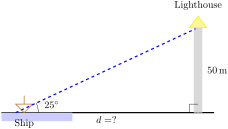
A lighthouse is \(50\,\text{m}\) tall. A sailor spots the top of the lighthouse at an angle of elevation of \(25^\circ\text{.}\) How far is the ship from the base of the lighthouse?
Solution.
Consider the sketch below:
Use \(\tan\text{:}\)
\begin{align*} \tan\,25^\circ \amp = \frac{50}{d} \\ d \amp = \frac{50}{\tan\,25^\circ} \\ \amp = \frac{50}{0.4663} \\ \amp = 107.2\,\text{m} \end{align*}

Exercises Exercises

1.
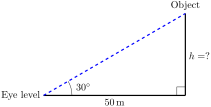
If the angle of elevation is \(30^\circ\) and the horizontal distance to the object is \(50\,\text{m}\text{,}\) find the height above eye level.
Answer.
In this problem:
Using tangent (opposite over adjacent):
\begin{align*} \tan\,30^\circ \amp = \frac{h}{50}\\ h \amp = 50 \times \tan\,30^\circ\\ \amp = 50 \times 0.5774\\ \amp = 28.87\,\text{m} \end{align*}
The height above eye level is approximately \(28.9\,\text{m}\text{.}\)
2.
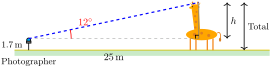
A wildlife photographer in the Maasai Mara stands \(25\,\text{m}\) away from a giraffe. The angle of elevation from the photographer’s eye level (\(1.7\,\text{m}\) above ground) to the top of the giraffe’s head is \(12^\circ\text{.}\) Calculate the total height of the giraffe.
Answer.
Given:
First, find the height above eye level:
\begin{align*} \tan\,12^\circ \amp = \frac{h}{25}\\ h \amp = 25 \times \tan\,12^\circ\\ \amp = 25 \times 0.2126\\ \amp = 5.31\,\text{m} \end{align*}
Total height of giraffe = height above eye level + eye level height:
\begin{align*} \text{Total height} \amp = 5.31 + 1.7\\ \amp = 7.01\,\text{m} \end{align*}
The giraffe is approximately \(7\,\text{m}\) tall.
3.
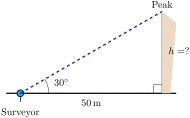
A surveyor is standing \(50\,\text{m}\) away from the base of a mountain. The angle of elevation to the peak of the mountain is \(30^\circ\text{.}\) Calculate the height of the mountain above the surveyor’s eye level.
Answer.
Given:
Using tangent:
\begin{align*} \tan\,30^\circ \amp = \frac{h}{50}\\ h \amp = 50 \times \tan\,30^\circ\\ \amp = 50 \times 0.5774\\ \amp = 28.87\,\text{m} \end{align*}
The height of the mountain above the surveyor’s eye level is approximately \(28.9\,\text{m}\text{.}\)
4.
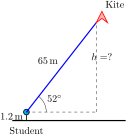
A student is flying a kite at a school field day. The string is \(65\,\text{m}\) long and makes an angle of elevation of \(52^\circ\) with the ground. The student holds the string \(1.2\,\text{m}\) above the ground. How high is the kite flying above the ground?
Answer.
Given:
Using sine to find the vertical component of the string:
\begin{align*} \sin\,52^\circ \amp = \frac{h}{65}\\ h \amp = 65 \times \sin\,52^\circ\\ \amp = 65 \times 0.7880\\ \amp = 51.22\,\text{m} \end{align*}
Total height above ground = vertical component + hand height:
\begin{align*} \text{Total height} \amp = 51.22 + 1.2\\ \amp = 52.42\,\text{m} \end{align*}
The kite is flying approximately \(52.4\,\text{m}\) above the ground.
5.
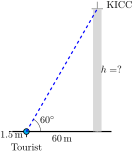
A tourist standing \(60\,\text{m}\) from the base of the Kenyatta International Convention Centre (KICC) in Nairobi looks up at the top of the tower. The angle of elevation from her eye level (\(1.5\,\text{m}\) above the ground) is \(60^\circ\text{.}\) Calculate the height of the KICC tower.
Answer.
Given:
First, find the height above eye level using tangent:
\begin{align*} \tan\,60^\circ \amp = \frac{h}{60}\\ h \amp = 60 \times \tan\,60^\circ\\ \amp = 60 \times 1.732\\ \amp = 103.92\,\text{m} \end{align*}
Total height of KICC = height above eye level + eye level:
\begin{align*} \text{Total height} \amp = 103.92 + 1.5\\ \amp \approx 105\,\text{m} \end{align*}
The KICC tower is approximately \(105\,\text{m}\) tall.
6.
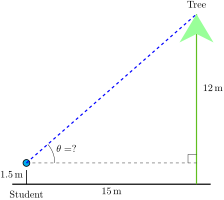
A student stands \(15\,\text{m}\) away from a tree. The tree is \(12\,\text{m}\) tall, and the student’s eye level is \(1.5\,\text{m}\) above the ground. Find the angle of elevation from the student’s eyes to the top of the tree.
Answer.
Given:
Using tangent:
\begin{align*} \tan\,\theta \amp = \frac{10.5}{15}\\ \tan\,\theta \amp = 0.7\\ \theta \amp = \tan^{-1}(0.7)\\ \amp = 34.99^\circ \end{align*}
The angle of elevation is approximately \(35^\circ\text{.}\)
7.
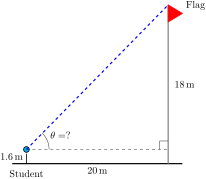
During a school assembly, a student stands \(20\,\text{m}\) from a flagpole. The flagpole is \(18\,\text{m}\) tall. If the student’s eye level is \(1.6\,\text{m}\) above the ground, at what angle of elevation does she look at the top of the flagpole?
Answer.
Given:
Using tangent:
\begin{align*} \tan\,\theta \amp = \frac{16.4}{20}\\ \tan\,\theta \amp = 0.82\\ \theta \amp = \tan^{-1}(0.82)\\ \amp = 39.35^\circ \end{align*}
The angle of elevation is approximately \(39.4^\circ\text{.}\)
8.
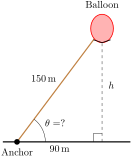
A hot air balloon is tethered to the ground by a rope that is \(150\,\text{m}\) long. The balloon floats directly above a point that is \(90\,\text{m}\) from where the rope is anchored. Find the angle of elevation from the anchor point to the balloon.
Answer.
Given:
Using cosine:
\begin{align*} \cos\,\theta \amp = \frac{90}{150}\\ \cos\,\theta \amp = 0.6\\ \theta \amp = \cos^{-1}(0.6)\\ \amp = 53.13^\circ \end{align*}
The angle of elevation from the anchor point to the balloon is approximately \(53.1^\circ\text{.}\)
9.
A ladder is leaning against a wall, forming an angle of \(60^\circ\) with the ground. If the ladder is \(10\) metres long, how high does it reach on the wall?
Solution.
The ladder is the hypotenuse, and the height on the wall is the side opposite the \(60^\circ\) angle. Using sine:
\begin{align*} \sin\,60^\circ \amp = \frac{h}{10}\\ h \amp = 10 \times \sin\,60^\circ\\ \amp = 10 \times 0.8660\\ \amp = 8.66\,\text{m} \end{align*}
The ladder reaches approximately \(8.66\,\text{m}\) up the wall.
10.
If the angle of elevation is \(30^\circ\) and the horizontal distance to the object is \(50\,\text{m}\text{,}\) find the height above eye level.
Solution.
Using tangent (opposite over adjacent):
\begin{align*} \tan\,30^\circ \amp = \frac{h}{50}\\ h \amp = 50 \times \tan\,30^\circ\\ \amp = 50 \times 0.5774\\ \amp = 28.87\,\text{m} \end{align*}
The height above eye level is approximately \(28.9\,\text{m}\text{.}\)
11.
A surveyor is standing \(50\) metres away from the base of a mountain. The angle of elevation to the peak is \(30^\circ\text{.}\) Calculate the height of the mountain above the surveyor’s eye level.
Solution.
Using tangent:
\begin{align*} \tan\,30^\circ \amp = \frac{h}{50}\\ h \amp = 50 \times \tan\,30^\circ\\ \amp = 50 \times 0.5774\\ \amp = 28.87\,\text{m} \end{align*}
The height of the mountain above the surveyor’s eye level is approximately \(28.9\,\text{m}\text{.}\)

Subsubsection 2.4.6.2 Angles of Depression

Learner Experience 2.4.16.

\(\textbf{Individual work}\)
What you require: Your homemade clinometer, a ruler or measuring tape, a notebook and pen and a friend (optional, but fun!)
  1. Climb up to a higher place like a step, a balcony, or a small hill
  2. Hold the clinometer at eye level, and look through it toward an object on the ground (like a cone, stone, or your friend’s shoes).
  3. Watch the string and record the angle where it crosses the scale. That’s your angle of depression!
  4. Measure the height from your eyes to the ground (that’s your vertical distance).
    Calculate how far the object is from the base of your standing point.
  5. Share and discuss your work with your classmates.

Exploration 2.4.17. Understanding Angle of Depression.

The angle of depression is formed when an observer looks down at an object. It is always measured from a strictly horizontal line extending from the observer’s eye, downward to the line of sight.
Because the horizontal line from the observer’s eye is parallel to the ground, we can use the geometric rule of alternate interior angles to simplify our calculations. Use the interactive tool below and follow the guided steps to see how this works.
Instructions.
Use the simulation to explore the relationship between height, distance, and the angle:
  • The Most Common Mistake: Look at the top angle (in red). Notice that it is drawn strictly outside the main vertical triangle. Why is it incorrect to place the angle of depression between the vertical cliff and the blue line of sight?
  • The Geometry "Cheat Code": Look at the blue angle at the target on the ground. This is the angle of elevation from the target to the observer. What do you notice about its value compared to the angle of depression?
  • Change the Altitude: Drag the Observer (the blue eye) up and down the y-axis to change the height. If the angle remains the same, what happens to the distance of the target on the ground?
  • Adjust the Angle: Use the slider to make the angle of depression larger (steeper). Does the target move closer to the base of the cliff or further away?
Figure 2.4.64. Interactive: Observer looking down at a target, illustrating Angle of Depression

Key Takeaway 2.4.65.

  • Definition of Angle of Depression
    The angle of depression is the angle measured downward from a horizontal line to an object below. It is how far your head must tilt from eye-level to look down at an object.
  • Relationship Between Angles of Elevation and Depression
    When you look down from a higher point at an object, you form an angle of depression. From the object looking up at you, that forms an angle of elevation. These two angles are equal due to alternate interior angles formed by parallel horizontal lines.
  • The Horizontal Reference Line
    The angle of depression is always measured from a horizontal line (eye level when looking straight ahead). The horizontal line is parallel to the ground.
  • Using Trigonometry with Angles of Depression
    To solve problems involving angles of depression:
    1. Draw a diagram showing the situation with a right triangle
    2. Identify the angle of depression from the horizontal line
    3. Find the corresponding angle inside the right triangle (often \(90^\circ -\) angle of depression, or use alternate interior angles)
    4. Identify which sides are opposite, adjacent, and hypotenuse relative to your working angle
    5. Choose the appropriate trigonometric ratio (\(sin, cos\text{,}\) or \(tan\))
    6. Solve for the unknown distance or height
  • Common Strategy
    For angles of depression problems:
    1. The vertical height is often given (height of building, cliff, tower)
    2. The horizontal distance is often unknown
    3. Use tan ratio: \(tan\)(angle) \(= \frac{\text{opposite}}{\text{adjacent}}\)
    4. Rearrange to find the unknown side
  • Real-World Applications
    Angles of depression are used in:
    1. Aviation: Pilots calculating descent angles to runways
    2. Maritime: Lighthouse keepers determining distances to ships
    3. Surveying: Measuring depths of valleys or wells
    4. Rescue operations: Helicopters locating people on the ground
    5. Architecture: Determining sight lines from elevated structures

Example 2.4.66.

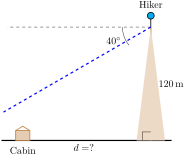
A hiker stands on top of a hill that is \(120\,\text{m}\) high and looks down at a cabin in a valley. The angle of depression to the cabin is \(40^\circ\text{.}\) Calculate the horizontal distance from the hiker to the cabin.
Solution.
Consider the figure below:
The angle of depression is \(40^\circ\text{.}\) Inside the right triangle at the hiker’s position, the angle between the line of sight and the vertical is \(90^\circ - 40^\circ = 50^\circ\text{.}\)
Using this angle, the horizontal distance \(d\) is opposite and the height \(120\,\text{m}\) is adjacent.
\begin{align*} \tan\,50^\circ \amp = \frac{d}{120} \\ d \amp = 120 \times \tan\,50^\circ \\ \amp = 120 \times 1.1918 \\ \amp = 143\,\text{m} \end{align*}

Exercises Exercises

1.
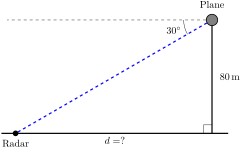
A plane flies to a height of \(80\,\text{m}\) above the ground. The angle of depression from the plane to a radar on the ground is \(30^\circ\text{.}\) Find the horizontal distance between the radar and the plane’s projection on the ground.
Answer.
The angle of depression is \(30^\circ\text{.}\) Inside the right triangle at the plane’s position, the angle between the line of sight and the vertical is \(90^\circ - 30^\circ = 60^\circ\text{.}\)
Given:
Using tangent:
\begin{align*} \tan\,60^\circ \amp = \frac{d}{80}\\ d \amp = 80 \times \tan\,60^\circ\\ \amp = 80 \times 1.7321\\ \amp = 138.57\,\text{m} \end{align*}
The horizontal distance is approximately \(138.6\,\text{m}\text{.}\)
2.
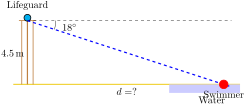
A lifeguard sits in a tower that is \(4.5\,\text{m}\) above the beach. She spots a swimmer in distress at an angle of depression of \(18^\circ\text{.}\) How far is the swimmer from the base of the lifeguard tower?
Answer.
The angle of depression is \(18^\circ\text{.}\) Inside the right triangle at the lifeguard’s position, the angle between the line of sight and the vertical is \(90^\circ - 18^\circ = 72^\circ\text{.}\)
Given:
Using tangent:
\begin{align*} \tan\,72^\circ \amp = \frac{d}{4.5}\\ d \amp = 4.5 \times \tan\,72^\circ\\ \amp = 4.5 \times 3.0777\\ \amp = 13.85\,\text{m} \end{align*}
The swimmer is approximately \(13.9\,\text{m}\) from the base of the tower.
3.
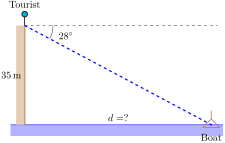
A tourist stands at the edge of a cliff overlooking Lake Victoria. The cliff is \(35\,\text{m}\) high. She sees a fishing boat on the water at an angle of depression of \(28^\circ\text{.}\) How far is the boat from the base of the cliff?
Answer.
The angle of depression is \(28^\circ\text{.}\) Inside the right triangle at the tourist’s position, the angle between the line of sight and the vertical is \(90^\circ - 28^\circ = 62^\circ\text{.}\)
Given:
Using tangent:
\begin{align*} \tan\,62^\circ \amp = \frac{d}{35}\\ d \amp = 35 \times \tan\,62^\circ\\ \amp = 35 \times 1.8807\\ \amp = 65.82\,\text{m} \end{align*}
The boat is approximately \(65.8\,\text{m}\) from the base of the cliff.
4.
An airplane is preparing to land. The pilot can see the runway at an angle of depression of \(5^\circ\text{.}\) If the airplane is flying at an altitude of \(1500\,\text{m}\text{,}\) what is the horizontal distance from the airplane to the runway?
Answer.
The angle of depression is \(5^\circ\text{.}\) Inside the right triangle at the airplane’s position, the angle between the line of sight and the vertical is \(90^\circ - 5^\circ = 85^\circ\text{.}\)
Given:
Using tangent:
\begin{align*} \tan\,85^\circ \amp = \frac{d}{1500}\\ d \amp = 1500 \times \tan\,85^\circ\\ \amp = 1500 \times 11.4301\\ \amp = 17145.15\,\text{m} \end{align*}
The horizontal distance is approximately \(17.1\,\text{km}\) (or \(17145\,\text{m}\)).
5.
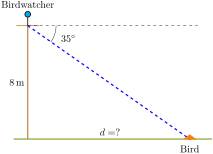
A birdwatcher is standing on a platform \(8\,\text{m}\) above the ground in Kakamega Forest. She spots a rare bird on the ground at an angle of depression of \(35^\circ\text{.}\) How far must she walk horizontally to reach the spot where the bird was standing?
Answer.
The angle of depression is \(35^\circ\text{.}\) Inside the right triangle at the birdwatcher’s position, the angle between the line of sight and the vertical is \(90^\circ - 35^\circ = 55^\circ\text{.}\)
Given:
Using tangent:
\begin{align*} \tan\,55^\circ \amp = \frac{d}{8}\\ d \amp = 8 \times \tan\,55^\circ\\ \amp = 8 \times 1.4281\\ \amp = 11.42\,\text{m} \end{align*}
The birdwatcher must walk approximately \(11.4\,\text{m}\) horizontally.
6.
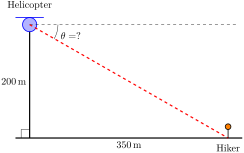
A rescue helicopter is hovering at a height of \(200\,\text{m}\) above ground level. The pilot can see a stranded hiker on the ground \(350\,\text{m}\) horizontally from the helicopter. Calculate the angle of depression from the helicopter to the hiker.
Answer.
Given:
Using tangent:
\begin{align*} \tan\,\theta \amp = \frac{200}{350}\\ \tan\,\theta \amp = 0.5714\\ \theta \amp = \tan^{-1}(0.5714)\\ \amp = 29.74^\circ \end{align*}
The angle of depression is approximately \(29.7^\circ\text{.}\)
7.
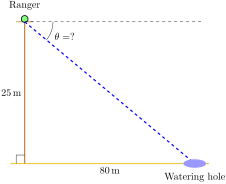
A ranger stands at the top of a \(25\,\text{m}\) lookout tower in Tsavo National Park. She spots a watering hole that is \(80\,\text{m}\) from the base of the tower. At what angle of depression is she looking at the watering hole?
Answer.
Given:
Using tangent:
\begin{align*} \tan\,\theta \amp = \frac{25}{80}\\ \tan\,\theta \amp = 0.3125\\ \theta \amp = \tan^{-1}(0.3125)\\ \amp = 17.35^\circ \end{align*}
The angle of depression is approximately \(17.4^\circ\text{.}\)
8.
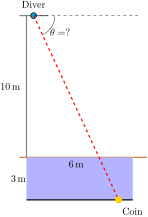
A diver stands on a diving board that is \(10\,\text{m}\) above the surface of the swimming pool. From where she stands, she can see a coin at the bottom of the pool. The coin is \(6\,\text{m}\) horizontally from a point directly below her. If the pool is \(3\,\text{m}\) deep, find the angle of depression from the diver to the coin.
Answer.
Given:
Using tangent:
\begin{align*} \tan\,\theta \amp = \frac{13}{6}\\ \tan\,\theta \amp = 2.1667\\ \theta \amp = \tan^{-1}(2.1667)\\ \amp = 65.22^\circ \end{align*}
The angle of depression from the diver to the coin is approximately \(65.2^\circ\text{.}\)