To assist your teaching, we have prepared lesson resources, aligned with this textbook and the CBC. The Lesson Plan links to syllabus learning outcomes and provides suggest time allocations. The Step-by-Step Guide provides more detailed guidance on how to teach the content, including suggested questions to ask learners, and possible answers.
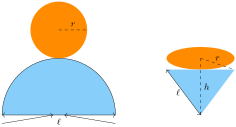
This curved surface can be cut into many thin triangles with height close to a (where \(\ell\) is the slant height). The area of these triangles or sectors can be summed as follow;
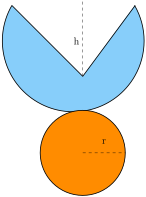
The \(\textbf{net of a cone} \) is a two-dimensional representation of the three-dimensional shape of the cone. It is made up of the curved surface of the cone laid out flat, so that you can see the shape of the cone. The net of a cone is useful for visualizing the shape of the cone and for calculating its surface area and volume.
No, a cone has a circular base and tapers to a point, while a cylinder has two parallel circular bases
I only need to find the curved surface area
No, you must add the base area to the curved surface area for the total surface area
The height and slant height are the same
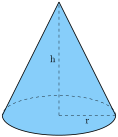
No, the slant height is the distance along the curved surface from the apex to the base edge, while the height is the perpendicular distance from the apex to the base
I can use the height directly in the formula
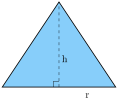
No, you must use the slant height, which can be calculated using the Pythagorean theorem if you know the height and radius
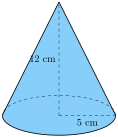
1. A circular cone has a base radius of 5 cm and a slant height of 12 cm. Calculate the total surface area of the cone, including both the curved surface and the circular base
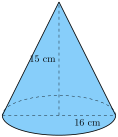
2. A cone is constructed with a base diameter of 16 cm and a height of 15 cm. Before finding the total surface area, determine the slant height of the cone using the Pythagorean theorem. Then, calculate the complete surface area.
3. A conical container, open at the top, is made of metal and has a base radius of 10 cm and a slant height of 18 cm. Determine the total metal sheet required to construct this container, excluding the base.
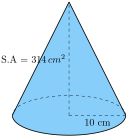
4. The total surface area of a cone is given as 314 cm², and its base radius is 10 cm. Using the surface area formula, determine the slant height of the cone.
5. A conical tent made of waterproof fabric has a radius of 4.2 m and a slant height of 7.5 m. If the tent does not have a base, calculate the area of fabric required to cover the tent completely.