Subsection 2.4.1 Tangents of Acute Angles

Learner Experience 2.4.1.

Work in pairs or small groups

What you require.

Part 1.

  1. In your group, find at least three different vertical objects that you can easily measure with a ruler or meter stick (e.g., a student’s height, a fence post, or a stick held perfectly upright).
  2. For each object, measure two things as precisely as possible:
    • Height (\(H\)): The actual height of the object from the ground up.
    • Shadow (\(S\)): The length of the shadow cast on the flat ground.
    Make a table to record your findings: For each object, write down in a row what the object is, its height \(H\text{,}\) and the shadow length \(S\text{.}\)
    Table 2.4.3.
    Object Height \(H\) Shadow \(S\) Ratio \(\frac{H}{S}\)
    Fence post
    ...
  3. Add another column to your table where you compute the ratio \(\frac{H}{S}\) for each object.
  4. Observe the ratios from the previous step.
    What do you notice about the relationship between them?
  5. Can you find a vertical object in your surroundings that’s too tall for you to measure its height? Can you measure the length of its shadow and estimate its height using the ratio you computed earlier?

Part 2.

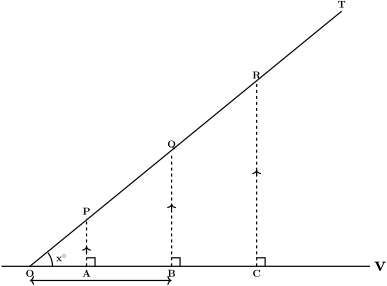
  1. Draw the situation on a piece of paper. For each object, sketch the vertical object and its shadow on the ground. Connect the top of the object to the tip of its shadow with a straight line (this represents the sun ray), so each object with its shadow forms a triangle. Make sure the sun rays are parallel. What do you notice about the angles formed between the sun rays and the ground for each object?
    Figure 2.4.4. Parallel sun rays hitting the ground, with objects and their shadows.
  2. Using a ruler, measure the height of each object that you drew and the length of its shadow. Make a table as before, and calculate the ratio of height to shadow length for each object. What do you notice about these ratios?
  3. Identify whether triangles formed by the objects and their shadows are similar.

Exploration 2.4.2. Exploring the tangent of an angle.

Instructions.

Use this interactive board to explore the relationship between the sides of similar right-angled triangles:
  • Adjust the Angle: Slide the \(\theta\) slider at the top left. Notice how all the vertical lines (the Opposite sides) grow or shrink together.
  • Change the Size: Drag points \(A\text{,}\) \(B\text{,}\) and \(C\) horizontally along the bottom line (the Adjacent side) to create right-angled triangles of any size.
  • Observe the Ratios: Look at the calculations at the bottom of the graph. Even as you change the size of the triangles by dragging the points, what happens to the ratio of the Opposite side divided by the Adjacent side?
Figure 2.4.5. Interactive Activity: Discovering the Tangent Ratio

Key Takeaway 2.4.6.

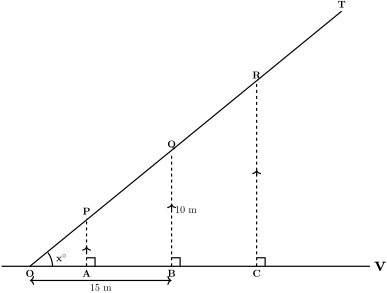
When given the triangles in the sketch below, you will notice the following:
Figure 2.4.7.
  1. The triangles in the drawing above are similar.
    This means that the ratios of their corresponding sides are equal:
    \begin{equation*} \frac{H_1}{S_1} = \frac{H_2}{S_2}\text{,} \end{equation*}
    in this case equalling \(1.25\)
  2. For any such right-angled triangle where the angle is \(\theta\text{,}\) the ratio of vertical distance (side opposite to the angle) to horizontal distance (side adjacent to the angle) remains the same, in this case \(1.25\text{.}\)
    This constant ratio, \(\frac{\text{Vertical distance}}{\text{Horizontal distance}}\) is called the tangent of angle \(\theta\text{,}\) written as \(\tan(\theta) = \frac{\text{Vertical distance}}{\text{Horizontal distance}}\text{.}\) In this example, \(\tan(\theta) = 1.25\text{.}\)
    The tangent of an angle depends only on the size of the angle, not on the triangle’s size.

Further activity.

The inclination of the observer’s line of sight to the top of a \(10\,m\) high flag pole, positioned \(15\,m\) away, can be determined using a scale drawing, as illustrated in the diagram below.
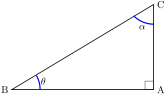
Look at the triangle shown in FigureΒ 2.4.8
In right-angled triangle:
\begin{equation*} \tan\, \alpha=\frac{\text{opposite side​}}{\text{adjacent side}} \end{equation*}
Express \(\tan\,\alpha\) in terms of the lengths of the sides of the triangle.

Key Takeaway 2.4.9.

The diagram below shows a right-angled triangle \(ABC\text{,}\) where:
\begin{equation*} \angle ABC = \theta\text{.} \end{equation*}
Figure 2.4.10.
  • The side \(AC\) is the vertical side, which is \(\textbf{opposite}\) to angle \(\theta\text{.}\)
  • The side \(AB\) is the horizontal side, which is \(\textbf{adjacent}\) to angle \(\theta\)
  • The side \(BC\) is the \(\textbf{hypotenuse}\text{,}\) which is the longest side of the right-angled triangle.
In this case, the tangent of angle \(\theta\) is defined as the ratio of the opposite side to the adjacent side:
\begin{equation*} \tan\,\theta = \frac{\textbf{Opposite side}}{\textbf{Adjacent side}}= \frac{AC}{AB}\text{.} \end{equation*}

Example 2.4.11.

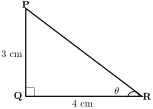
Find the tangent of the indicated angles using the given measurements below.
Solution.
The above diagram the sides given are,
Opposite side \(=3\,cm\)
Adjacent side \(= 4\,cm\)
Therefore,
\begin{align*} \tan \, \theta = \amp \frac{\text{Opposite }}{\text{Adjacent }} \\ =\amp \frac{3\,cm}{4\,cm} \\ = \amp \frac{3}{4}\\ =\amp 0.75 \end{align*}
Therefore, \(\tan \,\theta=0.75\)

Example 2.4.12.

Find the tangent of the angle \(\theta\) in the diagram below:
Solution.
Remember that
\begin{equation*} \tan \, \theta = \frac{\text{Opposite }}{\text{Adjacent }} \end{equation*}
In this case, the opposite side to \(\theta\) is \(AD\text{,}\) which has length 6 cm.
The adjacent side is \(CD\text{,}\) whose side length we can find via Pythagoras’ theorem:
\begin{align*} AD^2 + CD^2 \amp= AC^2 \\ CD^2 \amp = AC^2 - AD^2 \\ \amp = 10^2 - 6^2\\ \amp = 100 - 36 \\ \amp = 64 \\ CD \amp = \sqrt{64} \\ \amp = 8\,cm \end{align*}
Thus, we have:
\(\tan \theta = \frac{\text{Opposite }}{\text{Adjacent }} = \frac{6}{8} = \frac{3}{4}\)
Exercises Exercises

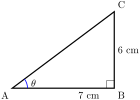
1.

In a right-angled triangle, the side opposite angle \(\theta\) is \(6\,\text{cm}\) and the side adjacent to \(\theta\) is \(7\,\text{cm}\text{.}\) Find \(\tan\theta\text{.}\)
Answer.
\(\tan\theta = \dfrac{\text{Opposite}}{\text{Adjacent}} = \dfrac{6}{7} \approx 0.857\text{.}\)

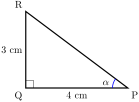
2.

In the right-angled triangle \(PQR\) below, find \(\tan\alpha\text{.}\)
Answer.
\(\tan\alpha = \dfrac{3}{4} = 0.75\text{.}\)

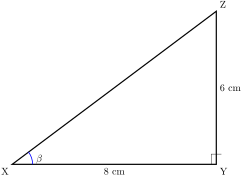
3.

A right-angled triangle has an angle \(\beta\) and the side opposite \(\beta\) is \(6\,\text{cm}\) while the side adjacent to \(\beta\) is \(8\,\text{cm}\text{.}\) Find \(\tan\beta\text{.}\)
Answer.
\(\tan\beta = \dfrac{6}{8} = \dfrac{3}{4} = 0.75\text{.}\)

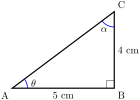
4.

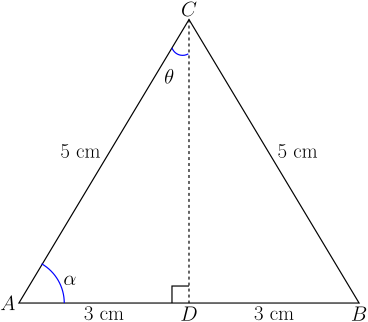
Consider the right-angled triangle \(ABC\) below.
  1. Use the side lengths to find \(\tan \theta\) and \(\tan \alpha\text{.}\)
  2. What do you notice about the relationship between \(\tan \theta\) and \(\tan \alpha\text{?}\) What is the value of \(\tan \theta \times \tan \alpha\text{?}\)
  3. Explain why \(\theta + \alpha = 90^\circ\)
  4. Hence explain why \(\tan \theta = \dfrac{1}{\tan(90^\circ - \theta)}\text{.}\)
Answer.
  1. For angle \(\theta\text{,}\) the opposite side is \(4\,\text{cm}\) and the adjacent side is \(5\,\text{cm}\text{,}\) so
    \begin{align*} \tan \theta \amp= \dfrac{4}{5} \end{align*}
    For angle \(\alpha\text{,}\) the opposite side is \(5\,\text{cm}\) and the adjacent side is \(4\,\text{cm}\text{,}\) so
    \begin{align*} \tan \alpha \amp= \dfrac{5}{4} \end{align*}
  2. Then
    \begin{align*} \tan \theta \times \tan \alpha \amp= \dfrac{4}{5} \times \dfrac{5}{4}\\ \amp= 1 \end{align*}
  3. Since angles \(\theta\) and \(\alpha\) are the two acute angles in a right-angled triangle, they add up to \(90^\circ\text{.}\) So \(\alpha = 90^\circ - \theta\text{.}\)
  4. Since \(\tan \theta \times \tan \alpha = 1\text{,}\) we have \(\tan \alpha = \dfrac{1}{\tan \theta}\text{.}\) Thus,
    \begin{equation*} \tan \theta = \dfrac{1}{\tan(90^\circ - \theta)}\text{.} \end{equation*}