Subsection 2.6.5 Area of Common Regions Between Circles
Teacher Resource 2.6.31.
To assist your teaching, we have prepared lesson resources, aligned with this textbook and the CBC. The Lesson Plan links to syllabus learning outcomes and provides suggest time allocations. The Step-by-Step Guide provides more detailed guidance on how to teach the content, including suggested questions to ask learners, and possible answers.
Learner Experience 2.6.11.
\(\textbf{work in groups}\)
What you require; Compass, ruler, pencil, graph paper and Calculator.
-
From a point \(2 \,cm\) to the right of \(O\text{,}\) draw another circle with the same radius (\(5 cm\)).This should create an overlapping region.
-
Name the intersection points of the two circles as P and Q.
-
Lightly shade the overlapping region between the two circles.
-
Finding the area of the common region.How does the distance between centers affect the common area?
-
Discuss your result with other learners in class.
Exploration 2.6.12. Exploring the Area of Intersection of Two Circles.
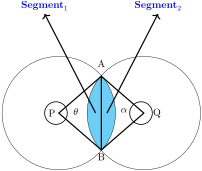
When two circles overlap, they form a shared region often called a lens. This region is made up of two circular segmentsβone from each circle.
In this exploration, you will adjust the radii of the two circles and the distance between their centers. Observe how these changes affect whether the circles intersect and how large the shared region becomes.
Before beginning, review the instructions below.
Instructions.
-
Use the slider
Radius 1 (rβ)to change the size of the first circle. -
Use the slider
Radius 2 (rβ)to change the size of the second circle. -
Use the slider
Distance (PβPβ)to move the centers closer together or farther apart. -
Observe when the circles:
-
Do not touch.
-
Touch at one point.
-
Overlap to form a shaded region.
-
-
When the circles overlap, observe the shaded region (the lens) and the angles shown.
-
Examine the calculation panel to see how the shared area is determined.
Use the interactive to explore and answer the following:
-
What happens when the distance between the centers is greater than the sum of the radii (\(d > r_1 + r_2\))? What do you observe about the shaded region?
-
What happens when the distance is less than the difference of the radii (\(d < |r_1 - r_2|\))? How are the circles positioned?
-
Adjust the sliders so the circles just touch at one point. What is the area of overlap in this case?
-
When the circles overlap, how does increasing the distance \(d\) affect the size of the shared region?
-
Keep the distance fixed and increase one of the radii. How does this change the overlap? Which circle contributes more to the shared region?
-
Observe the angles \(\theta\) and \(\alpha\text{.}\) How do these angles change as the overlap increases or decreases?
-
The shared region is made up of two segments. How is each segment related to its corresponding circle?
-
Based on your observations, explain why the total shared area can be found by adding two segment areas together.
-
Can you describe the conditions needed for two circles to intersect? How can these conditions be written using \(r_1\text{,}\) \(r_2\text{,}\) and \(d\text{?}\)
\(\textbf{Key Takeaway}\)
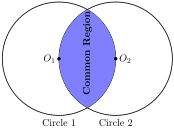
The \(\textbf{common region between two intersecting circles}\) refers to the overlapping area shared by both circles.
It is formed when two circles of different or equal radii intersect at two distinct points as shown below.
The area of the common region can be found by:
-
Calculating the area of the two circular segments formed by the chord joining the intersection points.
-
Sum the areas of the two segments.\begin{align*} A= \amp A_\text{segment 1}+ A_\text{segment 2} \end{align*}The figure below shows the two segments.
Example 2.6.33.
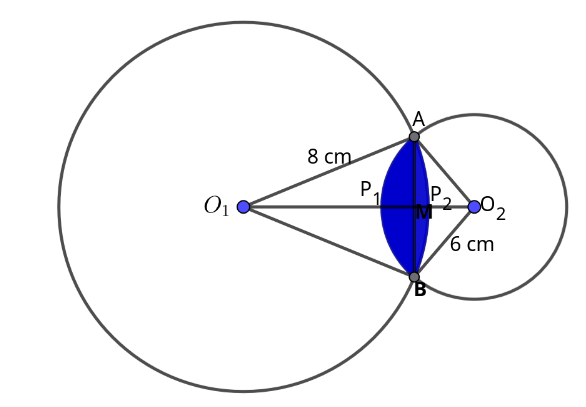
The figure below shows two circles of radii \(8\,
cm\) and \(6 \,cm\) with centres \(O_1\) and \(O_2\) respectively. The circles intersect at points A and B. The lines \(O_1O_2\) and AB are perpendicular to each other. If the common chord AB is \(9 \,cm\text{,}\) calculate the area of the shaded region.

Solution.
From \(\triangle AO_1M\text{;}\)
\begin{align*}
O_1M=\amp \sqrt{8^2-4.5^2} \\
= \amp \sqrt{43.75} \\
=\amp 6.14\,cm
\end{align*}
From \(\triangle AO_2M\text{;}\)
\begin{align*}
O_2M=\amp \sqrt{6^2-4.5^2} \\
= \amp \sqrt{15.75} \\
=\amp 3.969\,cm
\end{align*}
The area of the shaded region is the sum of the areas of segments \(AP_1B\) and \(AP_2B\text{.}\) \(\text{Area of segment }AP_1B = \text{area of
sector }C_2AP_1B β \text{area of }\triangle O_2AB.\)
Using trigonometry,
\begin{align*}
\angle AO_2M=\amp\frac{AM}{AO_2} \\
=\amp \frac{4.5}{6} \\
=\amp 0.75 \\
\angle =\amp sin^{-1} \,(0.75) \\
= \amp 48.59^\circ
\end{align*}
\begin{align*}
\angle AO_2B=\amp 2\angle AO_2M\\
=\amp 2 \times 48.59^\circ \\
=\amp 97.18^\circ
\end{align*}
Area of segment \(AP_1B\)
Area sector.
\begin{align*}
= \amp \frac{97.18}{360} \times 3.142 \times 6^2\\
=\amp 30.53
\end{align*}
Area of triangle.
\begin{align*}
=\amp\frac{1}{2} \times 9 \times 3.969 \\
=\amp 17.86
\end{align*}
Therefore,
\begin{align*}
\text{Area of segment}AP_1B=\amp 30.53 -17.86\\
=\amp 12.67\,cm^2
\end{align*}
\(\text{Area of segment }AP_2B = \text{area of
sector }0_1AP_2B β \text{area of }\triangle O_1AB.\)
Using trigonometry,
\begin{align*}
\angle AO_1M=\amp\frac{AM}{AO_1} \\
=\amp \frac{4.5}{8} \\
=\amp 0.5625 \\
\angle =\amp sin^{-1} \,(0.5625) \\
= \amp 34.23^\circ
\end{align*}
\begin{align*}
\angle AO_1B=\amp 2\angle AO_1M\\
=\amp 2 \times 34.23^\circ \\
=\amp 68.46^\circ
\end{align*}
Area of segment \(AP_2B\)
Area sector.
\begin{align*}
= \amp \frac{68.46}{360} \times 3.142 \times 8^2\\
=\amp 38.24
\end{align*}
Area of triangle.
\begin{align*}
=\amp\frac{1}{2} \times 9 \times 6.614 \\
=\amp 29.76
\end{align*}
Therefore,
\begin{align*}
\text{Area of segment}AP_2B=\amp 38.24-29.76\\
=\amp 8.48\,cm^2
\end{align*}
Therefore, area of the shaded region is given by; \(\text{Area of segment}AP_1B+\text{Area of segment}AP_2B\)
\begin{align*}
=\amp 12.67\,cm^2+8.48\,cm^2\\
=\amp 21.15\,cm^2
\end{align*}
Example 2.6.34.
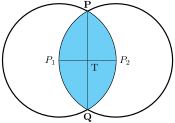
The figure below shows two intersecting circles of radius \(10\,cm\) each with centre \(P_1\) and \(P_2\text{.}\) The length of \(P_1\) and \(P_2\) is \(6\,cm\text{.}\) (Take \(\pi=3.142\))
Find:
-
the length of the common chord \(\textbf{PQ}\text{.}\)
-
the area common to the two circles.
Solution.
We are given:
-
Two intersecting circles with radius \(r=10,cm.\text{.}\)
-
Distance between the centers: \(P_1P_2=6\,cm\text{.}\)
-
Finding the Length of the Common Chord PQApplying the Right-angled triangle propertySince the chord PQ is perpendicular to the line joining the centers, we can analyze the right-angled triangle \(P_1TP\text{.}\)Using the Pythagorean theorem in \(\triangle P_1TP\text{;}\)\begin{equation*} P_1P^2=P_1T^2+PT^2 \end{equation*}Where:Substituting values:\begin{align*} 10^2=\amp 3^2+PT^2 \\ 100=\amp 9+PT^2 \\ PT^2=\amp 91 \\ PT=\amp 91 \\ =\amp \sqrt{91} \\ =\amp 9.54 \,cm \end{align*}Since PQ \(=2PT\)\begin{align*} \text{PQ}=\amp 2 \times 9.54 \,cm \\ =\amp 19.08\, cm \end{align*}
-
Finding the common area between the two circle.The common area consists of two identical circular segments, each subtended by the central angle \(2\theta\) at \(P_1\) or \(P_2\text{.}\)Finding \(\theta\)\begin{align*} cos\,\theta=\amp \frac{P_1T}{P_1P} \\ =\amp \frac{3}{10} \\ = \amp 0.3 \\ \theta= \amp cos^{-1}\,0.3\\ = \amp 72.54^\circ \end{align*}\(\angle\,P_1=\angle \,P_2= 2\times 72.54^\circ\)\begin{equation*} =145.08^\circ \end{equation*}Finding the segmet of \(P_1 \,\text{and} \, P_1\text{.}\) Since the segment are the same, it implies that area of segment \(P_1=P_2\text{.}\)Therefore,\(\text{Area of segment}=\text{area of sector}-\text{area of triangle}\)Area of sector\begin{align*} A=\amp \frac{145.08^\circ}{360} \times 3.142 \times 10^2\\ = \amp 126.62 \,cm^2 \end{align*}Area of triangle\begin{align*} A=\amp \frac{1}{2} \times 10 \times 10 \times sin\,145.08\\ = \amp \frac{1}{2} \times 10^2 \times sin\,145.08\\ = \amp 28.62\,cm^2 \end{align*}Area of segment \(= 126.62 \,cm^2-28.62\,cm^2\)\begin{equation*} =98.00\,cm^2 \end{equation*}Therefore,Area of the common region \(= 2\times 98.00\,cm^2\)\begin{equation*} 196.00\,cm^2 \end{equation*}
Exercises Exercises
1.
If two circles of radius \(r\) overlap such that their centers are at a distance \(0.5\,r\text{,}\) express the overlapping area in terms of \(r\text{.}\)
2.
Two circular traffic islands of radius \(10\) meters overlap so that the centers are \(12\) meters apart. The angle subtended at the center of each circle by the chord of intersection is \(120^\circ\text{.}\) Find the area of the overlapping region.
3.
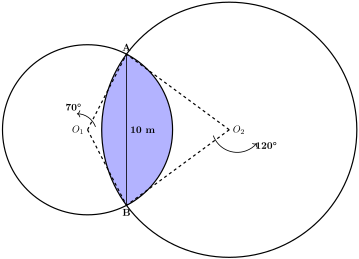
Find the shaded area of the figure below;
4.
In the Olympic symbol, circles of radius \(5\) cm overlap, forming intersections. If the central angle corresponding to the common region is \(90^\circ\text{,}\) find the area of the intersection.
5.
During a rare planetary alignment, two planets appear as overlapping circles in the sky. If both have an apparent radius of \(5000\) km, and their centers are \(6000\) km apart, with a central angle of \(145^\circ\text{,}\) find the overlapping shadow area visible from Earth.
\(\textbf{Technology Integration: Exploring Areas of Part of a Circle}\)
To deepen your understanding of how to find the area of different parts of a circle, explore the following interactive and insightful resources:
-
YouTube β Shifting Grades Online SchoolThis video lesson offers a visual and step-by-step explanation on how to find the area of parts of a circle. Itβs ideal for learners who prefer guided instruction with examples.
-
YouTube β Anil KumarLearn about circle sectors and other related topics with this clear and concise tutorial. Great for quick revision or reinforcing concepts.
-
BBC Bitesize β Guide on CirclesThis interactive webpage from BBC Bitesize explains how to calculate the area of parts of a circle using helpful visuals and explanations.
-
GeoGebra β Interactive Geometry ToolUse GeoGebra to explore and manipulate circle diagrams in real time. You can adjust radii and angles to see how the area of a sector or annulus changes perfect for visual learning and experimentation.