Skip to main content
Contents
Search Book
Search Results:
No results.
Read aloud Readability settings Prev Up Next \(\newcommand{\N}{\mathbb N} \newcommand{\Z}{\mathbb Z} \newcommand{\Q}{\mathbb Q} \newcommand{\R}{\mathbb R}
\newcommand{\lt}{<}
\newcommand{\gt}{>}
\newcommand{\amp}{&}
\definecolor{fillinmathshade}{gray}{0.9}
\newcommand{\fillinmath}[1]{\mathchoice{\colorbox{fillinmathshade}{$\displaystyle \phantom{\,#1\,}$}}{\colorbox{fillinmathshade}{$\textstyle \phantom{\,#1\,}$}}{\colorbox{fillinmathshade}{$\scriptstyle \phantom{\,#1\,}$}}{\colorbox{fillinmathshade}{$\scriptscriptstyle\phantom{\,#1\,}$}}}
\)
Subsection 2.10.5 Displacement-Time Graphs
Curriculum Alignment
Strand
2.0 Measurements and Geometry
Sub-Strand
Specific Learning Outcomes
Draw a displacement-time graph of different situations and interpret displacement-time graphs in different situations.
Teacher Resource 2.10.55 .
To assist your teaching, we have prepared lesson resources, aligned with this textbook and the CBC. The Lesson Plan links to syllabus learning outcomes and provides suggest time allocations. The Step-by-Step Guide provides more detailed guidance on how to teach the content, including suggested questions to ask learners, and possible answers.
Learner Experience 2.10.56 .
A motorist travels from Limuru to Kisumu. The table below shows the distances covered at different times:
Time
\(\text{Distance (km)}\)
\(\text{9:00 AM}\) \(0\)
\(\text{10:00 AM}\) \(80\)
\(\text{11:00 AM}\) \(160\)
\(\text{11:30 AM}\) \(160\)
\(\text{12:00 PM}\) \(210\)
Plot the graph using the data given in the table and use it to answer the questions below
How far was the motorist from Limuru at 10:30 AM?
What was the average speed during the first part of the journey?
What was the overall average speed?
Learner Experience 2.10.57 .
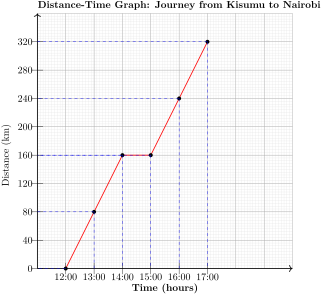
Consider the displacement time graph representing distance covered by a motorist traveling from Turkana to Nairobi.
How far was the motorist from the starting point at
\(2:30 \,\text{ PM}\text{?}\)
What was the total distance covered by the motorist?
During which periods was the motorist stationary?
Calculate the average speed of the motorist between
\(12 \,\text{ noon}\) and
\(2 \,\text{ PM}\text{.}\)
What was the overall average speed for the entire journey?
Exploration 2.10.58 . Exploring a Displacement–Time Graph.
Use the interactive simulation below to investigate how the motion evolves over time. Before beginning, read the instructions below carefully for using the interactive graphs.
Instructions.
Follow the steps below to explore how displacement changes with time.
Drag the time slider in the top panel from \(0\) seconds to \(6\) seconds. Observe how the point moves along the displacement–time graph.
Watch the arrow and moving dot on the vertical scale . They show the value of the displacement at the selected time.
Move the slider slowly and notice the shape of the curve. Observe how the displacement first increases and later decreases.
Use the interactive to investigate the following questions:
As time increases from \(0\) seconds, what happens to the displacement? Is the object moving away from or toward its starting position?
Find the point where the displacement reaches its maximum value . At approximately what time does this occur?
After the maximum point, what happens to the displacement as time continues? What does this suggest about the direction of motion?
Compare the steepness of the curve at different times. When is the graph steepest? What might this indicate about how fast the object is moving?
Move the slider back and forth several times. How does the displacement change throughout the entire motion?
Figure 2.10.59. Interactive Graphs of Displacement, Velocity, and Acceleration
Example 2.10.61 .
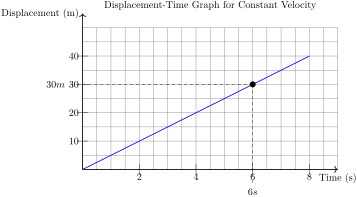
A car moves with a constant velocity of
\(\text{5 m/s}\) for
\(8\) seconds.
Draw the displacement-time graph and determine the displacement at
\(\text{t = 6s}\text{.}\)
Solution .
Since the velocity is constant, the displacement increases linearly with time
Hence ,
\begin{gather*}
\text{s = vt}
\end{gather*}
\begin{gather*}
\text{S = 5} \, \times \, \text{6 = 30}
\end{gather*}
Example 2.10.62 .
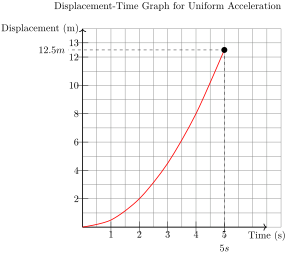
A car starts from rest and accelerates uniformly at
\(2 \,\text{m/s²}\) for
\(5\) seconds.
Draw the displacement-time graph.
Solution .
Since acceleration is constant, the displacement follows the equation
\begin{gather*}
s = \frac{1}{2}at^{2}
\end{gather*}
for different time values:
Time (s)
Displacement (m)
\(1\) \(0.5\)
\(2\) \(2\)
\(3\) \(4.5\)
\(4\) \(8\)
\(5\) \(12.5\)
Example 2.10.63 .
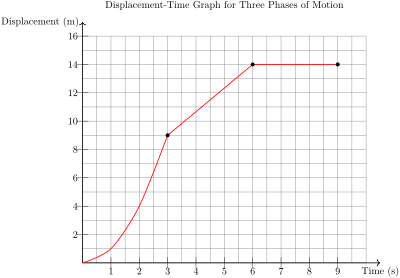
A car moves in three different phases as shown below;
The car starts from rest and accelerates uniformly. The car moves at a constant velocity. The car comes to a stop and remains at a fixed position.
Sketch a displacement-time graph for the motion.
Identify the type of motion in each phase.
Determine the displacement at
\(\text{t = 3s, t = 6s, and t = 9s }. \)
Solution .
\(\text{0s to 3s}\) - The displacement follows a curved path because the car is accelerating.
\(\text{3s to 6s}\) - The displacement increases linearly since the velocity is constant.
\(\text{6s to 9s}\) - The displacement remains constant because the car has stopped.
Example 2.10.64 .
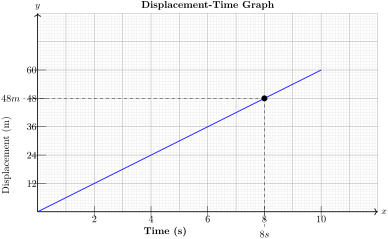
Use the displacement-time graph for constant velocity to answer the following questions.
What type of motion does the graph represent? Explain your answer.
What is the displacement of the car at
\(t\) =
\(8\) seconds?
What is the total displacement at
\(t\) =
\(10\) seconds
Determine the velocity of the car from the graph.
Solution .
The graph shows a straight line with a constant slope, indicating uniform motion. This means the car is moving at a constant velocity with no acceleration.
From the graph, the displacement at
\(t\) =
\(8\) seconds is
\(48\) meters.
Using the equation of motion:
\begin{align*}
s = \amp t \times v\\
= \amp 6 \times 10\\
= \amp 60 \, \text{meters}
\end{align*}
Therefore,
\(t\) =
\(10\) seconds, the car’s displacement is
\(60\) meters.
Velocity is given by the slope of the displacement-time graph:
\begin{align*}
\text{Velocity} = \amp \frac{\text{Change in displacement}}{\text{Change in time}}\\
\text{Velocity} = \amp \frac{48 - 0}{8 - 0}\\
= \amp \frac{48}{8} = 6
\end{align*}
This confirms the car’s velocity is
\(6\) \(\text{m/s}\text{.}\)
Example 2.10.65 .
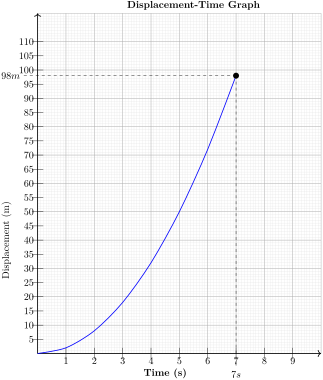
Use the graph below to answer the questions.
What type of motion is represented by the graph? Explain your reasoning.
If the train continued to accelerate at
\(4\) \(\text{ m/s²}\text{,}\) what would be its approximate displacement at
\(t\) =
\(8\) seconds?
What is the displacement of the body at
\(t\) =
\(7\) seconds?
Solution .
The graph represents uniformly accelerated motion.
The line on the graph is curved, not straight. This means the object is not moving the same distance each second. Its speed is changing.
\begin{align*}
S = \frac{1}{2}at^{2} + ut\\
S = \amp \frac{1}{2}4(8)^{2} + (0)(8)\\
S = \amp 0 + 2 (64)\\
S = \amp 128 \, \text{ m}
\end{align*}
The approximate displacement at
\(t\) =
\(8\) seconds would be
\(128\) meters.
\(\displaystyle 98 \, \text{ m}.\)
Checkpoint 2.10.66 .
Checkpoint 2.10.67 .
Checkpoint 2.10.68 .
Exercises Exercises
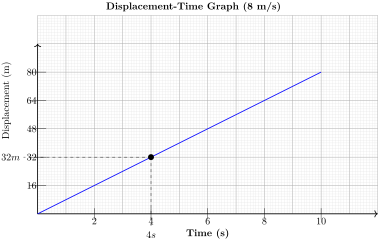
1. The displacement-time graph below shows a train moving at a constant velocity.
Use the graph to answer the following questions.
What is the displacement at
\(t\) =
\(4 \,\text{s}\text{?}\)
If the object continued moving for
\(15\) seconds, what would be its total displacement?
What would the graph look like if the object stopped moving after
\(6\) seconds?
Answer .
From the graph, at
\(t\) =
\(4 \,\text{s}\text{,}\) the displacement is
\(32 \,\text{m}\text{.}\)
\begin{align*}
s = 8 \,\text{m/s} \times 15 \,\text{s} \\\\
=\amp 120 \,\text{m}
\end{align*}
If the object stopped moving after
\(6 \,\text{s}\text{,}\) the graph would show a horizontal line starting from the point corresponding to
\(t\) =
\(6 \,\text{s}\) and the displacement at that time. This indicates that the displacement remains constant after that point.
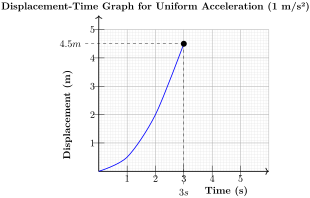
2. The displacement-time graph below shows a car accelerating smoothly from rest.
Use the graph to answer the following questions:
Describe the motion of the car as shown in the graph. Is the velocity constant, increasing, or decreasing? Justify your answer.
What does the y-intercept of the graph represent?
Calculate the average velocity of the object between
\(\textbf{t}\) =
\(0 \textbf{ s}\) and
\(\textbf{t}\) =
\(3 \textbf{ s}\)
Answer .
The graph shows a curved line that gets steeper over time, indicating that the car’s velocity is increasing. This means the car is accelerating.
The y-intercept of the graph represents the initial displacement of the car at time
\(t\) =
\(0 \,\text{s}\text{.}\) In this case, it is
\(0 \,\text{m}\text{,}\) indicating that the car started from rest at the origin.
\begin{gather*}
= \frac{4.5 \,\text{m} - 0 \,\text{m}}{3 \,\text{s} - 0 \,\text{s}}\\
= 1.5 \,\text{m/s}
\end{gather*}
Therefore, the average velocity of the car is
\(1.5 \,\text{m/s}\text{.}\)
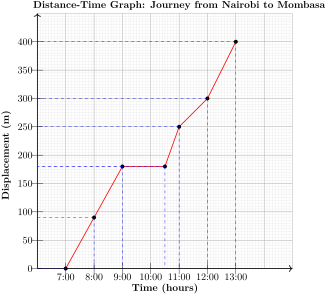
3. The distance-time graph below shows a motorist traveling from Nairobi to Mombasa with varying speeds and periods of rest.
Use the graph to answer the following questions:
What was the total distance traveled by the motorist?
At what time did the motorist stop for a break?
Calculate the speed of the motorist between
\(7:00\) \(\text{AM}\) and
\(8:00\) \(\text{AM}\text{.}\)
What was the speed of the motorist from
\(9:00\) \(\text{AM}\) and
\(10:30\) \(\text{AM}\text{?}\)
Find the overall average speed of the entire journey.
Identify a section of the graph where the motorist was stationary.
Describe what happens when the graph has a steeper slope.
Answer .
The total distance traveled by the motorist is
\(400 \,\text{ km}\text{.}\)
The motorist stopped for a break between
\(9:00 \,\text{ AM}\) and
\(10:30 \,\text{ AM}\text{.}\)
The speed of the motorist between
\(7:00 \,\text{ AM}\) and
\(8:00 \,\text{ AM}\) is:
\(\frac{90 \,\text{ km}}{1 \,\text{ hour}} = 90 \,\text{ km/h}\)
The speed of the motorist from
\(9:00 \,\text{ AM}\) to
\(10:30 \,\text{ AM}\) is:
\(\frac{0 \,\text{ km}}{1.5 \,\text{ hours}} = 0 \,\text{ km/h}\)
The overall average speed of the entire journey is:
\(\text{Average Speed} = \frac{400 \,\text{ km}}{6 \,\text{ hours}} = 66.67 \,\text{ km/h}\)
The motorist was stationary between
\(9:00 \,\text{ AM}\) and
\(10:30 \,\text{ AM}\text{.}\)
A steeper slope on the graph indicates a higher speed. The steeper the slope, the faster the motorist is traveling.
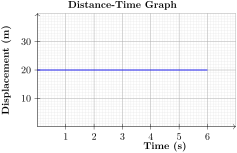
4. The displacement-time graph below shows a car parked on the roadside.
What is the displacement of the object throughout the time interval shown in the graph?
During which time interval(s) is the object stationary?
What is the total distance covered by the car in
\(6\) seconds?
What is the speed of the car during the time interval shown?
Answer .
The displacement of the object throughout the time interval shown in the graph is
\(20 \,\text{ m}\text{.}\)
The object is stationary during the entire time interval from
\(0 \,\text{s}\) to
\(6 \,\text{s}\text{.}\)
The total distance covered by the car in
\(6 \,\text{s}\) is
\(0 \,\text{ m}\text{,}\) as it did not move.
The speed of the car during the time interval shown is
\(0 \,\text{ m/s}\text{,}\) since it remained stationary.
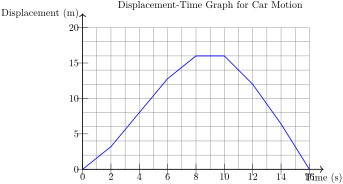
5. A car moves along a straight road, and its displacement from the starting point is recorded at different times.
Time (s)
\(\text{Displacement (m)}\)
\(0\) \(0\)
\(2\) \(4\)
\(4\) \(10\)
\(6\) \(16\)
\(8\) \(20\)
\(10\) \(20\)
\(12\) \(15\)
\(14\) \(8\)
\(16\) \(0\)
Plot a displacement-time graph using the data above
Describe the motion of the car based on the graph.
Identify the time intervals when the car is at rest
Find the velocity of the car at the following intervals
Determine the total distance traveled by the car.
Answer .
The car accelerates from rest to a displacement of
\(20\) m in the first
\(8\) seconds.
The car remains at rest from
\(8\) to
\(10\) seconds.
The car then decelerates back to the starting point over the next
\(6\) seconds.
The car is at rest between
\(8\) to
\(10\) seconds.
From 0 to 6 seconds: Velocity =
\(\frac{16 \, \text{m}}{6 \, \text{s}} = 2.67 \, \text{m/s}\)
From 6 to 10 seconds: Velocity =
\(0 \, \text{m/s}\) (car is at rest)
From 10 to 16 seconds: Velocity =
\(\frac{-15 \, \text{m}}{6 \, \text{s}} = -2.5 \, \text{m/s}\)
The total distance traveled by the car is
\(40\) m (20 m forward and 20 m backward).
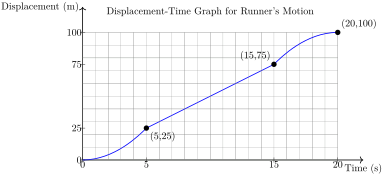
6.
Study the following description of a runner’s motion and sketch the corresponding displacement-time graph
The runner starts from rest and accelerates uniformly for
\(\text{ 5 seconds}\text{,}\) covering a displacement of
\(\text{25 meters}\text{.}\)
The runner maintains a constant speed for the next
\(\text{ 10 seconds}\text{,}\) covering an additional
\(\text{ 50 metres}\text{.}\)
The runner then decelerates uniformly for
\(\text{ 5 seconds}\) until stopping at
\(\text{ 100 meteres}\text{.}\)
Sketch the displacement-time graph based on this motion.
Determine the velocity during the constant speed phase.
Calculate the acceleration during the first
\(\text{ 5 seconds}\text{.}\)
Find the total time taken to complete the journey.
What is the average velocity for the entire motion?
Answer .
The velocity during the constant speed phase is
\(\frac{50 \, \text{m}}{10 \, \text{s}} = 5 \, \text{m/s}\text{.}\)
The acceleration during the first
\(5\) seconds is
\(\frac{25 \, \text{m}}{(5 \, \text{s})^2} = 2 \, \text{m/s}^2\text{.}\)
The total time taken to complete the journey is
\(5 + 10 + 5 = 20 \, \text{seconds}\text{.}\)
The average velocity for the entire motion is
\(\frac{100 \, \text{m}}{20 \, \text{s}} = 5 \, \text{m/s}\text{.}\)
7.
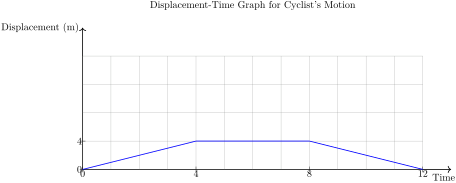
The displacement-time graph represents the motion of a cyclist
From
\(\text{0 to 4 seconds}\text{,}\) the cyclist moves forward at a uniform velocity.
From
\(\text{4 to 8 seconds}\text{,}\) the cyclist is stationary.
From
\(\text{8 to 12 seconds}\text{,}\) the cyclist moves back towards the starting point at a uniform velocity.
Sketch the graph for this motion.
What is the velocity during the first
\(\text{4 seconds}\text{?}\)
What does the flat section of the graph indicate?
Find the velocity during the last
\(\text{4 seconds}\text{.}\)
Calculate the total displacement at the end of
\(\text{12 seconds}\text{.}\)
Answer .
The velocity during the first
\(4\) seconds is
\(\frac{4 \, \text{m}}{4 \, \text{s}} = 1 \, \text{m/s}\text{.}\)
The flat section of the graph indicates that the cyclist is stationary during that time interval.
The velocity during the last
\(4\) seconds is
\(\frac{-4 \, \text{m}}{4 \, \text{s}} = -1 \, \text{m/s}\text{.}\)
The total displacement at the end of
\(12\) seconds is
\(0\) meters.