Subsection 2.7.2 Surface Area of Prisms

A prism is a three-dimensional solid made of two identical faces called faces, and connected by rectangular faces. Triangular prisms, cylinders, and cuboids are examples of prisms. The surface area of a prism can be found by calculating the area of each face and adding them to the area of the faces.

Learner Experience 2.7.3.

Work in groups: Form groups of \(2\) or \(3\) students.
Materials Needed:
  1. Pen or pencil
  2. Grid/graph paper or plain paper
  3. Rulers
  4. Pre-made nets of triangular prisms (optional)
Instructions:
  1. In your group, draw a triangular prism and its net on paper.
  2. Label the dimensions of the triangular face and the length of the prism.
  3. Calculate the area of the triangular face.
  4. Calculate the perimeter of the triangular face.
  5. Multiplying the perimeter of the face by the length of the prism to get the lateral area.
  6. Add the areas of the two triangular faces and the lateral area.
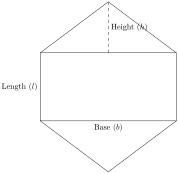
A triangular prism has two identical triangular faces and three rectangular faces.

Key Takeaway 2.7.13.

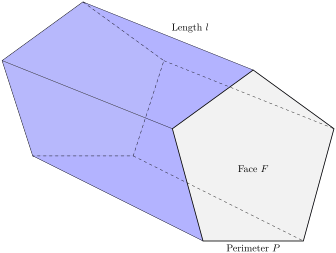
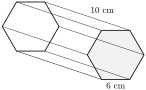
A \(\textbf{prism}\) is a geometric object with two identical, parallel faces and straight sides connecting them. These include rectangular prisms, triangular prisms, and pentagonal prisms (which is shown)
To calculate the surface area of a prisms, we use the formula:
\begin{align*} \text{Surface Area} \amp = 2\times \text{Area of Face} + \text{Perimeter of Face} \times \text{Length} \\ \amp = 2F + Pl \end{align*}
where \(F\) is the area of the face, \(P\) is the perimeter of the face, and \(l\) is length of the prism.
This works for any prism, including rectangular prisms (see SubsectionΒ 2.7.1), triangular prisms, and cylinders (see SubsectionΒ 2.7.3)
In the special case of a triangular prisms, we have \(F = \frac{1}{2} \times b \times h\) where \(b\) is the base of the triangle and \(h\) is the height of the triangle. The perimeter \(P\) is the sum of the three sides of the triangle.

Example 2.7.14.

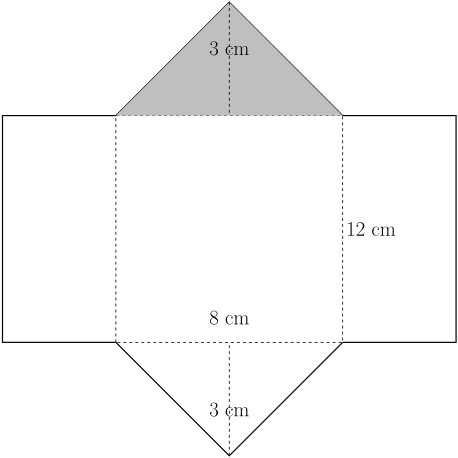
Find the surface area of a triangular prism with face \(8 \, \text{cm}\text{,}\) triangle height \(3 \, \text{cm}\text{,}\) and length \(12 \, \text{cm}\text{.}\)
Solution.
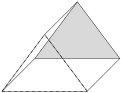
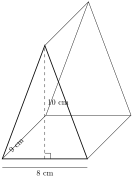
Triangular Prism example
Net of a triangular prism example.
The area of one triangular face is:
\begin{equation*} \text{Area of triangle} = \frac{1}{2} \times 8 \times 3 = 12 \, \text{ cm}^2 \end{equation*}
\begin{equation*} \text{Two faces} = 2 \times 12 = 24 \, \text{ cm}^2 \end{equation*}
\begin{equation*} \text{Perimeter} = 8 + 3 + 3 = 14 \, \text{ cm} \end{equation*}
\begin{equation*} \text{Lateral area} = 14 \times 12 = 168 \, \text{ cm}^2 \end{equation*}
\begin{equation*} \text{Total S.A} = 24 + 168 \end{equation*}
\begin{equation*} = 192 \, \text{ cm}^2 \end{equation*}

Example 2.7.15.

An octagonal prism has an octagonal face with area \(96 \, \text{cm}^2\) and perimeter \(32 \, \text{cm}\text{.}\) The length of the prism is \(12 \, \text{cm}\text{.}\) Calculate the total surface area.
Solution.
Surface area of a prism is given by \(2F + Pl\text{,}\) where \(F\) is face area, \(P\) is perimeter of the face and \(l\) is the length.
Given: \(F = 96 \, \text{cm}^2\text{,}\) \(P = 32 \, \text{cm}\text{,}\) \(l = 12 \, \text{cm}\text{.}\)
Lateral area = \(P\times l = 32 \times 12 = 384 \, \text{cm}^2\text{.}\)
Two faces = \(2F = 2 \times 96 = 192 \, \text{cm}^2\text{.}\)
Total surface area = \(192 + 384 = 576 \, \text{cm}^2\text{.}\)

Example 2.7.16.

Find the Surface area of the triangular prism with a slant height of \(5 \, \text{cm}\text{,}\) height of the triangular prism \(12 \, \text{cm}\) and a face of \(8 \, \text{cm}\text{.}\)
Solution.
Step 1: Find the area of the face.
The triangular face has a slant height of \(5 \, \text{cm}\) and face \(8 \, \text{cm}\text{.}\) Using pythagorean relationship height is:
\begin{align*} = \amp \sqrt{(5\,\text{cm})^2 - (4\, \text{cm})^2}\\ = \amp \sqrt{25 \, \text{cm} -16\, \text{cm}} = 3\, \text{cm}\\ \text{area of a triangle} = \amp \frac{1}{2}\times b \times h\\ = \amp \frac{1}{2} \times 8 \, \text{cm} \times 3 \, \text{cm} \\ = \amp 12 \,\text{cm}^2 \end{align*}
Step 2: Add the area of the face with the lateral area.
\begin{align*} \text{Surface Area} = \amp \text{area of face} + \text{lateral area}\\ \text{Lateral area} = \amp \text{Perimeter of Face} \times \text{Length}\\ = \amp (8 + 3 + 3) \, \text{cm} \times 12 \, \text{cm}\\ = \amp 14 \, \text{cm} \times 12 \, \text{cm}\\ = \amp 168\, \text{cm}^2\\ \text{Total Surface Area} = \amp 24\, \text{cm}^2 + 168\, \text{cm}^2\\ = \amp 192\, \text{cm}^2 \end{align*}
The surface area of the triangular prism is \(192 \, \text{cm}^2\text{.}\)
Exercises Exercises

1.

A pentagonal prism has a pentagonal face with area \(54 \, \text{cm}^2\) and perimeter \(30 \, \text{cm}\text{.}\) The length of the prism is \(10 \, \text{cm}\text{.}\) Find the total surface area.
Solution.
We have \(\text{Surface Area} = 2F + Pl \text{.}\) Given \(F = 54 \, \text{cm}^2\text{,}\) \(P = 30 \, \text{cm}\text{,}\) \(l = 10 \, \text{cm}\text{:}\)
Lateral area:
\begin{equation*} Pl = 30 \times 10 = 300 \, \text{cm}^2 \end{equation*}
Two faces:
\begin{equation*} 2F = 2 \times 54 = 108 \, \text{cm}^2 \end{equation*}
Total surface area:
\begin{equation*} 2F + Pl = 108 + 300 = 408 \, \text{cm}^2 \end{equation*}

2.

A triangular prism has a triangular face of base \(10 \text{cm}\) and height \(6 \text{cm}\text{.}\) The two equal sides of the triangle are \(8 \text{cm}\) each. The length of the prism is \(15 \text{cm}\text{.}\) Find its total surface area.
Solution.
Interpreting the triangular face as base \(b=10\,\text{cm}\) and triangle height \(h=6\,\text{cm}\) with equal sides \(8\,\text{cm}\) and prism length \(l=15\,\text{cm}\text{:}\)
Area of triangular face:
\begin{equation*} F = \tfrac{1}{2}bh = \tfrac{1}{2}\times10\times6 = 30 \, \text{cm}^2 \end{equation*}
Perimeter:
\begin{equation*} P = 10 + 8 + 8 = 26 \, \text{cm} \end{equation*}
Lateral area:
\begin{equation*} Pl = 26 \times 15 = 390 \, \text{cm}^2 \end{equation*}
Total surface area:
\begin{equation*} 2F + Pl = 2\times30 + 390 = 60 + 390 = 450 \, \text{cm}^2 \end{equation*}

3.

A triangular tent is shaped like a triangular prism. The triangular face has base \(8 \text{m}\) and height \(3 \text{m}\text{.}\) The slant sides are \(5 \text{m}\) each. The length of the tent is \(6 \text{m}\text{.}\) Find the total surface area of the tent canvas (including the two triangular ends).
Solution.
Area of triangular face:
\begin{equation*} F = \tfrac{1}{2} \times 8 \times 3 = 12 \, \text{m}^2\text{.} \end{equation*}
Perimeter of triangular face:
\begin{equation*} P = 8 + 5 + 5 = 18 \, \text{m}\text{.} \end{equation*}
Lateral area:
\begin{equation*} Pl = 18 \times 6 = 108 \, \text{m}^2\text{.} \end{equation*}
Total surface area:
\begin{equation*} 2F + Pl = 2\times12 + 108 = 24 + 108 = 132 \, \text{m}^2\text{.} \end{equation*}

4.

A triangular prism has a triangular face with base \(10 \, \text{cm}\) and height \(12 \, \text{cm}\text{.}\) The two remaining sides of the face are equal. The length of the prism is \(15 \, \text{cm}\text{.}\) Find its total surface area.
Solution.
Area of triangular face: \(F = \tfrac{1}{2}bh = \tfrac{1}{2}\times 10 \times 6 = 30 \, \text{cm}^2\)
For the perimeter, since the triangle is isoceles the vertical \(h\) bisects the base. So we can calculate the other side lengths \(x\) using Pythagoras’ theorem: \(x = \sqrt{12^2 + 5^2} = 13 \, \text{cm}\text{.}\) So \(P = 10 + 13 + 13 = 36 \, \text{cm}\)
Lateral area: \(Pl = 36 \times 15 = 540 \, \text{cm}^2\)
Total surface area: \(2F + Pl = 2\times 30 + 540 = 60 + 540 = 600 \, \text{cm}^2\)

5.

A bridge support structure has the shape of a triangular prism, with a face measuring \(10 \, \text{m}\text{,}\) \(17 \, \text{m}\text{,}\) and \(21 \, \text{m}\text{,}\) and a length of \(50 \, \text{m}\text{.}\) If paint costs \(300\) Ksh per square metre, how much will it cost to paint the entire surface area of the support structure?
Solution.
Surface Area = 2F + Pl. Compute using Heron’s formula for the triangular face with sides 10 m, 17 m and 21 m, and prism length \(l=50\,\text{m}\text{:}\)
Semi-perimeter:
\begin{equation*} s = \frac{10 + 17 + 21}{2} = 24 \, \text{m} \end{equation*}
Area of triangular face:
\begin{align*} F \amp = \sqrt{s(s-10)(s-17)(s-21)} \\ \amp = \sqrt{24\times14\times7\times3} \\ \amp = \sqrt{7056} \\ \amp = 84 \, \text{m}^2 \end{align*}
Perimeter:
\begin{equation*} P = 10 + 17 + 21 = 48 \, \text{m} \end{equation*}
Lateral area:
\begin{equation*} Pl = 48 \times 50 = 2400 \, \text{m}^2 \end{equation*}
Total surface area:
\begin{equation*} 2F + Pl = 2\times84 + 2400 = 168 + 2400 = 2568 \, \text{m}^2 \end{equation*}
Thus the total cost is
\begin{equation*} 2568 \, \text{m}^2 \times 300 \, \text{Ksh/m}^2 = 770400 \, \text{Ksh}\text{.} \end{equation*}

6.

A regular hexagonal prism has a hexagonal face with side \(6 \, \text{cm}\text{.}\) The length of the prism is \(10 \, \text{cm}\text{.}\)
Work out, giving an exact answer in terms of \(\sqrt{3}\text{,}\) the following:
  1. The area of one hexagonal face.
  2. The total surface area of the prism.
Solution.
  1. A regular hexagon can be split into six equilateral triangles of side \(s\text{.}\) Since the included angle is \(60^\circ\text{,}\) we have:
    \begin{align*} A_{\text{triangle}} \amp = \frac{1}{2} ab \sin C \\ \amp = \frac{1}{2} 6^2 \sin 60^\circ \\ \amp = \frac{1}{2} 36 \times \frac{\sqrt{3}}{2} \\ \amp = 9\sqrt{3} \end{align*}
    So the face area (the area of the hexagon) is six times the area of one triangle:
    \begin{equation*} F = 6 \times 9\sqrt{3} = 54\sqrt{3} \, \text{cm}^2. \end{equation*}
  2. Perimeter of the hexagon is \(P = 6s = 36 \, \text{cm}\text{.}\) Lateral area = \(P \times l = 36 \times 10 = 360 \, \text{cm}^2\text{.}\)
    Two faces = \(2A = 2 \times 54\sqrt{3} = 108\sqrt{3} \, \text{cm}^2 \approx 187.06 \, \text{cm}^2\text{.}\)
    Total surface area = \(2A + Pl = 108\sqrt{3} + 360 \, \text{cm}^2\text{.}\)

7. A Harder Exercise.

Two equilateral triangles with side lenghts \(s\) are connected by to form a prism of length \(10\,\text{cm}^2\text{.}\) Find an expression for the surface area in terms of \(s\text{.}\)
Hint.
Could Heron’s formula be useful here?
Solution.
Let the side length be \(s\text{.}\) The face area is given by Heron’s formula, with the semi-perimeter \(S = \frac{3s}{2}\text{,}\) and thus:
\begin{align*} F \amp = \sqrt{S(S-s)(S-s)(S-s)}\\ \amp = \sqrt{\frac{3s}{2}\left(\frac{3s}{2}-s\right)^3}\\ \amp = \sqrt{\frac{3s}{2}\left(\frac{s}{2}\right)^3}\\ \amp = \sqrt{\frac{3s^4}{16}}\\ \amp = \frac{s^2\sqrt{3}}{4} \end{align*}
The perimeter is \(P = 3s\text{,}\) so the lateral area is \(Pl = 3s \times 10 = 30s\text{.}\) The total surface area is thus:
\begin{align*} \text{Surface Area} \amp = 2F + Pl \\ \amp = 2 \times \frac{s^2\sqrt{3}}{4} + 30s\\ \amp = \frac{s^2\sqrt{3}}{2} + 30s \end{align*}