Subsection 1.3.1 Quadratic Expressions

A quadratic expression is an algebraic expression in which the highest power of the variable is \(2\text{.}\)
It can be written in the form:
\begin{equation*} ax^2 + bx + c \end{equation*}
where \(a\text{,}\) \(b\) and \(c\) are real numbers and \(a \neq 0\text{.}\)
The term \(ax^2\) is called the quadratic term, \(bx\) the linear term, and \(c\) the constant term.
Quadratic expressions are commonly formed by multiplying two linear expressions.

Subsubsection 1.3.1.1 Forming Quadratic Expressions by Multiplying 1

Learner Experience 1.3.1.

Work in Groups.
Quadratic expressions are often formed by multiplying two linear expressions.
For example:
\begin{equation*} (x + 2)(x + 3) \end{equation*}
When we multiply each term in the first bracket by each term in the second bracket, the result contains a term in \(x^2\text{.}\)
Expanding and simplifying:
\begin{equation*} (x + 2)(x + 3) = x^2 + 5x + 6 \end{equation*}
The result is a quadratic expression in standard form.

Key Takeaway 1.3.3.

A quadratic expression is an expression of the form: \(ax^2 + bx + c\) where:
  • \(a,\) \(b\) and \(c\) are constants (real numbers). \(a\) is the coefficient of the quadratic term, \(b\) is the coefficient of the linear term, and \(c\) is the constant term.
  • \(x\) is a variable (what we look for or are finding), and
  • \(a \neq 0\) because if \(a = 0\text{,}\) it would not be a quadratic expression.
In the previous grades you learned about algebraic expressions
An expression of the form \(3x \) or \(y^2 \) is called a monomial expression
A monomial expression is an expression with one term.
A binomial expression is an expression with two terms i.e. \(a + b \) or \(x^2 + y \)
Expressions can be formed in various ways:
  • Multiplying an expression with one term (a monomial) with an expression with two terms (a binomial)
  • Multiplying two expressions with two terms (two binomials).

Multiplying a monomial by a binomial..

Learner Experience 1.3.2.
Work in Groups
The following data represents the multiplication of a monomial by a binomial. Copy the table and complete it.
\(3x\) \((x + 4)\) \(3x(x + 4)\) \(3x^2 + 12x\)
\(2y\) \((y - 5)\) \(2y(y - 5)\) \(\)
\(-4a\) \((a + 7)\) \(-4a(a + 7)\) \(\)
\(6b\) \((b - 3)\) \(6b(b - 3)\) \(\)
Multiply the monomial by each binomial using the distributive property. For example, for \(3x(x+4)\text{,}\) distribute \(3x\) across the binomial and simplify.
  1. What do you notice about the process of multiplying a monomial by a binomial?
  2. How do you apply the distributive property when multiplying terms?
  3. Can you create your own examples of a monomial multiplied by a binomial and solve them?
  4. How can you simplify the expressions after distributing the monomial?
  5. Discuss in your group how the distributive property allows you to break down the multiplication step-by-step.
Key Takeaway 1.3.4.
When multiplying a monomial by a binomial, you apply the distributive property, multiplying the monomial by each term in the binomial, then combining like terms if necessary.
Example 1.3.5.
Simplify:
\begin{equation*} 2a(a - 1) -3(a^2 - 1) \end{equation*}
Solution.
Opening the brackets
\begin{align*} 2a(a - 1) -3(a^2 - 1) \amp = 2a(a) + 2a(-1) + (-3)(a^2) + (-3)(-1) \end{align*}
\begin{align*} \amp = 2a^2 - 2a -3a^2 + 3 \end{align*}
Collecting like terms we form a quadratic expression:
\begin{align*} \amp -a^2 - 2a + 3 \end{align*}
From the example above you can see that;
\((2a) \, \text{and} (-3)\) are the monomial expressions while \((a - 1)\, \text{and} (a^2 - 1)\) are the binomial expression.
Example 1.3.6.
Simplify the following expressions to form a quadratic expression.
\begin{equation*} 5(2x^2 + 5) + 6x(x -2) \end{equation*}
Solution.
Opening the brackets:
\begin{align*} 5(2x^2 + 5) + 6x(x -2) \amp = 10x^2 + 25 + 6x^2 - 12x \end{align*}
Collecting like terms:
\begin{align*} \amp 6x^2 + 10x^2 - 12x + 25 \end{align*}
Simplifying:
\begin{align*} \amp 16x^2 -12x + 25 \end{align*}

Exercises Exercises

1.
Form a quadratic equation using the following terms:
  1. \(\displaystyle 3x(x + 2) - 4(x^2 - 1)\)
  2. \(\displaystyle 8n(n + 5) - 3(n^2 - 6)\)
  3. \(\displaystyle 4p(p - 1) - 5(p^2 + 2)\)
  4. \(\displaystyle 7a(a + 3) - 2(a^2 - 2)\)
Answer.
  1. Expanding:
    \begin{align*} 3x(x + 2) - 4(x^2 - 1) \amp = 3x^2 + 6x - 4x^2 + 4\\ \amp = -x^2 + 6x + 4 \end{align*}
  2. Expanding:
    \begin{align*} 8n(n + 5) - 3(n^2 - 6) \amp = 8n^2 + 40n - 3n^2 + 18\\ \amp = 5n^2 + 40n + 18 \end{align*}
  3. Expanding:
    \begin{align*} 4p(p - 1) - 5(p^2 + 2) \amp = 4p^2 - 4p - 5p^2 - 10\\ \amp = -p^2 - 4p - 10 \end{align*}
  4. Expanding:
    \begin{align*} 7a(a + 3) - 2(a^2 - 2) \amp = 7a^2 + 21a - 2a^2 + 4\\ \amp = 5a^2 + 21a + 4 \end{align*}
2.
  1. \(\displaystyle 3m(m - 2) - 6(m^2 + 1)\)
  2. \(\displaystyle 9x(x + 3) - 4(x^2 - 4)\)
  3. \(\displaystyle 2y(y - 1) - 3(y^2 + 2)\)
  4. \(\displaystyle 2u^2 - 2(2u + 9)\)
Answer.
  1. Expanding:
    \begin{align*} 3m(m - 2) - 6(m^2 + 1) \amp = 3m^2 - 6m - 6m^2 - 6\\ \amp = -3m^2 - 6m - 6 \end{align*}
  2. Expanding:
    \begin{align*} 9x(x + 3) - 4(x^2 - 4) \amp = 9x^2 + 27x - 4x^2 + 16\\ \amp = 5x^2 + 27x + 16 \end{align*}
  3. Expanding:
    \begin{align*} 2y(y - 1) - 3(y^2 + 2) \amp = 2y^2 - 2y - 3y^2 - 6\\ \amp = -y^2 - 2y - 6 \end{align*}
  4. Expanding: \(2u^2 - 2(2u + 9) = 2u^2 - 4u - 18\)
3.
  1. \(\displaystyle 5a(a - 3) - 2(a^2 + 4)\)
  2. \(\displaystyle 9x(x -4) -1\)
  3. \(\displaystyle 13-(x+4)^2\)
  4. \(\displaystyle p(-2p) + 2(p -1)\)
Answer.
  1. Expanding:
    \begin{align*} 5a(a - 3) - 2(a^2 + 4) \amp = 5a^2 - 15a - 2a^2 - 8\\ \amp = 3a^2 - 15a - 8 \end{align*}
  2. Expanding: \(9x(x - 4) - 1 = 9x^2 - 36x - 1\)
  3. Expanding:
    \begin{align*} 13 - (x + 4)^2 \amp = 13 - (x^2 + 8x + 16)\\ \amp = -x^2 - 8x - 3 \end{align*}
  4. Expanding: \(p(-2p) + 2(p - 1) = -2p^2 + 2p - 2\)
4.
  1. \(\displaystyle 2b(b + 4) - 3(b^2 - 2)\)
  2. \(\displaystyle 5q(q + 4) - 2(q^2 - 3)\)
  3. \(\displaystyle 2r(r + 5) - r^2 + 7\)
  4. \(\displaystyle 2m - 2(m-1)^2\)
Answer.
  1. Expanding:
    \begin{align*} 2b(b + 4) - 3(b^2 - 2) \amp = 2b^2 + 8b - 3b^2 + 6\\ \amp = -b^2 + 8b + 6 \end{align*}
  2. Expanding:
    \begin{align*} 5q(q + 4) - 2(q^2 - 3) \amp = 5q^2 + 20q - 2q^2 + 6\\ \amp = 3q^2 + 20q + 6 \end{align*}
  3. Expanding:
    \begin{align*} 2r(r + 5) - r^2 + 7 \amp = 2r^2 + 10r - r^2 + 7\\ \amp = r^2 + 10r + 7 \end{align*}
  4. Expanding:
    \begin{align*} 2m - 2(m - 1)^2 \amp = 2m - 2(m^2 - 2m + 1)\\ \amp = 2m - 2m^2 + 4m - 2\\ \amp = -2m^2 + 6m - 2 \end{align*}

Subsubsection 1.3.1.2 Forming Quadratic Expressions by Multiplying 2

Multiplying Two Binomials..

Learner Experience 1.3.3.
Work in Groups
In groups of 3, look through the table below. The following pairs of expressions are given. Complete the table by multiplying the two binomials in the first two columns and writing the result in the third and fourth column.
\((x + 3)\) \((x + 5)\) \((x + 3)(x + 5)\) \(x^2 + 8x + 15\)
\((y - 4)\) \((y + 2)\) \((y - 4)(y + 2)\) \(y ^2 - 2y - 8\)
\((a + 6)\) \((a - 1)\)
\((b - 2)\) \((b + 7)\)
  1. After you have completed the table, discuss with your group members and write down the results in the table below.
  2. Discuss the pattern of the terms in the expanded form when both binomials have positive or negative terms.
  3. What do you notice about the results?
  4. How do the signs in the expressions affect the final expanded expression?
  5. Can you create and expand your own binomial multiplication problems?
Investigation 1.3.4.
What is the FOIL method, and why is it useful for multiplying binomials?
Suppose we want to Multiply
\begin{equation*} (a + b)(c +d) \end{equation*}
We have;
\begin{align*} (a + b)(c +d) \amp = (ac) + (ad) + (bc) + (bd) \end{align*}
Example 1.3.9.
Find the product:
\begin{equation*} (3x - 2)(5x +8) \end{equation*}
Solution.
\begin{align*} (3x) \cdot (5x) \amp = 15x^2 \\ (3x) \cdot(8) \amp = 24x\\ (-2) \cdot (5x) \amp = -10x \\ (-2) \cdot (8) \amp = -16 \end{align*}
Now combine the terms:
\begin{align*} 15x^2 + 24x - 10x + 16 \amp = 15x^2 + 14x - 16 \end{align*}
Therefore;
\begin{align*} (3x - 2)(5x + 8) \amp = 15x^2 + 14x - 16 \end{align*}
From the example we can see we formed an algebraic expression
Example 1.3.10.
Form a quadratic expression:
\begin{equation*} (8x + 5)^2 \end{equation*}
Solution.
\begin{align*} (8x + 5)^2 \amp = (8x + 5)(8x + 5) \end{align*}
Expanding the brackets
\begin{align*} \amp 64x^2 + 40x + 40x + 25 \end{align*}
Collect like terms and form a quadratic expression:
\begin{align*} \amp 64x^2 + 80x + 25 \end{align*}

Exercises Exercises

2.
Form quadratic expressions:
  1. \(\displaystyle (y + 5)(y + 2)\)
  2. \(\displaystyle -(4 - x)(x + 4)\)
  3. \(\displaystyle (s + 6)^2\)
  4. \(\displaystyle \left( \frac{1}{4} - \frac{1}{x} \right)^2\)
  5. \(\displaystyle (1 - 3h)(1 + 3h)\)
  6. \(\displaystyle (2p + 3)(2p + 2)\)
  7. \(\displaystyle -10(2y^2 + 8y + 3)\)
  8. \(\displaystyle \left(x + \frac{4}{x} \right)^2\)
Answer.
  1. Expanding:
    \begin{align*} (y + 5)(y+ 2) \amp = (y)(y) + (2)(y) + (5)(y) + (5)(2)\\ \amp = y^2 + 7y + 10 \end{align*}
  2. Expanding:
    \begin{align*} -(4 - x)(x + 4) \amp = -\left(4x + 16 - x^2 - 4x\right)\\ \amp = -\left(-x^2 + 16\right)\\ \amp = x^2 - 16 \end{align*}
  3. Expanding:
    \begin{align*} (s + 6)^2 \amp = s^2 + (2)(s)(6) + 6^2 \\ \amp = s^2 + 12s + 36 \end{align*}
  4. Expanding:
    \begin{align*} \left( \frac{1}{4} - \frac{1}{x} \right)^2 \amp = \left(\frac{1}{4}\right)^2 - \left(2\right) \left(\frac{1}{4}\right)\left(\frac{1}{x}\right) + \left(\frac{1}{x}\right)^2 \\ \amp = \frac{1}{16} - \frac{1}{2x} + \frac{1}{x^2} \end{align*}
  5. Expanding:
    \begin{align*} (1 - 3h)(1 + 3h) \amp = 1 + (1)(3h) + (-3h)(1) + (-3h)(3h) \\ \amp = 1 - 9h^2 \end{align*}
  6. Expanding:
    \begin{align*} (2p + 3)(2p + 2) \amp = (2p)(2p) + (2p)(2) + (3)(2p) + (3)(2) \\ \amp = 4p^2 + 10p + 6 \end{align*}
  7. Expanding: \(-10(2y^2 + 8y + 3) = -20y^2 - 80y - 30 \)
  8. Expanding:
    \begin{align*} \left(x + \frac{4}{x} \right)^2 \amp = x^2 + (2)(x)\left(\frac{4}{x}\right) + \left(\frac{4}{x}\right)^2 \\ \amp = x^2 + 8 + \frac{16}{x^2} \end{align*}
3.
Form quadratic expressions:
  1. \(\displaystyle (x - 1) (x - 6) \)
  2. \(\displaystyle (x - 2) (x - 3)\)
  3. \(\displaystyle (2x + 3)(x + 4)\)
  4. \(\displaystyle (3y - 5)(2y + 7)\)
Answer.
  1. Expanding:
    \begin{align*} (x - 1) (x - 6) \amp = (x)(x) + (x)(-6) + (-1)(x) + (-1)(-6) \\ \amp = x^2 - 6x - x + 6 \\ \amp = x^2 - 7x + 6 \end{align*}
  2. Expanding:
    \begin{align*} (x - 2) (x - 3) \amp = (x)(x) + (x)(-3) + (-2)(x) + (-2)(-3) \\ \amp = x^2 - 3x - 2x + 6 \\ \amp = x^2 - 5x + 6 \end{align*}
  3. Expanding:
    \begin{align*} (2x + 3)(x + 4) \amp = (2x)(x) + (2x)(4) + (3)(x) + (3)(4) \\ \amp = 2x^2 + 8x + 3x + 12 \\ \amp = 2x^2 + 11x + 12 \end{align*}
  4. Expanding:
    \begin{align*} (3y - 5)(2y + 7) \amp = (3y)(2y) + (3y)(7) + (-5)(2y) + (-5)(7) \\ \amp = 6y^2 + 21y - 10y - 35 \\ \amp = 6y^2 + 11y - 35 \end{align*}

Subsubsection 1.3.1.3 Forming Quadratic Expressions in Real-Life

Quadratic expressions often arise when working with area and geometric situations.

Learner Experience 1.3.5. Design a frame.

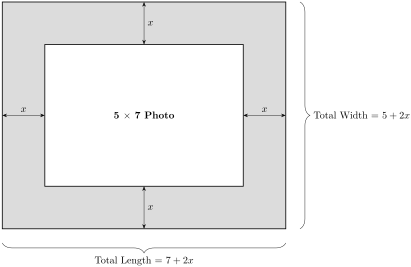
Imagine you are framing a picture for someone. The picture is 7 cm \(\times\) 5 cm, and you want to make a custom wood frame of uniform width \(x\) around all four sides. In terms of \(x\text{:}\)
Framed picture with dimensions
  1. What are the widths and height of the framed picture?
  2. What is the total area of the framed picture?
  3. What is the total area of the frame without the picture (in other words, how much wood do you need)?
  4. Write each of the expressions in standard form. Geometrically, what does the quadratic, linear and constant terms represent?

Key Takeaway 1.3.14. Quadratic expressions describe interacting growth.

Quadratic expressions are not just numbers; they describe multidimensional growth. In many real-life situations a quadratic term appears because two independent linear factors interact with each other.
A quadratic expression represents the accumulation of different types of growth in a single system:
  • The \(ax^2\) term captures the "compounding" or "area" effect where a change in \(x\) impacts the result in two directions at once (for example, the four corners of a frame or a change that affects both price and quantity).
  • The \(bx\) term captures linear growth, where a change in \(x\) affects only one dimension (for example, side strips of a frame).
  • The constant term represents the baseline or starting state before any changes were made.

Conclusion.

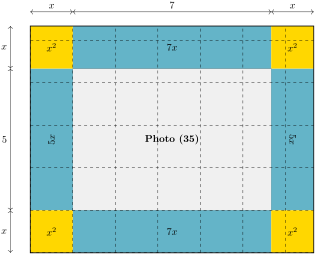
In the picture below we can see which parts of the expression correspond to the different areas of the frame. The four corners (yellow) represent the \(x^2\) term, the four sides (blue) represent the \(x\) term, and the photo (white) represents the constant term:
  • Area = \(4x^2 + 24x + 35\)
  • 1 photo: \(35 \text{ cm}^2\)
  • 4 sides: \(7x + 7x + 5x + 5x = 24x \text{ cm}^2\)
  • 4 corners: \(4x^2 \text{ cm}^2\)
Quadratic expression as area of a framed picture

Example 1.3.15.

A rectangular garden has a length of \((x + 4)\) metres and a width of \((x + 1)\) metres.
  1. Form an expression for the area of the garden.
  2. Write the expression in standard form.
Solution.
Area of a rectangle:
\begin{equation*} \text{Area} = \text{length} \times \text{width} \end{equation*}
Substitute the given expressions:
\begin{equation*} (x + 4)(x + 1) \end{equation*}
Expand:
\begin{equation*} x^2 + x + 4x + 4 \end{equation*}
\begin{equation*} = x^2 + 5x + 4 \end{equation*}
The area is expressed as a quadratic expression.

Example 1.3.16.

A local football league has \(n\) teams. Each pair of teams plays two matches: one at Team A’s home ground and one at Team B’s home ground. How many matches are played in total? Express your answer as a quadratic expression in \(n\text{.}\)
Solution.
Each of the \(n\) teams will play \(n-1\) matches in its home ground (one against each other team), because there are \(n-1\) other teams to play against (a team cannot play itself). So the total number of ordered matches is \(n(n-1)\) which expands to \(n^2 - n\text{.}\)

Example 1.3.17.

The product of two consecutive integers is formed.
  1. Represent the integers algebraically.
  2. Form the expression for their product.
  3. Write the result in standard form.
Solution.
Let the first integer be \(x\text{.}\) The next consecutive integer is \(x + 1\text{.}\)
Their product:
\begin{equation*} x(x + 1) \end{equation*}
Expand:
\begin{equation*} x^2 + x \end{equation*}
This is a quadratic expression.

Example 1.3.18.

A farmer wants to build a rectangular pen for goats. She has \(60\) metres of fencing and will use an existing wall as one side of the pen. If the width of the pen (perpendicular to the wall) is \(x\) metres:
  1. Express the length of the pen in terms of \(x\text{.}\)
  2. Form a quadratic expression for the area of the pen.
  3. Write the expression in standard form.
Solution.
Since the wall forms one side, the farmer only needs fencing for three sides: two widths and one length.
\begin{align*} 2x + \text{length} \amp= 60\\ \text{length} \amp= 60 - 2x \end{align*}
Finding the area of the rectangular pen:
\begin{align*} \text{Area} \amp= \text{length} \times \text{width}\\ \amp= (60 - 2x) \times x \end{align*}
Expanding:
\begin{align*} \amp= 60x - 2x^2 \end{align*}
Writing in standard form (with \(x^2\) term first):
\begin{align*} \amp= -2x^2 + 60x \end{align*}
This quadratic expression represents the area of the pen in square metres.
Exercises Exercises

1.
Form a quadratic expression for each situation and write your answer in standard form.
  1. The area of a rectangle with length \((x + 3)\) and width \((x + 2)\text{.}\)
  2. The product of a number and the number increased by \(5\text{.}\)
  3. The product of two numbers where one is \(x\) and the other is \((x - 4)\text{.}\)
  4. The area of a square with side length \((x + 6)\text{.}\)
  5. The area of a rectangle with length \((2x + 1)\) and width \((x + 4)\text{.}\)
  6. The product of two consecutive even numbers.
  7. A number is multiplied by three more than itself.
  8. The product of \((x - 7)\) and \((x + 2)\text{.}\)
  9. The area of a rectangular field whose length is \((x - 5)\) metres and width is \((x + 3)\) metres.
  10. The product of two numbers whose difference is \(4\text{,}\) if the smaller number is \(x\text{.}\)
  11. The area of a square whose side length is \((3x - 2)\text{.}\)
  12. The product of \((x + 1)\text{,}\) \((x + 2)\text{,}\) and \(x\text{.}\) (Expand fully.)
Solution.
  1. Expanding:
    \begin{align*} \text{Area} \amp= (x + 3)(x + 2)\\ \amp= x^2 + 2x + 3x + 6\\ \amp= x^2 + 5x + 6 \end{align*}
  2. Let the number be \(x\text{.}\) The number increased by \(5\) is \(x + 5\text{.}\)
    \begin{align*} \text{Product} \amp= x(x + 5)\\ \amp= x^2 + 5x \end{align*}
  3. Expanding:
    \begin{align*} \text{Product} \amp= x(x - 4)\\ \amp= x^2 - 4x \end{align*}
  4. Expanding:
    \begin{align*} \text{Area of square} \amp= (x + 6)^2\\ \amp= (x + 6)(x + 6)\\ \amp= x^2 + 6x + 6x + 36\\ \amp= x^2 + 12x + 36 \end{align*}
  5. Expanding:
    \begin{align*} \text{Area} \amp= (2x + 1)(x + 4)\\ \amp= 2x^2 + 8x + x + 4\\ \amp= 2x^2 + 9x + 4 \end{align*}
  6. Let the first even number be \(x\text{.}\) The next consecutive even number is \(x + 2\text{.}\)
    \begin{align*} \text{Product} \amp= x(x + 2)\\ \amp= x^2 + 2x \end{align*}
  7. Let the number be \(x\text{.}\) Three more than itself is \(x + 3\text{.}\)
    \begin{align*} \text{Product} \amp= x(x + 3)\\ \amp= x^2 + 3x \end{align*}
  8. Expanding:
    \begin{align*} \text{Product} \amp= (x - 7)(x + 2)\\ \amp= x^2 + 2x - 7x - 14\\ \amp= x^2 - 5x - 14 \end{align*}
  9. Expanding:
    \begin{align*} \text{Area} \amp= (x - 5)(x + 3)\\ \amp= x^2 + 3x - 5x - 15\\ \amp= x^2 - 2x - 15 \end{align*}
  10. The smaller number is \(x\text{.}\) The larger number (difference of \(4\)) is \(x + 4\text{.}\)
    \begin{align*} \text{Product} \amp= x(x + 4)\\ \amp= x^2 + 4x \end{align*}
  11. Expanding:
    \begin{align*} \text{Area of square} \amp= (3x - 2)^2\\ \amp= (3x - 2)(3x - 2)\\ \amp= 9x^2 - 6x - 6x + 4\\ \amp= 9x^2 - 12x + 4 \end{align*}
  12. Expanding in stages:
    \begin{align*} \text{Product} \amp= x(x + 1)(x + 2) \end{align*}
    First expand \((x + 1)(x + 2) = x^2 + 3x + 2\text{,}\) then multiply by \(x\text{:}\)
    \begin{align*} \amp= x(x^2 + 3x + 2)\\ \amp= x^3 + 3x^2 + 2x \end{align*}
2.
A mobile phone company is designing a new phone screen. The screen is rectangular with a length that is \(3\) cm more than twice the width. If the width of the screen is \(x\) cm:
  1. Write an expression for the length of the screen.
  2. Form a quadratic expression for the area of the screen.
  3. If the company adds a \(0.5\) cm border around the screen, write the new dimensions and form an expression for the total area including the border.
Solution.
  1. The length is \(3\) cm more than twice the width.
    \begin{equation*} \text{Length} = 2x + 3 \text{ cm} \end{equation*}
  2. Since \(\text{Area} = \text{length} \times \text{width}\text{:}\)
    \begin{align*} \text{Area} \amp= (2x + 3)(x)\\ \amp= 2x^2 + 3x \text{ square cm} \end{align*}
  3. A \(0.5\) cm border on each side adds \(1\) cm to both width and length.
    \begin{align*} \text{New width} \amp= x + 1 \text{ cm}\\ \text{New length} \amp= (2x + 3) + 1 = 2x + 4 \text{ cm} \end{align*}
    \begin{align*} \text{Total area} \amp= (x + 1)(2x + 4)\\ \amp= 2x^2 + 4x + 2x + 4\\ \amp= 2x^2 + 6x + 4 \text{ square cm} \end{align*}