Subsection 2.3.1 Properties of Rotation
Teacher Resource 2.3.2.
To assist your teaching, we have prepared lesson resources, aligned with this textbook and the CBC. The Lesson Plan links to syllabus learning outcomes and provides suggest time allocations. The Step-by-Step Guide provides more detailed guidance on how to teach the content, including suggested questions to ask learners, and possible answers.
Learner Experience 2.3.1.
(a)
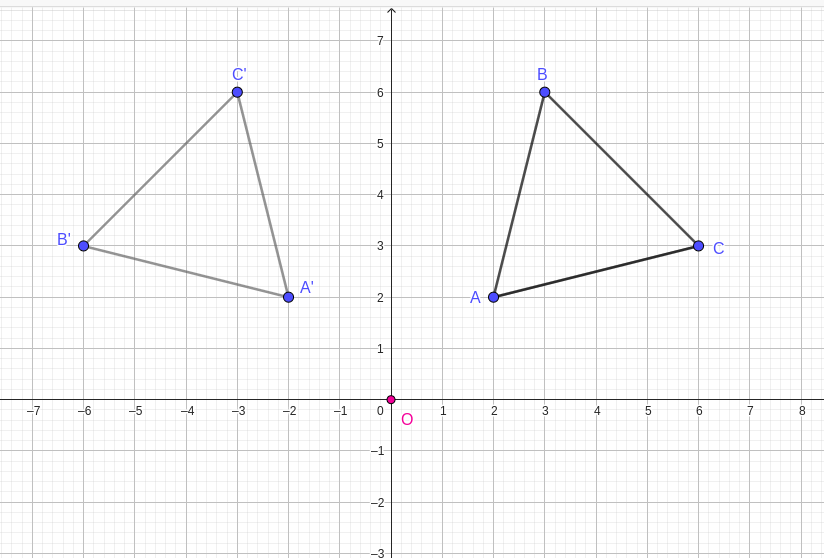
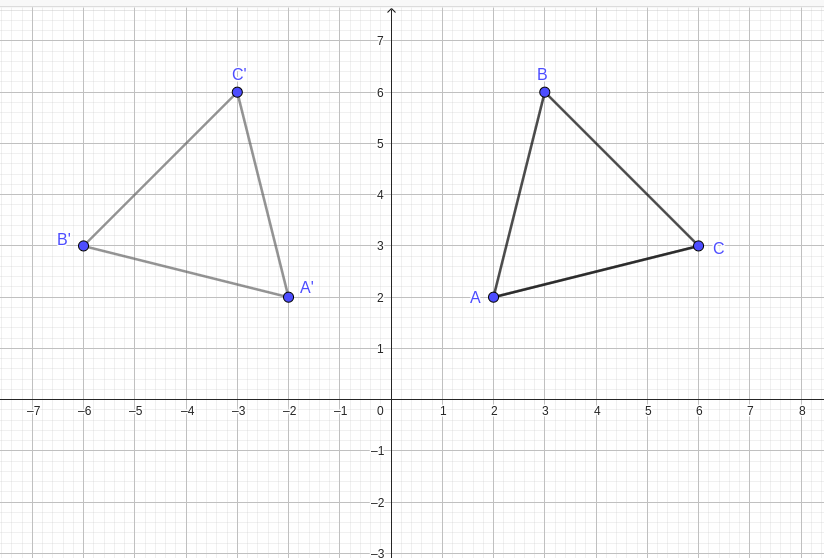
On a graph paper, draw triangle \(ABC\) and its image, triangle \(A'B'C'\) as shown in the figure below.

(b)
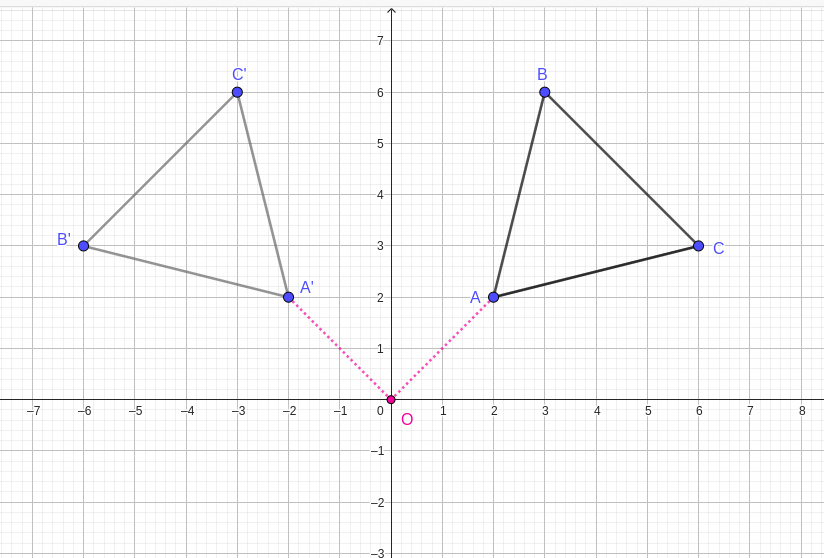
Pick a point on the graph to act as the centre of rotation. Mark this point \(O\)

(c)
Using a ruler, draw a straight line from point \(A\) to \(O\) and also from point \(A'\) to \(O\) as shown below. Measure the distance \(OA\) and \(OA'\) and record your results. What do you notice?

(d)
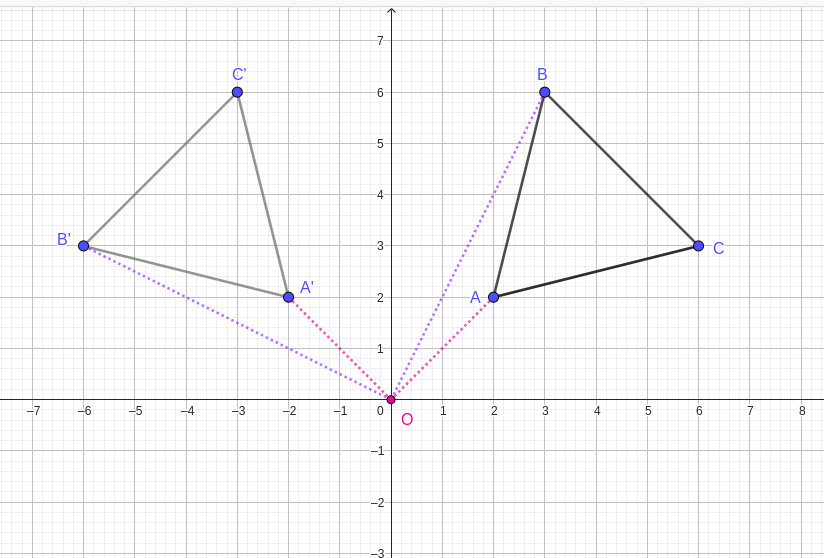
Similarly, draw a straight line from point \(B\) to \(O\) and also from point \(B'\) to \(O\text{.}\) Measure the distance \(OB\) and \(OB'\) and record your results. What do you notice?

(e)
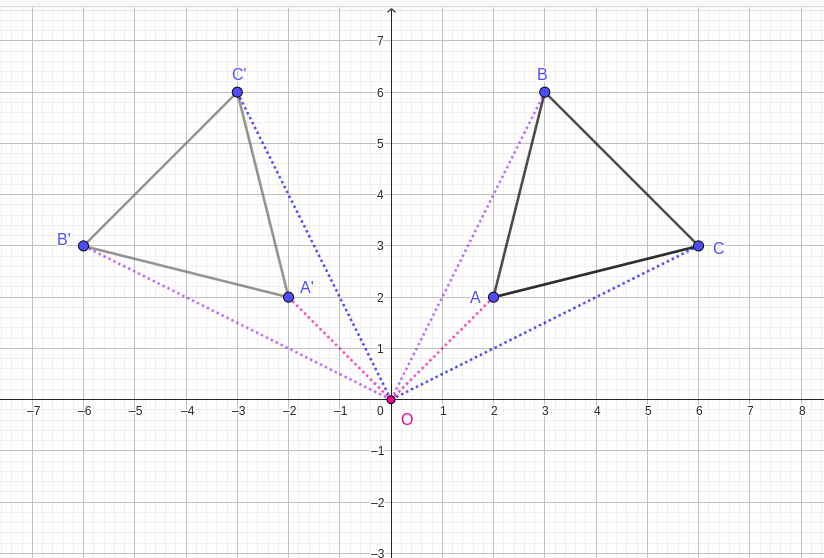
Finally, draw a straight line from point \(C\) to \(O\) and also from point \(C'\) to \(O\text{.}\) Measure the distance \(OC\) and \(OC'\) and record your results. What do you notice?

(f)
Now using a protractor, measure \(\angle\, AOA'\text{,}\) \(\angle\, BOB'\) and \(\angle\, COC'\) and record your results. What do you notice?
Exploration 2.3.2.
Instructions.
Follow the steps of your activity using this interactive board! Adjust the angle slider or drag the center of rotation \(O\text{.}\)
Use the checkboxes at the bottom left to systematically draw the lines from the vertices to the center \(O\text{.}\) Observe the text calculations at the bottom right to verify that the distance from the object to the center is exactly equal to the distance from the image to the center.
Key Takeaway 2.3.4.
The distance from a point to the centre of rotation is the same as the distance from the image of that point to the centre of rotation.
The angle of rotation is the same for all points in the shape.
In this case, Point \(O\) is the centre of rotation and angle \(90^\circ\) is the angle of rotation.
\(\textbf{Note:}\)
-
A rotation in the anticlockwise direction is taken to be positive i.e a rotation of \(45^\circ\) anticlockwise is \(+45^\circ\)
-
A rotation in the clockwise direction is taken to be negative i.e a rotation of \(45^\circ\) clockwise is \(-45^\circ\)
-
In general, for a rotation to be completely defined, the centre and angle of rotation must be stated.
Key Properties.
-
Centre stays fixed.
-
Distance from centre preserved (\(OA = OA'\)).
-
Angle of rotation same for all points.
-
Shape and size preserved (congruent).
-
Orientation preserved (unlike reflection).
Rotation Rules.
| Rotation | Rule |
|---|---|
| \(90Β°\) anticlockwise | \((x,y) \to (-y, x)\) |
| \(180Β°\) | \((x,y) \to (-x, -y)\) |
| \(270Β°\) anticlockwise / \(90Β°\) clockwise | \((x,y) \to (y, -x)\) |
| \(360Β°\) | \((x,y) \to (x, y)\) |
Finding the Centre of Rotation.
Perpendicular Bisector Method: Draw segment \(PP'\text{,}\) draw its perpendicular bisector, repeat for \(QQ'\text{,}\) the intersection is the centre of rotation.
Misconception Alert: βRotation about the ORIGIN is simpler. Rotation about other centres requires translation first.β
Example 2.3.6.
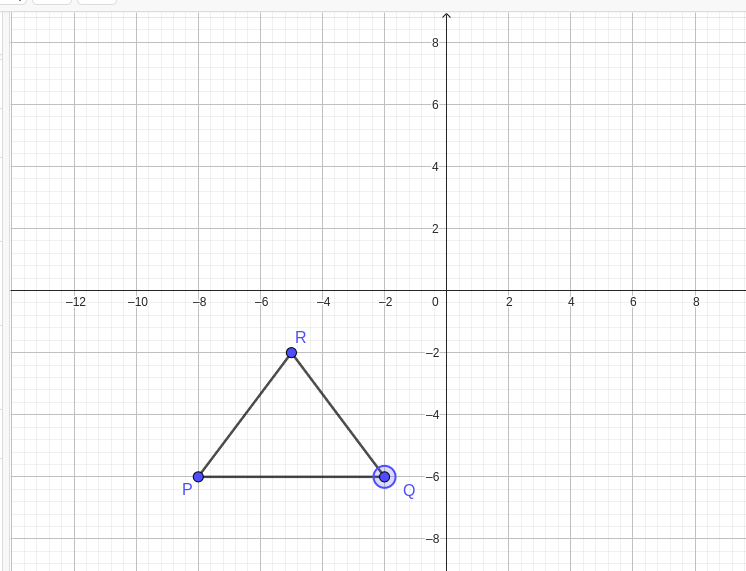
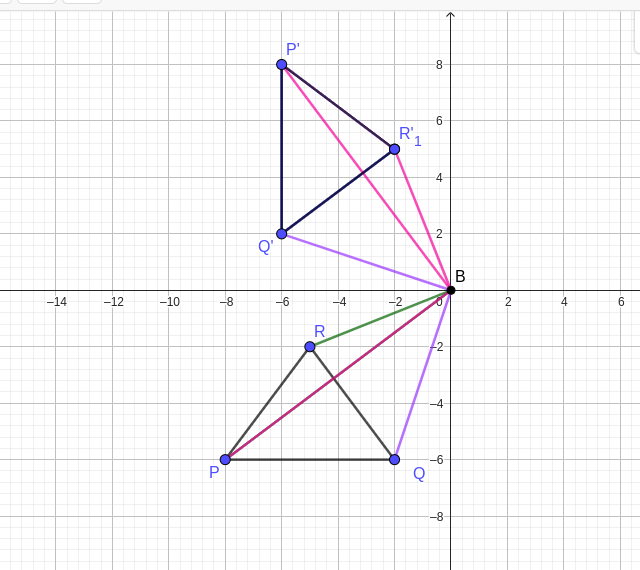
The coordinates of the vertices for triangle \(PQR\) that can be graphed in the coordinate plane are \((-8,-6)\text{,}\) \((-2,-6)\) and \((-5,-3)\) as shown below. The triangle is rotated through \(90^\circ\) in a clockwise direction about the origin to produce triangle \(P'Q'R'\text{.}\)Copy the figure and draw triangle \(P'Q'R'\)

Checkpoint 2.3.9.
Exercises Exercises
1.
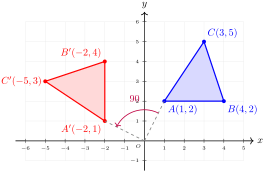
Triangle \(ABC\) has vertices \(A(1,2)\text{,}\) \(B(4,2)\text{,}\) and \(C(3,5)\text{.}\) Rotate the triangle \(90Β°\) anticlockwise about the origin. State the coordinates of the image \(A'B'C'\) and verify that the distance from the origin is preserved.
Solution.
Using the rotation rule for \(90Β°\) anticlockwise about the origin: \((x, y) \to (-y, x)\text{.}\)
\begin{align*}
A(1, 2) \amp\to A'(-2, 1)\\
B(4, 2) \amp\to B'(-2, 4)\\
C(3, 5) \amp\to C'(-5, 3)
\end{align*}
Verifying that distances from the origin are preserved:
\begin{align*}
OA \amp= \sqrt{1^2 + 2^2} = \sqrt{5}\\
OA' \amp= \sqrt{(-2)^2 + 1^2} = \sqrt{5} \checkmark
\end{align*}
\begin{align*}
OB \amp= \sqrt{4^2 + 2^2} = \sqrt{20} = 2\sqrt{5}\\
OB' \amp= \sqrt{(-2)^2 + 4^2} = \sqrt{20} = 2\sqrt{5} \checkmark
\end{align*}
\begin{align*}
OC \amp= \sqrt{3^2 + 5^2} = \sqrt{34}\\
OC' \amp= \sqrt{(-5)^2 + 3^2} = \sqrt{34} \checkmark
\end{align*}
In each case, the distance from the origin to the image point equals the distance from the origin to the original point, confirming the distance-preserving property of rotation.
2.
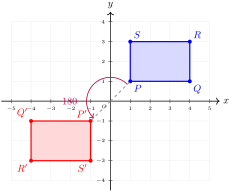
Rectangle \(PQRS\) has vertices \(P(1,1)\text{,}\) \(Q(4,1)\text{,}\) \(R(4,3)\text{,}\) and \(S(1,3)\text{.}\) Rotate the rectangle \(180Β°\) about the origin. State the coordinates of the image \(P'Q'R'S'\) and verify that the distance from the origin is preserved.
Solution.
\begin{align*}
P(1, 1) \amp\to P'(-1, -1)\\
Q(4, 1) \amp\to Q'(-4, -1)\\
R(4, 3) \amp\to R'(-4, -3)\\
S(1, 3) \amp\to S'(-1, -3)
\end{align*}
Verifying that distances from the origin are preserved:
\begin{align*}
OP \amp= \sqrt{1^2 + 1^2} = \sqrt{2}\\
OP' \amp= \sqrt{(-1)^2 + (-1)^2} = \sqrt{2} \checkmark
\end{align*}
\begin{align*}
OQ \amp= \sqrt{4^2 + 1^2} = \sqrt{17}\\
OQ' \amp= \sqrt{(-4)^2 + (-1)^2} = \sqrt{17} \checkmark
\end{align*}
The distances are preserved for every vertex, confirming the property of rotation. Note also that the shape and size of the rectangle are unchanged β \(PQRS\) is congruent to \(P'Q'R'S'\text{.}\)