Subsection 2.8.2 Volume of Prisms
Teacher Resource 2.8.8.
To assist your teaching, we have prepared lesson resources, aligned with this textbook and the CBC. The Lesson Plan links to syllabus learning outcomes and provides suggest time allocations. The Step-by-Step Guide provides more detailed guidance on how to teach the content, including suggested questions to ask learners, and possible answers.
The volume of a three-dimensional shape is the amount of space it occupies, measured in cubic units (like cmΒ³, mΒ³). A prism is a solid with two identical parallel faces called bases, and flat faces connecting corresponding edges of the bases.
In this section, we explore how to calculate the volume of prisms by using the area of the base and the height of the prism. We begin with rectangular and triangular prisms, then extend the idea to any prism.
A key principle is that the volume of a prism depends on the area of its base and how βdeepβ that base extends in space.
Learner Experience 2.8.2.
Materials: Grid/graph paper, ruler and a paper made one unit cube (or square cut-outs)
Instructions:
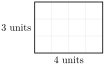
Consider the rectangular base below:
-
Count the number of unit squares in the base.
-
Verify your answer using multiplication.
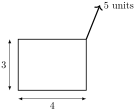
Now imagine stacking identical layers to form a prism of height \(5\) units.
-
How many layers are stacked?
-
How many unit cubes are in the entire prism?
-
Verify your answer using multiplication.
What relationship do you observe between:
-
Area of the base,
-
Height of the prism, and
-
Total number of unit cubes in the prism?
Key Takeaway 2.8.9.
The number of unit cubes that fit inside a prism depends on the area of the base and the height (depth) of the prism.
For any prism:
\begin{equation*}
\textbf{Volume} = \text{Area of base} \times \text{Height}
\end{equation*}
This formula works regardless of the shape of the base (rectangle, triangle, or any polygon), as long as the cross-section is constant along the height.
Example 2.8.10.
Find the volume of a triangular prism whose base is a triangle with area \(12\ \text{cm}^2\) and height \(10\ \text{cm}\text{.}\)
Example 2.8.11.
Finding the volume of a triangular prism.
Solution.
Step 1: Find the area of the base
\begin{align*}
\textbf{area of triangle =}\amp \frac{1}{2}b \times h\\
= \amp \frac{1}{2} \times 9\, \text{cm} \times 12 \, \text{cm} \\
= \amp 54 \, \text{cm}^2
\end{align*}
Step 2: Multiply the area of the base by the height of the solid to find the volume
\begin{align*}
\text{Volume} = \amp \text{Base Area} \times \text{height}\\
= \amp \frac{1}{2}b \times h \times H\\
= \amp 54 \, \text{cm}^2\times 25\, \text{cm} \\
= \amp 1350 \, \text{cm}^3
\end{align*}
The volume of the triangular prism is \(1350 \, \text{cm}^3\)
Now letβs extend this to a prism with any polygon as a base.
Example 2.8.12.
A pentagonal prism has a base area of \(20\ \text{m}^2\) and a height of \(7\ \text{m}\text{.}\) Find its volume.
Example 2.8.13.
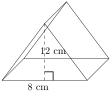
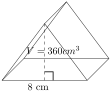
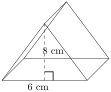
Find the volume of the triangular prism below.
Solution.
Step 1: Find the area of the base.
\begin{align*}
\text{area of a triangle} = \amp \frac{1}{2} b\, \times \,h\\
= \amp \frac{1}{2} \times 8 \text{cm} \times 12\, \text{cm} \\
= \amp 48\, \text{cm}^2
\end{align*}
Step 2: Multiply the area of the base by the height of the solid to find the volume
\begin{align*}
\text{volume} = \amp \text{area of base} \times \text{height}\\
= \amp \frac{1}{2} b \times h \times H\\
= \amp 48 \,\text{cm}^2 \times 12\, \text{cm} \\
= \amp 576\, \text{cm}^3
\end{align*}
The volume of the triangular prism is\(\, 576 \, \text{cm}^3\)
Exercises Exercises
1.
A triangular prism has base triangle area \(15 \, \text{cm}^2\) and height \(9 \, \text{cm}\text{.}\) Find its volume.
2.
The area of the base of a prism is \(18 \, \text{m}^2\) and its height is \(12 \, \text{m}\text{.}\) Find the volume.
3.
A prism has a volume of \(200 \, \text{cm}^3\) and a height of \(10 \, \text{cm}\text{.}\) Find the area of the base.
4.
A prism has a volume of \(500 \, \text{m}^3\) and a base area of \(25 \, \text{m}^2\text{.}\) Find the height of the prism.
5.
A triangular prism has vertices at (0,0), (4,0) and (0,3). If the height of the prism is \(15\) units, find its volume.
6.
A prism has a base area \((x^2 + 4x) \, \text{cm}^2\) and height \((x + 3) \, \text{cm}\text{.}\) Write an algebraic expression for its volume.
7.
A triangular prism has base triangle area \((2x - 3) \, \text{m}^2\) and height \(4 \, \text{m}\text{.}\) Form the expression for its volume.
8.
A rectangular greenhouse measures \(15 \, \text{m}\) long, \(8 \, \text{m}\) wide and \(3 \, \text{m}\) high. Find the volume of air inside the greenhouse.
9.
A solid block of wood is in the shape of a prism. Its triangular base has area \(24 \, \text{cm}^2\) and the prism height is \(18 \, \text{cm}\text{.}\) Find its volume.
10.
A triangular prism has a volume of 360 cmΒ³. The base of the triangular cross-section is 10 cm, and the height of the triangle is 9 cm. Find the length of the prism.
11.
A water trough is in the shape of a triangular prism. The triangular cross-section has a base of 10 cm and a height of 12 cm. The trough is 2 meters long. How much water can it hold in liters? (Hint: 1 cmΒ³ = 1 mL, and 1,000 mL = 1 L)
12.
A triangular prism has a triangular base with a base length of 8 cm and a height of 6 cm. Find the total volume of the solid.
13.
A company manufactures Toblerone-shaped chocolate bars, which are shaped like triangular prisms. Each bar has a triangular cross-section with a base of 5 cm and a height of 4 cm, and the length of the chocolate bar is 30 cm. Find the volume of a single chocolate bar. If 100 bars are packed into a box, what is the total volume of chocolate in the box?
14.
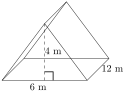
An architect designs a triangular prism-shaped roof for a house. The triangular cross-section has a base of 6 m and a height of 4 m. The length of the roof is 12 m. Calculate the total volume of the roof structure.