Subsection 2.5.1 Area of Triangles

Learner Experience 2.5.2.

Building a Triangle Garden.
Working in groups of 3-5 students.
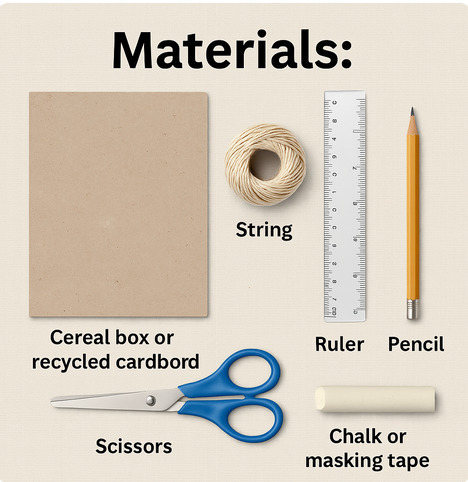
\(\textbf{Materials needed:}\)
  1. Preferably conduct this activity outside on sand or cement, or inside with tape/string.
    • Ensure you have a rectangle (or square) drawn with chalk/tapeβ€”e.g. 60 cm Γ— 40 cm.
    • Can you use string to form a triangle that perfectly fits inside this rectangle?
    • Can you make the triangle cover exactly half of the space?
    • Use a string from corner to corner, or make triangles by connecting midpoints.
    • Take a manilla paper or cardboard. Draw a rectangle (e.g. 10 cm by 6 cm).
    • Cut along a diagonal to get two right triangles. Rearrange the two triangles to form a rectangle again.
    • Now try : Drawing a triangle with the same base and height, but different shape (scalene, obtuse). Cut and rearrange it against the original rectangle.
  2. On the board or chart, formulate the rule:
    • If the area of a rectangle is base Γ— height, and the triangle is always half of it, What will be the formula of a triangle?
    • Write it down together in your groups.
\(\textbf{Review of properties of a triangle}.\)
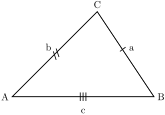
  • A triangle is a three-sided polygon with three angles which add up to \(180^\circ \) and three vertices.
  • \(\textbf {Key Properties of a Triangle}\)
    ♦ A triangle has three Sides and Three Angles.
    ♦ A triangle has three edges and three vertices (corner points).
    ♦ Angle Sum Property - The sum of all three interior angles of a triangle adds up to 180Β°.
  • \(\displaystyle \textbf{Types of Triangles (by Sides).}\)
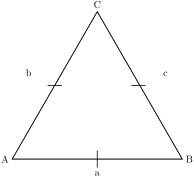
    πŸ”Ή \(\textbf {Equilateral Triangle}\) - All sides of the triangle are equal and have an angle of 60Β° each.
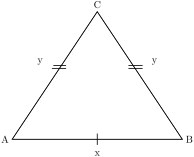
    πŸ”Ή \(\textbf {Isosceles Triangle}\) - Two sides of the triangle are equal, and the angles opposite these sides are also equal.
    πŸ”Ή \(\textbf {Scalene Triangle}\) - All three sides of the triangle have different lengths, and all angles are different.
  • \(\text{Types of Triangles (by Angles).}\)
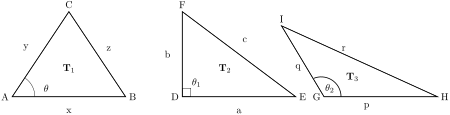
    πŸ”Ή \(\textbf {Acute-Angled Triangle} (T_1)\) - All three angles are less than 90Β°.
    πŸ”Ή \(\textbf {Right-Angled Triangle}(T_2)\) - One angle is exactly 90Β°.
    πŸ”Ή \(\textbf {Obtuse-Angled Triangle}(T_3)\) - One angle is greater than 90Β° but less than \(180 \circ .\)

Example 2.5.2.

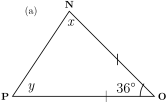
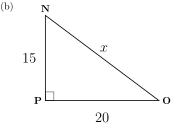
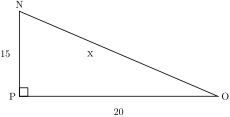
Calculate the unknown variables in each of the following figures
Solution.
(a) An isosceles triangle has two angles that are equal. Sum of interior angles of triangle is \(180 ^\circ\)
\begin{align*} = \amp 180^\circ - 36^\circ \\ = \amp 144^\circ \\ = \amp \frac{144^ \circ}{2} \\ = \amp 72^ \circ \end{align*}
Therefore \(x = 72 ^\circ \) , \(y = 72^ \circ \)
(b) To find \(x\) we use pythagorean relationship.
\begin{equation*} a^2 + b^2 = c^2 \end{equation*}
In our case our \(c\) is \(x\)
\begin{equation*} 20^2 + 15^2 = c^2 \end{equation*}
\begin{equation*} 400 + 225 = 625 \end{equation*}
\begin{equation*} =\sqrt{625} \end{equation*}
\begin{equation*} = 25 \,\text{cm} \end{equation*}

Subsubsection 2.5.1.1 Using Two Sides and an Angle

Learner Experience 2.5.3.

  1. What you require:
  2. \(\textbf {Identify the Tall Object }\text{.}\)
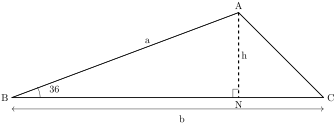
    • Choose a tree, flagpole, or lamp post as the vertical height (like \(A\) in the diagram below).
    • The ground acts as the base \((BC)\text{.}\)
  3. \(\textbf {Find the Shadow Length}\)
    • Measure the length of the shadow cast by the object on the ground (\(BC\)).
    • This represents the long horizontal base in the diagram.
  4. \(\textbf {Measure the Angle of Elevation}\)
    • Stand some distance away and use a protractor or a phone app to measure the angle of elevation from your eyes to the top of the object.
    • This represents the \(30^ \circ \) angle at \(B\) in the diagram.
    • If no protractor is available, use similar triangles by measuring the shadow of a known object (like a stick) and comparing proportions.
  5. Discuss your findings with your group members.
    • \(\textbf{Apply Trigonometry Using Sine}\)
      Using the sine function to calculate the height of the object \(AN\text{.}\)
      Drop a perpendicular line from Point A to meet line BC at N .
    • Formula:
      \begin{align*} Height (AN) = \amp \text{Hypotenuse(AB)} \times \text{ sin }30^ \circ \end{align*}
    • AN is therefore the height for triangle ABC.
    • In a triangle \(\text{sin} \, \theta = \frac{\text{Opposite}}{\text{Hypotenuse}}\text{.}\)
      From the figure shown above, Opposite = AN, the height of triangle ABN whereas the hypotenuse i \(AB\) is the longest side of a triangle.
      Where \(AN\) = \(\textbf{h}\) and \(BA\) = \(\textbf{a}\)
      \begin{align*} \text{In triangle ABN, sin}30^ \circ = \amp \frac{AN}{a} \\ \text{sin } 30^ \circ = \amp \frac{\textbf{h}}{\textbf{a}} \\ \text{ height of }\angle \text{ABC} \, \textbf{h} = \amp \textbf{a} \, \text{sin } 30^ \circ \\ \text{ Since sin } 30^ \circ = 1/2 \textbf{a} \end{align*}
    • Area of Triangle ABC will be:
      \begin{align*} \triangle \, ABC = \amp \frac{1}{2} \times \text {Base}\, \textbf{ (b)} \times \text { Height}\, \textbf{(h)} =\textbf{a} \,\text{sin}\theta \\ = \amp \frac{1}{2} \, \textbf{ ab } \, \textbf{ sin } \, \theta \end{align*}
♦ Generally, if the lengths of the two sides and an included angle of a triangle are given, then the area of the triangle is \(\text{A} = \frac{1}{2}\textbf{ab}\textbf{sin}\theta\text{.}\) Where \(\textbf{ b } \text{is the base and } \textbf{ h } \text{ height.}\)

Key Takeaway 2.5.4.

Deriving the Formula: \(\frac {1}{2}ab\, \text{sin C} \)
  1. Step 1: Let’s recall the Basic Formula for finding area of a triangle.
    • Area = \(\frac {1}{2} \times \text {Base} \times \text {Height}\)
  2. Step 2: Consider a Triangle with an Angle
    • Let’s take a triangle ABC with sides \(a \text{,}\) \(b \) and included angle \(C\text{.}\)
    • Side\(\, a\) and Side \(b\) form the triangle.
    • The height \(h\) is perpendicular from the top vertex to the base.
  3. Step 3: Express Height in Terms of Sin
    • Using trigonometry, we know that in a right-angled triangle:
    • \(\displaystyle \text{sin} \,\theta = \frac{\text{Hypotenuse}}{\text{Opposite}}\)
    • In our case, the height \(h\) is the \(\textbf{opposite side}\) of angle \(C\text{,}\) and side \(b\) is the \(\textbf{hypotenuse}\text{.}\)
    • So, we can write it as:
      \(h = b \text{ sin} \, C\)
  4. Step 4: Substitute into the Area Formula
    • Now, take the basic Formula for finding area of a triangle;
    • Substituting \(\textbf{Base}\) and \(\textbf{Height} = \text{b sin C} \) .
      \begin{align*} \text{Area} =\amp \frac {1}{2} \times a \times \text{(b sin C)}\\ \text{Area} = \amp \frac {1}{2} ab \, \text{ sin C} \end{align*}

Example 2.5.5.

A triangle FGH has sides \(FG=10 \text{ cm}, GH=7, \text{ cm and } \angle FGH = 65^\circ\text{.}\) Find the area of the triangle in \(2 \, \text{dp}\text{?}\)
Solution.
Using the formula \(\text{Area} = \frac{1}{2} ab \sin C\text{,}\) where \(a = 10\text{,}\) \(b = 7\text{,}\) and \(C = 65^\circ\text{:}\)
\begin{align*} \text{Area} \amp = \frac{1}{2} \times 10 \times 7 \times \sin(65^\circ) \\ \amp = 35 \times 0.9063 \\ \amp = 31.72\, \text{cm}^2 \end{align*}

Example 2.5.6.

The area of triangle ABC is \(28.1 \text{cm}^2\) . It’s side AB \(= 7.2 \text{cm} \) and \(\angle\) ABC \(= 48.6^\circ\text{.}\) Find:
  1. The length BC?
  2. The perpendicular height from vertex C to line AB?
Solution.
  1. Using the formula \(\text{Area} = \frac{1}{2} ab \sin C\text{,}\) where \(a = 7.2\text{,}\) \(b = BC\text{,}\) and \(C = 48.6^\circ\text{:}\)
    \begin{align*} 28.1 \amp = \frac{1}{2} \times 7.2 \times b \times \sin(48.6^\circ) \\ \amp = 3.6 \times b \times \sin(48.6^\circ)\\ \amp = 3.6 \times b \times 0.7501\\ \amp = 2.70036 \times b\\ \amp = 28.1\\ b \amp = \frac{28.1}{2.70036} = 10.4\, \text{cm} \end{align*}
  2. To find the perpendicular height from vertex C to line AB, we use the area formula again by taking AB to be the base and calculate the height.
    \begin{align*} 28.1 \amp = \frac{1}{2} \times 7.2 \times h\\ \amp = 3.6 \times h\\ h \amp = \frac{28.1}{3.6} = 7.8\, \text{cm} \end{align*}
Therefore the length of BC is \(10.4\) cm and the perpendicular height from vertex C to line AB is \(7.8\) cm.

Exercises Exercise

1.
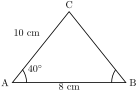
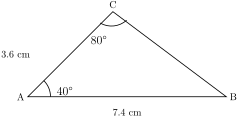
In \(\triangle \textbf{ABC}\text{,}\) \(\angle \textbf{BAC} = 40^\circ\text{,}\) \(\text{side} BC = 10\) cm, and side \(\textbf{AB} = 8 \)cm. Find it’s area.
Answer.
Area of \(\triangle ABC = 25.71 \text{ cm}^2\)
2.
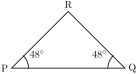
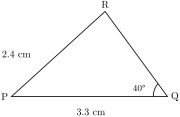
Find the area of the triangle below given that length \(RQ = 10\text{ cm}\text{.}\)
Answer.
\(\text{Area} = 49.73\text{ cm}^2 \text{ to 2 decimal places}\)
3.
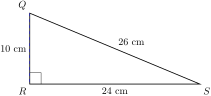
In \(\triangle QRS\text{,}\) \(QR = 10\) cm, \(RS = 24\) cm and \(QS = 26\) cm. Find the length of the perpendicular from vertex \(Q\) to side \(RS\text{.}\) Hence find its area.
Solution.
First, check whether the triangle is right-angled:
\begin{align*} QR^2 + RS^2 \amp = 10^2 + 24^2 = 100 + 576 = 676\\ QS^2 \amp = 26^2 = 676 \end{align*}
Since \(QR^2 + RS^2 = QS^2\text{,}\) by the converse of Pythagoras’ theorem, the triangle is right-angled at \(R\text{.}\)
Since \(\angle QRS = 90^\circ\text{,}\) \(QR\) is perpendicular to \(RS\text{.}\) Therefore the perpendicular from \(Q\) to side \(RS\) is \(QR = 10\) cm.
\begin{align*} \text{Area} \amp = \frac{1}{2} \times RS \times QR\\ \amp = \frac{1}{2} \times 24 \times 10\\ \amp = 120\,\text{cm}^2 \end{align*}
4.
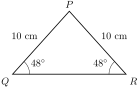
\(\triangle PQR\) is isosceles with \(PQ = PR = 10\) cm. The base angle is \(48^\circ\text{.}\) Find its area.
Solution.
Since the triangle is isosceles with \(PQ = PR = 10\) cm and base angles of \(48^\circ\text{,}\) the apex angle at \(P\) is:
\begin{align*} \angle QPR \amp = 180^\circ - 48^\circ - 48^\circ = 84^\circ \end{align*}
Using the area formula with the two equal sides and the included apex angle:
\begin{align*} \text{Area} \amp = \frac{1}{2} \times PQ \times PR \times \sin(\angle QPR)\\ \amp = \frac{1}{2} \times 10 \times 10 \times \sin 84^\circ\\ \amp = 50 \times 0.9945\\ \amp = 49.73\,\text{cm}^2 \end{align*}
5.
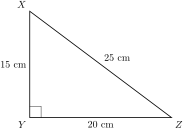
\(\triangle XYZ\) has side \(XY = 15\) cm, \(YZ = 20\) cm, and \(XZ = 25\) cm. Show that this is a right-angled triangle and find its area.
Solution.
Check whether the sides satisfy Pythagoras’ theorem. The longest side is \(XZ = 25\) cm.
\begin{align*} XY^2 + YZ^2 \amp = 15^2 + 20^2 = 225 + 400 = 625\\ XZ^2 \amp = 25^2 = 625 \end{align*}
Since \(XY^2 + YZ^2 = XZ^2\text{,}\) by the converse of Pythagoras’ theorem, the triangle is right-angled at \(Y\text{.}\)
The two shorter sides are the base and height:
\begin{align*} \text{Area} \amp = \frac{1}{2} \times XY \times YZ\\ \amp = \frac{1}{2} \times 15 \times 20\\ \amp = 150\,\text{cm}^2 \end{align*}
6.
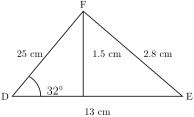
Determine the unknown angles and sides in the figures below
Answer.
  1. \(\angle ABC = 60^\circ\)
    Length \(BC = 2.7\) cm
  2. \(\angle PRQ = 62.1^\circ\)
    \(\angle RPQ = 77.9^\circ\)
    Length \(RQ = 3.7\) cm
  3. \(\angle DEF = 32.4^\circ\)
    \(\angle DFE = 115.6^\circ\)
  4. \(ON = 25\) units
    \(\angle PON = 36.9^\circ\)
    \(\angle ONP = 53.1^\circ\)

Subsubsection 2.5.1.2 Heron’s Formula

Learner Experience 2.5.4.

Pair up students and give each pair a triangular surface to measure. This could be:
  • A triangular classroom table
  • A triangular signboard
  • A triangular cutout from paper
  • A drawn triangle on graph paper
    \(\textbf{Materials needed.}\)
  • Ruler
  • Graph paper
  • Calculator
  • String or measuring tape
  • Pre-cut paper triangles (optional)
    1. Recall the Standard Triangle Area Formula
      • How do we find the area of a triangle?
        Expected answer ; \(a = \frac{1}{2} \times \text{base} \times \text{height}\)
      • This method works only when we know the height.
      • \(\textbf{What if we don’t know the height?}\) Today, they will discover how to find the area \(\textbf{only using side lengths}\text{.}\)
    2. Construct a Triangle and Introduce Semi-Perimeter
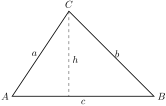
      • Draw a triangle with sides labeled as \(\textbf{a, b} \, \text{and} \, \textbf{c}\text{.}\) Using a ruler or measuring tape, measure the \(\textbf{three sides of the triangle}\) and record the lengths.
      • Measure and calculate the semi-perimeter using:
        \begin{align*} S = \amp \frac{a+b+c} {2} \end{align*}
        This helps divide the triangle into manageable parts for the area calculation.
    3. Express the\(\textbf{ Area} \) in Terms of the \(\textbf{Semi-Perimeter.}\)
      • Use the right-angle criteria.i.e:
        \(\textbf{Drop a perpendicular}\) from \(\textbf{one vertex to the opposite side}\) (splitting the triangle into two right-angled triangles).
        Let’s call the base \(\textbf{b}\) and split it into two parts using the perpendicular.
      • Use the \(\textbf{Pythagorean Theorem}\) to express the height \(h\) in terms of \(\textbf{ a, b, c}.\)
        Instead of solving fully, guide students to realize that the height can be found using algebraic manipulation.
      • Introduce the \(\textbf{squared form}\) and take the \(\textbf{square root}\text{:}\)
        \begin{align*} A= \amp \sqrt{S(S-a)(S-b)(S-c)} \end{align*}
      • This is the final area using Heron’s Formula.
      • In conclusion, Heron’s Formula is finding the area of any triangle using only its sides.

Key Takeaway 2.5.7.

We know that the area of a triangle can be calculated using:
\begin{equation*} \textbf{Area} = \frac{1}{2} \times \text{base} \times \text{height} \end{equation*}
Consider a triangle with sides \(a\text{,}\) \(b\text{,}\) and \(c\text{.}\) Let side \(c\) be the base and drop a perpendicular height \(h\text{.}\)
Then:
\begin{equation*} \textbf{Area} = \frac{1}{2} c h \end{equation*}
Using Pythagoras’ Theorem on the two right triangles formed, we can express \(h\) in terms of \(a\text{,}\) \(b\text{,}\) and \(c\text{.}\)
After algebraic manipulation and simplification, the area can be written purely in terms of the three sides.
Let the semi-perimeter be:
\begin{equation*} s = \frac{a + b + c}{2} \end{equation*}
Substituting and simplifying leads to:
\begin{equation*} \textbf{Area} = \sqrt{s(s-a)(s-b)(s-c)} \end{equation*}
This result is known as Hero’s Formula. It allows us to calculate the area of any triangle when all three sides are known, without needing the height.

Example 2.5.8.

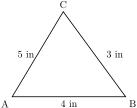
If the length of the sides of a triangle \(ABC\) are \(5\) inches, \(5\) inches and \(3\) inches. Calculate its area using the heron’s formula.
triangle
Solution.
To find: Area of the triangle \(ABC\text{.}\)
Given that AB \(= 3\) in, BC \(= 5\) in, AC \(= 5\) in.
Using Heron’s Formula,
\begin{align*} A \amp = \sqrt{s(s - a)(s - b)(s - c)} \end{align*}
\begin{align*} s \amp = \frac{a + b + c}{2} \end{align*}
\begin{align*} s \amp = \frac{5+5+3}{2} \end{align*}
\begin{align*} \amp = \frac{13}{2} \, \text{in} \end{align*}
Substitute in the values,
\begin{align*} A \amp = \sqrt{\frac{13}{2}\left(\frac{13}{2} - 5\right)\left(\frac{13}{2} - 5\right)\left(\frac{13}{2} - 3\right)} \end{align*}
\begin{align*} A \amp = \sqrt{\frac{13}{2} \times \frac{3}{2} \times \frac{3}{2} \times \frac{7}{2}} \end{align*}
\begin{align*} A \amp = \sqrt{\frac{819}{16}} \end{align*}
\begin{align*} \amp = \frac{3\sqrt{91}}{4} \approx 7.15 \, \text{in}^2 \end{align*}
The area of the triangle is \(\frac{3\sqrt{91}}{4} \approx 7.15 \, \text{in}^2\text{.}\)

Exercises Exercises

1.
A right-angled triangle has sides \(9\) cm, \(12\) cm and \(15\) cm.
(a) Verify that the triangle satisfies the Pythagorean relationship.
(b) Find its area using both the standard formula and Heron’s formula, and confirm the answers agree.
Answer.
Area \(= 54 \, \text{cm}^2\)
Solution.
(a) Check: \(9^2 + 12^2 = 81 + 144 = 225 = 15^2\text{.}\) The triangle is right-angled.
(b) Standard formula: Taking the two shorter sides as base and height,
\begin{align*} A \amp = \frac{1}{2} \times 9 \times 12 = 54 \, \text{cm}^2 \end{align*}
Heron’s formula: Let \(a = 9\text{,}\) \(b = 12\text{,}\) \(c = 15\text{.}\)
\begin{align*} s \amp = \frac{9 + 12 + 15}{2} = 18 \end{align*}
\begin{align*} A \amp = \sqrt{s(s-a)(s-b)(s-c)}\\ \amp = \sqrt{18(18-9)(18-12)(18-15)}\\ \amp = \sqrt{18 \times 9 \times 6 \times 3}\\ \amp = \sqrt{2916}\\ \amp = 54 \, \text{cm}^2 \end{align*}
Both methods give the same area of \(54 \, \text{cm}^2\text{.}\)
2.
Find the area of a triangle with sides \(7\) cm, \(8\) cm and \(9\) cm using Heron’s formula.
Answer.
\(12\sqrt{5} \approx 26.83 \, \text{cm}^2\)
Solution.
Let \(a = 7\text{,}\) \(b = 8\text{,}\) \(c = 9\text{.}\)
\begin{align*} s \amp = \frac{7 + 8 + 9}{2} = 12 \end{align*}
\begin{align*} A \amp = \sqrt{s(s-a)(s-b)(s-c)}\\ \amp = \sqrt{12(12-7)(12-8)(12-9)}\\ \amp = \sqrt{12 \times 5 \times 4 \times 3}\\ \amp = \sqrt{720}\\ \amp = 12\sqrt{5} \approx 26.83 \, \text{cm}^2 \end{align*}
3.
An equilateral triangle has side length \(10\) cm. Use Heron’s formula to find its area.
Answer.
\(25\sqrt{3} \approx 43.30 \, \text{cm}^2\)
Solution.
Since the triangle is equilateral, \(a = b = c = 10\text{.}\)
\begin{align*} s \amp = \frac{10 + 10 + 10}{2} = 15 \end{align*}
\begin{align*} A \amp = \sqrt{15(15-10)(15-10)(15-10)}\\ \amp = \sqrt{15 \times 5 \times 5 \times 5}\\ \amp = \sqrt{1875}\\ \amp = 25\sqrt{3} \approx 43.30 \, \text{cm}^2 \end{align*}
4.
A triangular plot of land has sides measuring \(50\) m, \(65\) m and \(75\) m. Find the area of the land using Heron’s formula.
Answer.
\(\approx 1620.19 \, \text{m}^2\)
Solution.
Let \(a = 50\text{,}\) \(b = 65\text{,}\) \(c = 75\text{.}\)
\begin{align*} s \amp = \frac{50 + 65 + 75}{2} = 95 \end{align*}
\begin{align*} A \amp = \sqrt{95(95-50)(95-65)(95-75)}\\ \amp = \sqrt{95 \times 45 \times 30 \times 20}\\ \amp = \sqrt{2\,565\,000}\\ \amp \approx 1620.19 \, \text{m}^2 \end{align*}
5.
An isosceles triangle has two equal sides of length \(13\) cm and a base of \(10\) cm. Find its area using Heron’s formula.
Answer.
\(60 \, \text{cm}^2\)
Solution.
Let \(a = 13\text{,}\) \(b = 13\text{,}\) \(c = 10\text{.}\)
\begin{align*} s \amp = \frac{13 + 13 + 10}{2} = 18 \end{align*}
\begin{align*} A \amp = \sqrt{18(18-13)(18-13)(18-10)}\\ \amp = \sqrt{18 \times 5 \times 5 \times 8}\\ \amp = \sqrt{3600}\\ \amp = 60 \, \text{cm}^2 \end{align*}
6.
A farmer has a triangular piece of land with sides \(120\) m, \(150\) m and \(200\) m. If the cost of planting grass is KSh \(45\) per square metre, find the total cost of planting grass on the entire plot.
Answer.
\(\approx \text{KSh } 394\,348\)
Solution.
First find the area. Let \(a = 120\text{,}\) \(b = 150\text{,}\) \(c = 200\text{.}\)
\begin{align*} s \amp = \frac{120 + 150 + 200}{2} = 235 \end{align*}
\begin{align*} A \amp = \sqrt{235(235-120)(235-150)(235-200)}\\ \amp = \sqrt{235 \times 115 \times 85 \times 35}\\ \amp = \sqrt{80\,413\,125}\\ \amp \approx 8763.29 \, \text{m}^2 \end{align*}
Total cost:
\begin{align*} \text{Cost} \amp = 8763.29 \times 45 \approx \text{KSh } 394\,348 \end{align*}
7. A Challenging Question.
A triangle has two sides of length \(2\) cm and \(2\) cm, and its area is \(\sqrt{3} \, \text{cm}^2\text{.}\) Use Heron’s formula to find the length of the third side.
Hint.
You will need to use your quadratic identities from SubsectionΒ 1.3.2, and your factorisation skills from SubsubsectionΒ 1.3.3.1. If you encounter an expression in the form \(c^4 + ac^2 + b = 0\text{,}\) you can use the substitution \(u = c^2\) to transform it into a quadratic, and solve for \(u\text{.}\)
Answer.
\(2\) cm or \(2\sqrt{3}\) cm
Solution.
Let \(a = 2\text{,}\) \(b = 2\text{,}\) and \(c\) be the unknown side. By Heron’s formula,
\begin{align*} A \amp = \sqrt{s(s-a)(s-b)(s-c)} \end{align*}
where \(s = \frac{2 + 2 + c}{2} = \frac{4 + c}{2}\text{.}\)
Since \(A = \sqrt{3}\text{,}\) we square both sides:
\begin{align*} 3 \amp = s(s-2)(s-2)(s-c)\\ 3 \amp = \frac{4+c}{2} \cdot \frac{c}{2} \cdot \frac{c}{2} \cdot \frac{4-c}{2} \end{align*}
Simplify by grouping:
\begin{align*} 3 \amp = \frac{(4+c)(4-c)}{4} \cdot \frac{c \cdot c}{4}\\ 3 \amp = \frac{(16 - c^2) \cdot c^2}{16} \end{align*}
Multiply both sides by 16:
\begin{align*} 48 \amp = c^2(16 - c^2)\\ 48 \amp = 16c^2 - c^4\\ c^4 - 16c^2 + 48 \amp = 0 \end{align*}
Let \(u = c^2\text{:}\)
\begin{align*} u^2 - 16u + 48 \amp = 0 \end{align*}
Factorise: we need two numbers that multiply to \(48\) and add to \(-16\text{.}\) These are \(-4\) and \(-12\text{.}\)
\begin{align*} (u - 4)(u - 12) \amp = 0 \end{align*}
So \(u = 4\) or \(u = 12\text{.}\)
Since \(c^2 = u\text{,}\) we get \(c = \sqrt{4} = 2\) or \(c = \sqrt{12} = 2\sqrt{3} \approx 3.46\text{.}\)
We check the triangle inequality: both values satisfy \(c \lt a + b = 4\text{,}\) so both give valid triangles.
Verification: with \(c = 2\text{,}\) \(s = \frac{2+2+2}{2} = 3\text{.}\)
\begin{align*} A \amp = \sqrt{3 \times 1 \times 1 \times 1} = \sqrt{3} \, \text{cm}^2 \quad \checkmark \end{align*}
(This is the equilateral triangle with side 2.)
The third side is \(2\) cm or \(2\sqrt{3}\) cm.