Subsection 1.1.1 Classification of Numbers
In this subsection, we classify whole numbers and real numbers into different categories such as odd, even, prime, composite, rational and irrational.
Subsubsection 1.1.1.1 Even and Odd Numbers
Learner Experience 1.1.1.
-
Recall: What is an odd number? What is an even number?
-
Sort the numbers you wrote down into odd or even.
-
What patterns do you notice between even and odd numbers?
-
Discuss how a number is classified.
-
Brainstorm a real life example where you can find odd and even numbers e.g pairs of shoes are even numbers.
-
Describe why classifying numbers in real-life could be useful.
-
Share your work with your fellow learners.
Key Takeaway 1.1.4.
Even numbers are numbers that are divisible by \(2\text{.}\)
Odd numbers are numbers that when divided by \(2\text{,}\) you get a remainder.
Properties
-
The sum or difference of two even numbers is even.
-
The sum or difference of two odd numbers is even.
-
The sum or difference of an even and an odd number is always odd.
-
When two odd integers are multiplied, the result is always an odd number.Example: \(3 \times 3 = 9\)
-
When two even integers are multiplied, the result is an even number.
-
An even number multiplied by an odd number equals an even number.Example: \(12 \times 3 = 36\)
Remark 1.1.5.
We can only talk about even and odd numbers if they are integers (like \(1, 2, 3, 4\)). Non-integers (like \(3.2\) or \(3.14159\ldots\)) are neither even nor odd.
Criterion 1: How to Identify Even or Odd Integers
A number is even if it ends with one of the digits: \(0, 2, 4, 6, 8. \)
A number is odd if it ends with one of the digits: \(1, 3, 5, 7, 9.\)
Example 1.1.6.
Classify the following numbers as even or odd:
-
\(\displaystyle 1107\)
-
\(\displaystyle 2028\)
-
\(\displaystyle 3333\)
-
\(\displaystyle 5052\)
-
\(\displaystyle 1800\)
-
\(\displaystyle 1349\)
Solution.
Example 1.1.7.
Kirui has 35 cows on his farm and wants to group them into 2 pens. Will each pen have an equal number of cows? Explain using properties of even and odd numbers.
Solution.
First we identify whether \(35\) is even or odd.
Since an odd number cannot be divided evenly into equal groups, the cows can only be divided into two groups: one with \(18\) cows and the other with \(17\) cows. Therefore, the cows cannot be shared evenly across all pens.
Checkpoint 1.1.8.
Checkpoint 1.1.9.
Exercises Exercise
1.
Classify the following numbers as even or odd using the given criterion.
-
\(\displaystyle 1008\)
-
\(\displaystyle 1521\)
-
\(\displaystyle 2117\)
-
\(\displaystyle 625\)
-
\(\displaystyle 14\)
-
\(\displaystyle 1703\)
-
\(\displaystyle 9272\)
-
\(\displaystyle 22801\)
Answer.
2.
List all the numbers between \(8102\) and \(8130\) and identify odd and even number from the range.
3.
Find the sum of the first \(20\) numbers and determine if the result is odd or even.
4.
A grade \(10\) class has \(52\) students and their class teacher wanted to group them in pairs. Will each group have an equal number of students? Explain using odd or even properties.
Subsubsection 1.1.1.2 Prime and Composite Numbers
Curriculum Alignment
-
Classify whole numbers as odd, even, prime and composite in different situations
Teacher Resource 1.1.10.
To assist your teaching, we have prepared lesson resources, aligned with this textbook and the CBC. The Lesson Plan links to syllabus learning outcomes and provides suggest time allocations. The Step-by-Step Guide provides more detailed guidance on how to teach the content, including suggested questions to ask learners, and possible answers.
Whole numbers can be classified as odd, even, prime or composite based on their divisibility and factor properties.
Learner Experience 1.1.2.
-
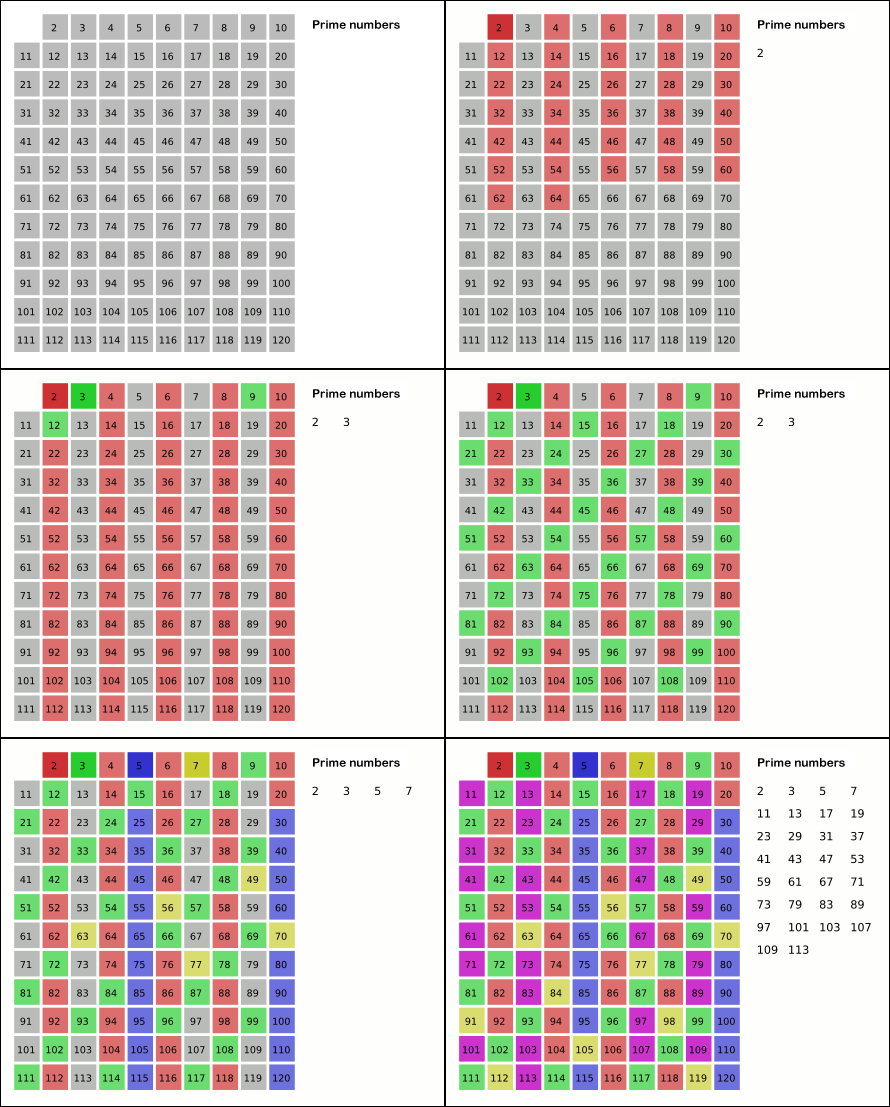
Working in groups, write numbers from \(1\) to \(30\) in a grid with ten numbers on each row, like so:\begin{equation*} \begin{matrix} 1 \amp 2 \amp 3 \amp 4 \amp 5 \amp 6 \amp 7 \amp 8 \amp 9 \amp 10\\ 11 \amp 12 \amp 13 \amp 14 \amp 15 \amp 16 \amp 17 \amp 18 \amp 19 \amp 20\\ 21 \amp 22 \amp 23 \amp 24 \amp 25 \amp 26 \amp 27 \amp 28 \amp 29 \amp 30 \end{matrix} \end{equation*}
-
Draw a circle around all the numbers that are multiples of \(2\) (such as \(4, 6, 8\)), except for \(2\) itself
-
Draw a square around all the numbers that are divisible by \(3\) (such as \(6, 9, 12\)), except for \(3\) itself
-
Draw a diamond (a tilted square) around all the numbers that are divisible by \(5\) (such as \(10, 15, 20\)), except for \(5\) itself
-
What patterns do you notice with the circles, squares, and diamonds?
-
Numbers which have no divisors apart from 1 and themselves are called prime. Write down all the numbers which do not have a circle, square, or diamond around them.
-
Numbers which do have divisors apart from 1 and themselves are called composite. Write down all the numbers which have a circle, square, or diamond around them.
-
Identify prime numbers that are even.
-
Brainstorm a real life example where you can prime and composite numbers e.g. sharing seven pens with three people fairly.
-
Share your work with your fellow learners.
Hint.
This process is known as the Sieve of Eratosthenes. See the animation below for a visual demonstration of how it works:

Further activity.
Mutula is organizing a party, and he has \(35\) party hats. Can Mutula arrange the hats in rows where each row has the same number of hats? What does this tell you about the number \(35\text{?}\)
Key Takeaway 1.1.12.
A factor of a number is a natural number that divides it exactly with no remainder.
A prime number is a number that has only two factors, that is, \(1\) and itself. For example: \(2,3,5,7,11,\ldots\)
For example, \(6\) is not a prime number because it has more than two factors: \(1, 2, 3,\) and \(6\text{.}\) That is, \(6 = 1 \times 6\) and \(6 = 2 \times 3\text{.}\)
To identify if a number is prime, check if the number has exactly two factors: \(1\) and itself.
Composite numbers are natural numbers greater than \(1\) that have more than two factors.
Examples:
Properties
Every composite number has prime factors. That is, it can be broken down into a product of prime numbers.
-
The only even prime number is \(2\) .
-
All other even numbers greater than \(2\) are composite.
-
The smallest composite number is \(4\text{.}\)
-
Odd composite numbers are odd natural numbers greater than \(1\) that are not prime (e.g., \(9, 15, 21,...)\text{.}\)
Think of prime numbers as building blocks, and composite numbers as being made by combining those blocks.
Example 1.1.13.
Determine all the factors of 45. Which of these are prime?
Solution.
To find factors, we work upwards from 2 to see which (prime) numbers divide 45. Clearly 45 is not divisible by 2 (as it is odd), so we next try 3.
\(45 \div 3 = 15\text{,}\) so 3 is a factor. We know also know 15 is a factor, so we can see if 15 can be further divided. 15 is odd, so it is not divisible by 3, but \(15 \div 3 = 5\text{,}\) so 3 and 5 are factors. Both 3 and 5 are prime, so we have found all the prime factors:
\begin{equation*}
45 = 3 \times 3 \times 5
\end{equation*}
All the factors of 45 are some combination of these three prime factors. We have the factors as:
So the factors of 45 are \(1,3,5,9,15,45\text{,}\) and the prime factors are \(3\) and \(5\text{.}\)
Note 1.1.14.
\(0\) and \(1\) are neither prime nor composite, since they each only have one factor, which is themselves.
Example 1.1.15.
Which of the following numbers are prime and which are composite?
-
\(\displaystyle 29\)
-
\(\displaystyle 21\)
-
\(\displaystyle 5\)
-
\(\displaystyle 30\)
Solution.
-
Hence \(29\) is a prime number.
-
\(21 = 3 \times 7\) meaning it is divisible by both \(3\) and \(7\text{.}\) it is also divisible by \(1\) and itself.Therefore, \(21\) is a composite number.
-
This means that \(5\) is a prime number.
-
\(30 = 2 \times 15\) which implies that \(2\) and \(15\) are its factors. Since \(15 = 3 \times 5\text{,}\) these are also factors. Hence \(30\) is divisible by: \(1,2,3,5,10,15,30\text{.}\)Therefore, \(30\) is a composite number
Checkpoint 1.1.16. Classification of Prime and Composite Numbers.
Load the question by clicking the button below.
Checkpoint 1.1.17. Classifying a Number as Odd, Even, Prime or Composite.
Load the question by clicking the button below.
Exercises Exercises
1.
Classify the following numbers as prime or composite.
-
\(\displaystyle 14\)
-
\(\displaystyle 11 \)
-
\(\displaystyle 3\)
-
\(\displaystyle 25\)
-
\(\displaystyle 17\)
-
\(\displaystyle 18\)
Answer.
-
\(18\) is composite, as its factors are \(1,2,9,18\text{,}\) (\(18 = 1 \times 18 = 2 \times 9\))
2.
The number \(51\) is suspected to be prime. Use divisibility rules to determine whether it is a prime or composite number.
3.
A teacher writes a two-digit number on the board. The number is prime, less than \(30\text{,}\) and ends with \(3\text{.}\) List all possible numbers it could be.
4.
A marathon is divided into \(42\)-kilometer relay sections. Each runner must cover a distance (in km) that is a composite number. List three possible distances a runner could cover.
5.
A class of students forms a rectangular grid. The total number of students is \(35\text{.}\) Determine whether this number is prime or composite and explain your reasoning.
6.
-
If a number is divisible by \(2\) and \(3\text{,}\) what is the smallest composite number could it be?
-
If a number is divisible by \(6\) and \(8\text{,}\) what is the smallest composite number could it be?
Solution.
-
Since \(2\) and \(3\) are both prime, they share not common factors. Therefore, the smallest composite number that is divisible by both \(2\) and \(3\) is their product, which is \(6\text{.}\)
-
Unlike \(2\) and \(3\text{,}\) the numbers \(6\) and \(8\) are not prime, and they share a common factor of \(2\text{.}\) The prime factorisation of each number is:\begin{align*} 6 \amp = 2 \times 3 \\ 8 \amp = 2 \times 2 \times 2 \end{align*}The least common multiple of \(6\) and \(8\) is the smallest number that is divisible by both. Its prime factorisation needs to include both \(2 \times 3\) and \(2 \times 2 \times 2\text{.}\) The smallest way to do this is to have \(2 \times 2 \times 2 \times 3 = 24\text{.}\) Therefore, the smallest composite number that is divisible by both \(6\) and \(8\) is \(24\text{.}\)
7.
Simplify each of the following expressions and state whether the result is a prime or composite number.
-
\(\displaystyle 1024 \times 5 \div 4\)
-
\(\displaystyle \sqrt{144} \times 3 - 9 +4\)
-
\(\displaystyle \sqrt{64} \times 5\)
-
\(\displaystyle 4^2 \times 2 + 4\)
-
\(\displaystyle 49^2 + 6 \div 7\)
-
\(\displaystyle \sqrt{25} \times 2 - 8\)
Answer.
-
\(1024 \times 5 \div 4 = 1280\text{,}\) which is composite.
-
\(\sqrt{144} \times 3 - 9 +4 = 31\text{,}\) which is prime.
-
\(\sqrt{64} \times 5 = 40\text{,}\) which is composite.
-
\(4^2 \times 2 + 4 = 36\text{,}\) which is composite.
-
\(49^2 + 6 \div 7 = 2401 + \frac{6}{7} = 2401.857\) when given to 3 decimal places, and is classified as neither prime nor composite.
-
\(\sqrt{25} \times 2 - 8 = 2\text{,}\) which is prime.
8. Wilsonβs Theorem.
-
Find \(1 + 1\text{.}\) Is it divisible by 2?
-
Find \(2 \times 1 + 1\text{.}\) Is it divisible by 3?
-
Find \(3 \times 2 \times 1 + 1\text{.}\) Is it divisible by 4?
-
Find \(4 \times 3 \times 2 \times 1 + 1\text{.}\) Is it divisible by 5?
-
Find \(5 \times 4 \times 3 \times 2 \times 1 + 1\text{.}\) Is it divisible by 6?
-
Can you find a general expression for these multiplications in terms of the divisor, \(n\text{?}\) (In the last example, we had \(n = 6\text{.}\))
-
When do you think this general expression is divisible by \(n\text{?}\) Form a hypothesis, and test it for all \(n\) up to 10.
Solution.
-
\(1 + 1 = 2\text{,}\) which is divisible by 2.
-
\(2 \times 1 + 1 = 3\text{,}\) which is divisible by 3.
-
\(3 \times 2 \times 1 + 1 = 7\text{,}\) which is not divisible by 4.
-
\(4 \times 3 \times 2 \times 1 + 1 = 25\text{,}\) which is divisible by 5.
-
\(5 \times 4 \times 3 \times 2 \times 1 + 1 = 121\text{,}\) which is not divisible by 6.
-
If \(n\) is the divisor, then the expression on the left is the product of all integers less than \(n\) plus one. That is,\begin{equation*} (n-1) \times (n-2) \times (n-3) \times \ldots \times 3 \times 2 \times 1 + 1 \end{equation*}
-
Our expression was divisible by \(n\) when \(n = 2,3,\text{ and } 5\text{,}\) but not when \(n = 4\text{ or }6\text{.}\) A resonable hypothesis is that the expression is divisible only when \(n\) is prime.In fact, this is true! You can follow the link to read more about this result, called Wilsonβs Theorem.
Subsubsection 1.1.1.3 Rational and Irrational Numbers
Curriculum Alignment
Learner Experience 1.1.3.
-
Working in groups, choose any set of natural numbers between \(1\) and \(10\) (e.g., \(2, 3, 5,7,..\))\(\bullet\) Use these numbers to create at least two fractions:One proper fraction (e.g., \(3/5\))One improper fraction (e.g., \(7/4\))
-
Use a calculator to divide each of your fractions.Write down the decimal value of each.Example: \(7 Γ· 4 = 1.75\text{.}\)
-
Write each number as a square root.
-
Classify each number you have created (fractions, decimals, and square roots) as either rational or irrational.
-
What do you notice about the decimal form of rational numbers compared to irrational numbers?Are there any patterns?
-
Discuss your observations with your fellow learners.
Key Takeaway 1.1.18.
\(\bullet\) Rational number\((\mathbb{Q}):\) A rational number is any number that can be written as a fraction \(\frac{p}{q}\) where \(p\) and \(q\) are integers and \(q \neq 0\text{.}\)
Example: \(\frac{2}{3},-3,4 \)
\(\bullet\) Irrational number: An irrational number is any number that cannot be expressed as a fraction of two intergers.
Example: \(\sqrt{7}, \sqrt{2}, \pi\)
\(\bullet\) Integers consists of positive whole numbers, negative whole numbers and \(0\text{.}\)
\(\bullet\) The decimal representation of a rational number either terminates (stops at some point) or repeats (continues but has a repeating pattern).
Example: \(0.375, 3.45454545...\)
\(\bullet\) The decimal representation of an irrational number neither terminates (does not stop) nor repeats (continues without a repeated pattern).
Example: \(3.14285714..., 4.298103993...\)
\(\bullet\) The square root of a perfect square is a rational number.
\(\bullet\) The square root of an imperfect square is an irrational number.
Example: \(\sqrt{2} = 1.41421356237\) which is an irrational number.
How to determine if a number is rational or irrational.
-
Rule: Check if the number is an integer or a fraction with an integer as the numerator and the denominator. If it is, then it is a rational number.Example: \(7\) or \(\frac{4}{5}\) are both rational numbers because they are either whole numbers or simple fractions.
-
Rule: "If the number is in decimal form, check if the decimal stops at some point. If it stops then the number is a rational number."Example: \(3.25\) is rational because the decimal terminates.
-
Rule: If the number is in decimal form, check if the decimal continues. If it continues with a repeated pattern then the number is a rational number and if it continues without a pattern then it is irrational.Example (rational): \(0.666β¦ \)(with pattern)Example (irrational): \(0.1010010001β¦ \)(no pattern)
-
Rule: "If the number is expressed as a square root, find the square root of the number first and identify if it is a perfect or an imperfect square. If it is a perfect square (results to a whole number) then it is rational and if it is an imperfect square, then it is irrational.Example (rational): \(\sqrt{49} = 7\)Example (irrational): \(\sqrt{2} β 1.414213...\)
Example 1.1.19.
Identify if the following numbers are rational or irrational.
-
\(\displaystyle \pi\)
-
\(\displaystyle \frac{2}{3}\)
-
\(\displaystyle 3.75\)
-
\(\displaystyle \sqrt{20}\)
-
\(\displaystyle \frac{\sqrt{9}}{\sqrt{16}}\)
Solution.
-
We check if the decimal has a pattern.Hence \(\pi\) is irrational because its decimal continues without having a repeated pattern.
-
Since \(\frac{2}{3}\) is a fraction, we check if the fraction consist of integers with the denominator not equal to zero.Therefore \(\frac{2}{3}\) is a rational number.
-
To identify if \(3.75\) is rational or irrational, we check the decimal.A rational number can have a terminating decimal or a repeating decimal. In this case, the decimal terminates, so the number is rational
-
For \(\sqrt{20}\text{,}\) first we find its value.\(\sqrt{20} = 4.472135955\)\(\sqrt{20}\) has decimal which continues without a repeated pattern.Hence \(\sqrt{20}\) is irrational.
-
The value of \(\frac{\sqrt{9}}{\sqrt{16}} = \frac{3}{4}\)\(\frac{3}{4}\) is a fraction with integers on the numerator and the denominator.Therefore, \(\frac{\sqrt{9}}{\sqrt{16}}\) is rational.
Example 1.1.20.
Joy is designing a square garden. She measures the total area of the garden to be \(50\) square meters and wants to find the length of one side. What is the exact length of one side of the garden? Classify the answer as a rational or irrational number.
Solution.
Area of the garden = \(50 \text{ m}^2\)
To find the length of one side of the square, we take the square root of its area.
Side length = \(\sqrt{50}\text{.}\)
Simplifying the side length \(\sqrt{50} = \sqrt{(25 \times 5)} = \sqrt{25} \times \sqrt{2} = 5 \sqrt{2}\text{.}\)
Since \(\sqrt{2}\) an irrational number, multiplying it by \(5\) still gives an irrational number.
Therefore, the exact length of one side of the garden is \(5 \sqrt{2}\) meters, which is an irrational number.
Checkpoint 1.1.21. Classifying Given Numbers as Irrational.
Load the question by clicking the button below.
Checkpoint 1.1.22. Classifying Rational Numbers from a List.
Load the question by clicking the button below.
Exercises Exercise
1.
Classify the following numbers as rational or irrational giving reasons.
-
\(\displaystyle \sqrt{25}\)
-
\(\displaystyle 2\pi\)
-
\(\displaystyle \sqrt{2}\)
-
\(\displaystyle \frac{7}{3}\)
-
\(\displaystyle 0.25\)
-
\(\displaystyle 0.121221222\)
-
\(\displaystyle - 4.5\)
-
\(\displaystyle \sqrt{2} + \sqrt{8}\)
-
\(\displaystyle \pi - 3\)
-
\(\displaystyle \frac{\sqrt{4}}{\sqrt{9}} \times 4\)
-
\(\displaystyle 2 \times \sqrt{2}\)
Answer.
-
\(\sqrt{25}\) is rational.
-
\(2\pi\) is irrational.
-
\(\sqrt{2}\) is irrational.
-
\(\frac{7}{3}\) is rational.
-
\(0.25\) is rational.
-
\(0.121221222...\) is irrational.
-
\(-4.5\) is rational.
-
\(\sqrt{2} + \sqrt{8}\) is irrational.
-
\(\pi - 3\) is irrational.
-
\(\frac{\sqrt{4}}{\sqrt{9}} \times 4 = \frac{8}{3}\) is rational.
-
\(2 \times \sqrt{2}\) is irrational.
2.
A square garden has a perimeter of \(8\) units. Find its area and identify if it is a rational or irrational number.
3.
For each of the following values of \(m\) state whether \(\frac{m}{16}\) is rational or irrational.
-
\(\displaystyle 1\)
-
\(\displaystyle -10\)
-
\(\displaystyle \sqrt{2}\)
-
\(\displaystyle \sqrt{25}\)
-
\(\displaystyle \pi\)
4.
A car is moving at \(\sqrt{225}\) km/h. Is the speed rational or irrational? Explain your answer.
5.
Iregi a grade \(10\) student measures a triangular shelf in their home and found out its sides of length was \(\sqrt{12}\) meters, \(\sqrt{27}\) meters and \(5\) meters. He wants to find the perimeter of the triangle and identify if it is rational or irrational. Help Iregi to find out if the perimeter is rational or irrational explaining your workings.
6.
A rectangular garden has a length of \(4\) meters and a width of \(\sqrt{8}\) meters. Find the area of the garden and identify if it is rational or irrational.