To assist your teaching, we have prepared lesson resources, aligned with this textbook and the CBC. The Lesson Plan links to syllabus learning outcomes and provides suggest time allocations. The Step-by-Step Guide provides more detailed guidance on how to teach the content, including suggested questions to ask learners, and possible answers.
Volume tells us how much space an object or container holds. In everyday life we use volume to know how much water fits in a jerrycan, how much grain a sack will carry, or how much fuel a drum can store. Knowing how to calculate volume helps families and communities measure and plan for storage, transport and household needs, and it is useful in farming, construction and cooking.
In this section we practice simple formulas for common shapes (box, cylinder, cone) and learn to convert between litres and cubic metres so the results are useful in ordinary situations.
Volume of a cylinder: \(V=\pi r^2 h.\) So \(V=\pi\times(0.25)^2\times1.0\approx\pi\times0.0625\approx0.19635\,\text{m}^3.\) In litres: \(0.19635\times1000\approx196\,\text{L}.\)
Volume of a cone: \(V=\tfrac{1}{3}\pi r^2 h\text{.}\) So \(V=\tfrac{1}{3}\pi(0.15)^2(1.2)\approx\tfrac{1}{3}\pi\times0.027\approx0.0283\,\text{m}^3\text{,}\) which is about \(28\,\text{L}.\)
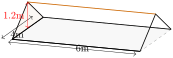
The storage space under a roof forms a triangular prism. The triangular cross-section has base 4 m and height 1.2 m, and the attic runs 6 m along the house. Estimate the storage volume in cubic metres and litres.
Area of triangle = \(\tfrac{1}{2}bh = 0.5\times4\times1.2 = 2.4\,\text{m}^2\text{.}\) Volume = area × length = \(2.4\times6 = 14.4\,\text{m}^3\text{,}\) which is \(14{,}400\,\text{L}.\)
Example2.8.69.Composite Solid: Cylinder with Cone Top.
A container is made by placing a cone (height 0.5 m, base radius 0.3 m) on top of a cylinder (height 1.0 m, same radius 0.3 m). Find the total volume in litres.
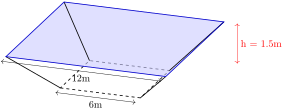
A shallow pond is shaped like a frustum of a square pyramid. The water surface is a square 12 m by 12 m, the bottom is a square 6 m by 6 m, and the depth is 1.5 m. Estimate the volume of water in the pond in cubic metres and litres.
For a pyramidal frustum the volume is \(V=\tfrac{h}{3}(A_1 + A_2 + \sqrt{A_1A_2})\) where \(A_1\) and \(A_2\) are the areas of the top and bottom squares. Here \(A_1=12^2=144\) and \(A_2=6^2=36\text{,}\) so \(\sqrt{A_1A_2}=\sqrt{144\times36}=72\text{.}\) Thus \(V=\tfrac{1.5}{3}(144+36+72)=0.5\times252=126\,\text{m}^3\text{,}\) which is about \(126{,}000\,\text{L}.\)
A small store has a square pyramidal roof under which we want to store grain. The base of the pyramidal roof is 4 m by 4 m and its height 2.5 m. Estimate the volume of the the space under the roof in cubic metres.
Volume of a pyramid: \(V=\tfrac{1}{3}Bh\) where \(B\) is base area. Here \(B=4\times4=16\,\text{m}^2\) and \(h=2.5\,\text{m}\text{,}\) so \(V=\tfrac{1}{3}\times16\times2.5=\tfrac{40}{3}\approx13.33\,\text{m}^3.\)
Volume of a cone: \(V=\tfrac{1}{3}\pi r^2 h\text{.}\) With \(r=1.2, h=0.8\) we get \(V=\tfrac{1}{3}\times3.14\times1.2^2\times0.8\approx1.206\,\text{m}^3\text{,}\) about \(1{,}206\,\text{L}.\)