To assist your teaching, we have prepared lesson resources, aligned with this textbook and the CBC. The Lesson Plan links to syllabus learning outcomes and provides suggest time allocations. The Step-by-Step Guide provides more detailed guidance on how to teach the content, including suggested questions to ask learners, and possible answers.
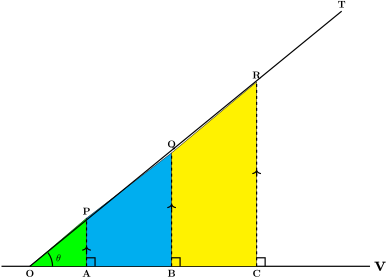
Adjust the Angle: Drag the \(\theta\) slider. As the angle changes, what happens to the lengths of the opposite sides and the hypotenuses of the three triangles?
Change Triangle Sizes: Slide points \(A\text{,}\)\(B\text{,}\) and \(C\) horizontally. How does resizing the base (adjacent side) of the triangle affect the lengths of the other two sides?
Explore the Sine Ratios: Look at the left column of calculations below the graph. Try moving points \(A\text{,}\)\(B\text{,}\) and \(C\) while keeping the angle constant. What do you notice about the ratio of the Opposite side divided by the Hypotenuse? How does this value compare to the sine of \(\theta\) calculated at the top?
Explore the Cosine Ratios: Now look at the right column. When you change the angle \(\theta\text{,}\) how does the ratio of the Adjacent side divided by the Hypotenuse change? Does dragging points \(A\text{,}\)\(B\text{,}\) or \(C\) to change the size of the triangles alter this ratio?
This constant value is obtained by taking the ratio of the side opposite to the angle \(\theta \) to the hypotenuse side in each case. This ratio is called the sine of angle \(\theta \text{,}\) which can be written as as \(\sin \, \theta\text{.}\)
This constant value is obtained by taking the ratio of the side adjacent to the angle \(\theta \) to the hypotenuse side in each case. This ratio is called the cosine of angle \(\theta \text{,}\) which can be written as \(\cos \, \theta\text{.}\)