Subsection 2.5.5 Area of Polygons in Real-Life
In everyday life there are many situations where we need to estimate the area of a piece of land, a roof, a classroom floor or the cover of a water tank.
In this section we learn how to apply area formulas for triangles, quadrilaterals, regular polygons and irregular polygons.
Summary of area techniques
- Triangles
- Use \(A=\tfrac12ab\sin C\) for two sides and included angle, Heronβs formula if all three sides are known.
- Quadrilaterals
- Split into two triangles along a diagonal and add; rectangles and parallelograms use base \(\times\) height.
- Regular \(n\)-gons
- Irregular polygons
- Decompose into triangles or other familiar shapes; measure and estimate when necessary.
Example 2.5.48. Area of a Triangular Plot.
A farmer near Eldoret has a triangular plot of land. Two sides measure \(50\,\text{m}\) and \(80\,\text{m}\text{,}\) and the angle between them is \(60^\circ\text{.}\) Estimate the area of the plot.
Solution.
Use the formula for the area of a triangle when two sides and the included angle are known:
\begin{align*}
A \amp= \frac{1}{2} ab \sin C
\end{align*}
Substituting the given values:
\begin{align*}
A \amp= \frac{1}{2} \times 50 \times 80 \times \sin 60^\circ\\
\amp= 2000 \times \frac{\sqrt3}{2}\\
\amp= 1000\sqrt3 \approx 1732\,\text{m}^2
\end{align*}
The triangular plot has area approximately \(1732\,\text{m}^2\text{.}\)
Example 2.5.49. Surveying an Irregular Field.
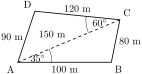
A surveyor in Kisumu is measuring a piece of land that is not quite a rectangle, as shown below. He records the lengths of the four sides: \(AB=100\,\text{m}, BC=80\,\text{m},
CD=120\,\text{m}, DA=90\,\text{m}\text{,}\) and he also measures the diagonal \(AC=150\,\text{m}\text{.}\) The angle between \(AB\) and \(AC\) at point A is \(35^\circ\text{,}\) and the angle between \(AC\) and \(CD\) at point C is \(60^\circ\text{.}\) Estimate the total area of the field by splitting it into two triangles.
Solution.
Split the field along the diagonal \(AC\text{,}\) giving triangles \(ABC\) and \(ACD\text{.}\) We find each area using the formula \(\frac12 ab\sin C\) and then add them.
For triangle \(ABC\text{:}\)
\begin{align*}
A_{ABC} \amp= \frac12 \times 100 \times 150 \times \sin 35^\circ\\
\amp\approx 7500 \times 0.574 \approx 4305\,\text{m}^2
\end{align*}
For triangle \(ACD\text{:}\)
\begin{align*}
A_{ACD} \amp= \frac12 \times 150 \times 120 \times \sin 60^\circ\\
\amp= 9000 \times \frac{\sqrt3}{2} \approx 7794\,\text{m}^2
\end{align*}
Adding the two areas gives a total of about \(4305 + 7794 \approx 12\,099\,\text{m}^2\text{,}\) so the irregular field covers roughly \(12\,100\,\text{m}^2\text{.}\)
Example 2.5.50. Area of a Pavilion and Forecourt.
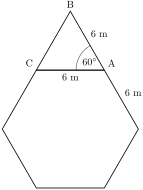
A village school in Kilifi wants to pave a new outdoor area consisting of a regular hexagonal pavilion attached to a triangular forecourt. The hexagon will have sides of \(6\,\text{m}\) and the forecourt is a triangle with two sides \(6\,\text{m}\text{,}\) meeting the hexagon at an angle of \(60^\circ\) as shown below.
Estimate the total area that must be tiled, and then find the cost if tiles are \(5\,500\) Kenyan shillings per square metre. Give your answer rounded to the nearest shilling.
Solution.
The total area is the sum of the hexagon and triangle areas.
For the hexagon, divide it into 6 identical triangles by joining the centre to each corner. Each triangle has two sides of length \(6\,\text{m}\) and the angle between them at the centre is \(360^\circ/6 = 60^\circ \text{.}\)
Use the sine formula \(A=\tfrac12ab\sin C\) for one such triangle:
\begin{align*}
A_{small} \amp= \frac12 \times 6 \times 6 \times \sin 60^\circ\\
\amp= 18 \times \frac{\sqrt3}{2} = 9\sqrt3\, \text{m}^2
\end{align*}
Multiplying by 6 gives
\begin{align*}
A_{hex} \amp= 6 \times 9\sqrt3 = 54\sqrt3\,\text{m}^2
\end{align*}
Triangle: the forecourt is a triangle with sides 6 m and 6m and an included angle of 60Β°. We apply the same sine formula \(A=\tfrac12ab\sin C\) to find its area:
\begin{align*}
A_{tri} \amp= \frac12 \times 6 \times 6 \times \sin 60^\circ\\
\amp= 18 \times \frac{\sqrt3}{2} = 9\sqrt3\,\text{m}^2
\end{align*}
Total area is \(54\sqrt3 + 9\sqrt3 = 63\sqrt3 \approx 109.1\,\text{m}^2\text{.}\) At \(5,500\,\text{KSh/m}^2\) the paving will cost approximately
\begin{align*}
\text{Cost} \amp= 63\sqrt3 \times 5\,500 \approx 600\,156\,\text{KSh}
\end{align*}
So the school should budget \(600\,156\) Kenyan shillings.
Exercises Exercises
1.
A landowner near Kisumu has a triangular plot whose three boundary lengths are measured as \(50\, \text{m}\text{,}\) \(65\,\text{m}\) and \(77\,\text{m}\text{.}\) There is no convenient angle to measure. Find the area of the plot.
Solution.
Use Heronβs formula. First compute the semi-perimeter
\begin{equation*}
s=\tfrac{1}{2}(a+b+c)\text{.}
\end{equation*}
\begin{gather*}
s = \tfrac{1}{2}(50+65+77) = 96\,\text{m}\\
A = \sqrt{s(s-a)(s-b)(s-c)}\\
\quad= \sqrt{96\times46\times31\times19}\\
\quad= \sqrt{2\,601\,024} \approx 1612.8\,\text{m}^2
\end{gather*}
2.
A Mombasa school wants a regular octagonal flower bed, where the distance from the center to a vertex is \(4\,\text{m}\text{.}\) Calculate the area of the bed, giving your answer exactly in simplest surd form.
Solution.
Join the centre to each vertex to form 8 congruent isosceles triangles. Each triangle has two equal sides of length \(R\) (the circumradius) and vertex angle \(\theta=360^\circ/8=45^\circ\text{.}\)
The area of one triangle is
\begin{gather*}
A_{triangle}=\tfrac{1}{2}R^{2}\sin\theta=\tfrac{1}{2}R^{2}\sin45^\circ=\tfrac{1}{2}R^{2}\cdot\dfrac{\sqrt{2}}{2}=\dfrac{R^{2}}{2\sqrt{2}}
\end{gather*}
Multiplying by 8 gives the octagon area
\begin{gather*}
A_{octagon}=8A_{triangle}=8\cdot\dfrac{R^{2}}{2\sqrt{2}}=2\sqrt{2}\;R^{2}
\end{gather*}
With \(R=4\,\text{m}\) we obtain
\begin{gather*}
A=2\sqrt{2}\times 4^{2}=32\sqrt{2}\,\text{m}^{2}
\end{gather*}
The exact area is \(32\sqrt{2}\,\text{m}^{2}\text{.}\) (Approx. \(45.25\,\text{m}^{2}\text{.}\))
3.
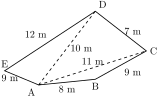
An irregular pentagon has been split into three triangles by drawing diagonals from vertex \(A\) to vertices \(C\) and \(D\) as shown in the diagram. The side-lengths of the three triangles are given; use Heronβs formula to find the area of each triangle and hence the total area of the pentagon.
Triangle side-lengths (metres):
-
\(\triangle ABC:\) 8, 9, 11
-
\(\triangle ACD:\) 11, 7, 10
-
\(\triangle ADE:\) 10, 12, 9
Calculate the area to one decimal place and give the final answer in square metres.
Hint.
Solution.
We compute each triangleβs area using Heronβs formula.
\begin{gather*}
\triangle ABC:\quad s=\tfrac12(8+9+11)=14\\
\quad A_{ABC}=\sqrt{14(14-8)(14-9)(14-11)}=\sqrt{1260}\approx35.5\,\text{m}^2\\
\triangle ACD:\quad s=\tfrac12(11+7+10)=14\\
\quad A_{ACD}=\sqrt{14(14-11)(14-7)(14-10)}=\sqrt{1176}\approx34.3\,\text{m}^2\\
\triangle ADE:\quad s=\tfrac12(10+12+9)=15.5\\
\quad A_{ADE}=\sqrt{15.5(15.5-10)(15.5-12)(15.5-9)}\approx44.1\,\text{m}^2\\
\text{Total area} = 35.5+34.3+44.1 \approx 113.9\,\text{m}^2
\end{gather*}
The pentagon therefore has area approximately \(113.9\,\text{m}^2\text{.}\)
4.
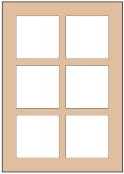
A carpenter in Nairobi is making a rectangular window with a grid of six glass panes (arranged in 3 rows and 2 columns). Each glass pain is a square with length \(30\,\text{cm}\text{.}\) The frame is made of wood, and the external borders should be \(10\,\text{cm}\) on all sides, while the internal borders should be \(5\,\text{cm}\)
-
Determine the total area of glass required in \(\text{m}^2\)
-
Find the width and length of the frame in meters
-
By subtracting the glass area from the total area, find the area of wood required for the frame and dividers.
Solution.
We need to convert to meters to ensure our answers are in the correct units.
-
Each pane has area \(0.3\,\text{m} \times 0.3\,\text{m} = 0.09\,\text{m}^2\text{.}\) With 6 panes, the total glass area is \(6 \times 0.09 = 0.54\,\text{m}^2\text{.}\)
-
The total width of the frame is the sum of the widths of the panes, internal dividers and external borders. Since there is one internal divider between the two columns of panes, the total width is\begin{gather*} W = 2 \times 0.1 + 1 \times 0.05 + 2 \times 0.3 = 0.85\,\text{m} \end{gather*}For the height, there are two internal dividers, so\begin{gather*} H = 2 \times 0.1 + 2 \times 0.05 + 3 \times 0.3 = 1.2\,\text{m} \end{gather*}
-
The total area of the window is \(W \times H = 0.85\,\text{m} \times 1.2\,\text{m} = 1.02\,\text{m}^2\text{.}\) Subtracting the glass area gives the area of wood required:\begin{equation*} \text{Wood Area} = 1.02 - 0.54 = 0.48 \text{ m}^2 \end{equation*}
5.
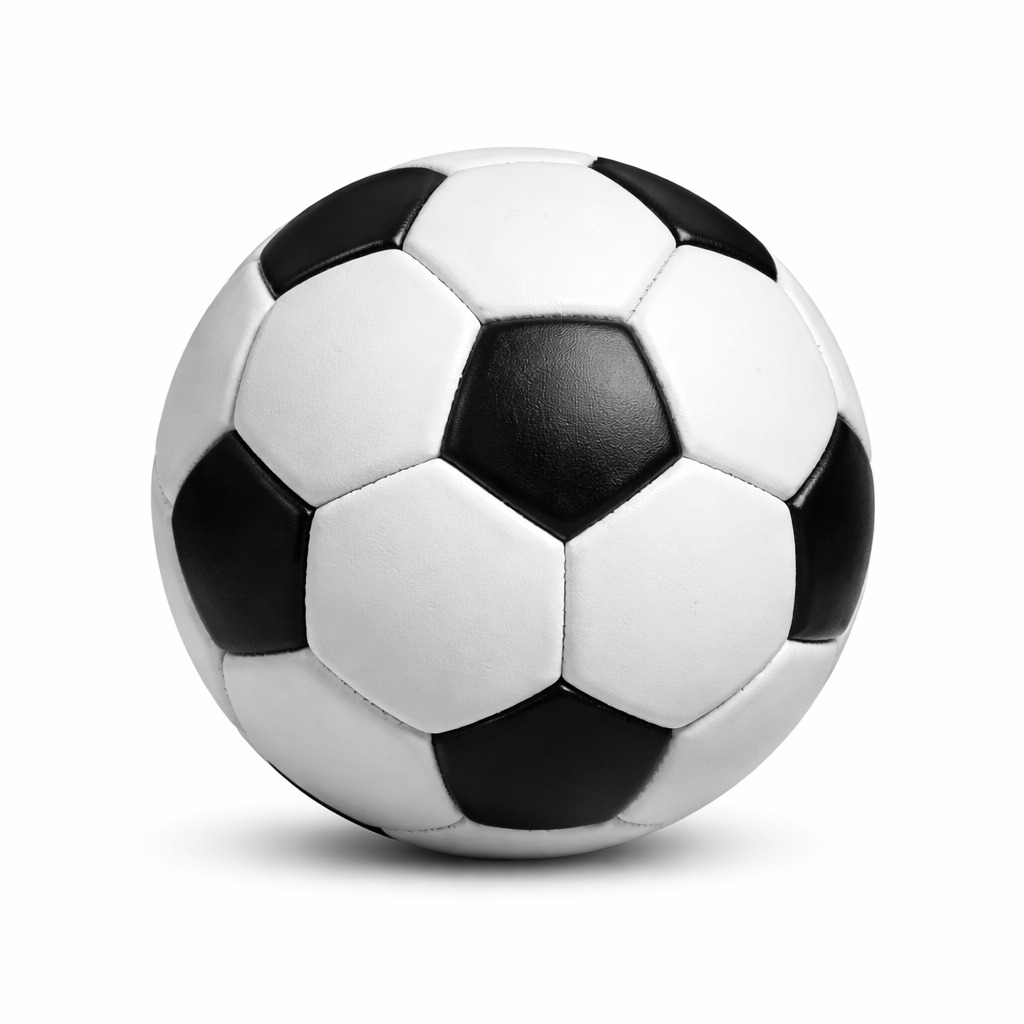
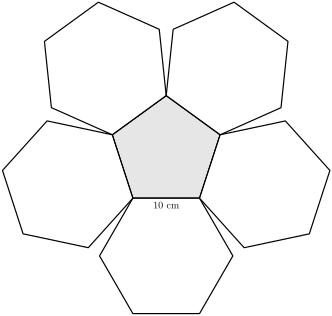
Footballs are created using a pattern of 12 regular pentagons and 20 regular hexagons, as shown below.

Letβs consider just one petal, consisting of one pentagon surrounded by five hexagons, as shown below. The side length is \(10 \text{cm}\text{.}\)
-
Find the area of the central pentagon
-
Find the area of the six hexagons, and thus the area of the petal
-
Why canβt we just glue together 12 petals? How many should we use?
-
Calculate the total area of the 12 pentagons and 20 hexagons, and thus the surface area of the net.
Solution.
-
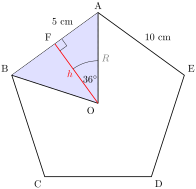
To find the area of the pentagon, divide it into 5 triangles from the center, whose bases are the edges (length \(10 \text{cm}\)). Draw the height \(h\) for the center \(O\) to the edge (bisecting it at \(F\)).The angle \(\angle AOB\) is \(360^\circ/5=72^\circ\text{,}\) so since \(F\) bisects \(AB\text{,}\) \(\angle AOF = 72/2 = 36^\circ\text{.}\) Using trigonometry, we have:\begin{align*} \tan 36^\circ \amp = \frac{5}{h} \\ h \amp = \frac{5}{\tan 36^\circ}\\ \amp \approx 6.8819 \end{align*}Area of one triangle is \(\tfrac{1}{2}\times10\times h\approx34.41\,\text{cm}^2\text{,}\) so the pentagon area is \(5\times34.41\approx172.05\,\text{cm}^2\text{.}\)
-
The hexagon can be split into 6 equilateral triangles of length \(10\,\text{cm}\text{,}\) so each has area\begin{align*} A_{\text{triangle}} \amp = \frac{1}{2} \times 10 \times 10 \times \sin 60^\circ \\ \amp = \frac{1}{2} \times 100 \times \frac{\sqrt{3}}{2} \\ \amp = 25\sqrt{3} \end{align*}So the total area of a hexagon is:\begin{gather*} A_{\text{hexagon}}=6 \times 25\sqrt{3} = 150\sqrt{3} \end{gather*}Thus the petal has total area:\begin{align*} A_{\text{petal}} \amp = 5 A_{\text{hexagon}} + A_{\text{pentagon}} \\ \amp = 5 \times 150\sqrt{3} + 172.05 \\ \amp \approx 1471\,\text{cm}^2 \end{align*}
-
To get 12 pentagons would require 12 petals, which would give \(5 \times 12 = 60\) hexagons, which is too many. The correct net uses 20 hexagons, so we need to use only 4 petals, giving \(4 \times 5 = 20\) hexagons and \(4\) pentagons. We then add the remaining 8 pentagons separately to get the total of 12 pentagons.
-
We have\begin{align*} A_{\text{ball}} \amp = 4 \times A_{\text{petal}} + 8 \times A_{\text{pentagon}} \\ \amp = 4 \times 1471 + 8 \times 172.05 \\ \amp \approx 6,056\,\text{cm}^2 \end{align*}