Subsection 2.4.7 Trigonometry in Real-Life

Trigonometric ratios are powerful tools used to find unknown angles or side lengths in right-angled triangles. These ratios have many real-life applications in fields such as architecture, engineering, navigation, sports, surveying, and construction.
In this section, you will explore how sine, cosine, and tangent are used to solve practical problems involving heights, distances, and angles in everyday situations.

Learner Experience 2.4.18. Designing a Kite.

Work in pairs or small groups.
In this activity, you will design a kite and use trigonometry to calculate the lengths of the pieces needed to build it.

(b)

A traditional kite is made from two sticks crossing at right angles. The vertical stick (spine) is \(60\,\text{cm}\) long. The horizontal stick (spar) crosses the spine \(15\,\text{cm}\) from the top.
Draw a labelled diagram of this kite shape, marking the lengths given.

(c)

If the top edge of the kite (from the top of the spine to the end of the spar) makes an angle of \(60^\circ\) with the spine, use trigonometry to calculate the length of half the spar (from center to tip).

(d)

Calculate the length of the top edge of the kite (the string from the top of the spine to the end of the spar). Give your answer in exact form.

(e)

The bottom section of the kite has its edge making an angle of \(30^\circ\) with the spine. Calculate the length of the bottom edge of the kite in exact form.

(f)

Find the total length of string needed to go around the outside of the kite.

(g)

Extension: If you have materials, build your kite! Compare your calculated measurements with the actual lengths you cut.

Key Takeaway 2.4.67.

The learner experience shows how trigonometry can be used in design and construction. By calculating the length of kite’s edge using the given measurements, you can create a precise plan for building a kite. Trigonometry therefore helps us solve problems where direct measurements are difficult to find, allowing us to find unknown measurements based on known values.
Key Problem-Solving Steps:
  1. Draw and label a clear right-angled triangle from the context
  2. Identify the known and unknown sides/angles
  3. Choose the correct trigonometric ratio (SOH CAH TOA)
  4. Substitute, solve, and check the answer is reasonable

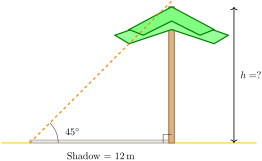
Example 2.4.68. Finding the Height of an Acacia Tree.

A farmer in Kajiado County wants to estimate the height of an acacia tree in her field. On a sunny afternoon, the tree casts a shadow that is \(12\,\text{m}\) long. If the angle of elevation of the sun is \(45^\circ\text{,}\) find the height of the tree.
Solution.
In this right triangle:
Using tangent:
\begin{align*} \tan\,45^\circ \amp= \frac{\text{opposite}}{\text{adjacent}} = \frac{h}{12}\\ h \amp= 12 \times \tan\,45^\circ\\ \amp= 12 \times 1\\ \amp= 12\,\text{m} \end{align*}
The height of the acacia tree is \(12\,\text{m}\text{.}\)
Note: This result makes sense because when the angle of elevation is \(45^\circ\text{,}\) the height equals the shadow length since \(\tan\,45^\circ = 1\text{.}\)

Example 2.4.69. Angle of a Football Shot.

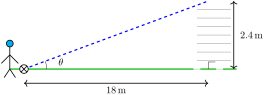
A football player stands \(18\,\text{m}\) away from the goal. The crossbar of the goal is \(2.4\,\text{m}\) high. At what angle of elevation must the player kick the ball so that it just clears the crossbar?
Solution.
In this right triangle:
Using tangent:
\begin{align*} \tan\,\theta \amp= \frac{\text{opposite}}{\text{adjacent}} = \frac{2.4}{18}\\ \tan\,\theta \amp= 0.1333\\ \theta \amp= \tan^{-1}(0.1333)\\ \theta \amp= 7.6^\circ \end{align*}
The player must kick the ball at an angle of elevation of at least \(7.6^\circ\) to clear the crossbar.

Example 2.4.70. Flying a Kite.

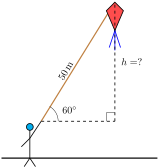
A child is flying a kite with a string that is \(50\,\text{m}\) long. If the string makes an angle of \(60^\circ\) with the ground, find the exact height of the kite above the child’s hand. (Assume the string is taut and straight.)
Solution.
In this right triangle:
Using sine:
\begin{align*} \sin\,60^\circ \amp= \frac{\text{opposite}}{\text{hypotenuse}} = \frac{h}{50}\\ h \amp= 50 \times \sin\,60^\circ\\ \amp= 50 \times \frac{\sqrt{3}}{2}\\ \amp= 25\sqrt{3}\,\text{m} \end{align*}
The kite is exactly \(25\sqrt{3}\,\text{m}\) above the child’s hand, which is approximately \(43.3\,\text{m}\text{.}\)

Exercises Exercises

1.

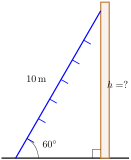
A ladder is leaning against a wall, forming an angle of \(60^\circ\) with the ground. If the ladder is \(10\,\text{m}\) long, find the exact height it reaches on the wall.
Answer.
Using sine: \(h = 10 \times \sin\,60^\circ = 10 \times \frac{\sqrt{3}}{2} = 5\sqrt{3}\,\text{m}\)
The ladder reaches exactly \(5\sqrt{3}\,\text{m}\) (approximately \(8.66\,\text{m}\)) up the wall.

2. Diagonals of a Rhombus Tile.

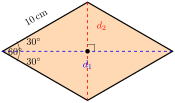
A craftsman in Lamu is creating decorative floor tiles in the shape of rhombuses. Each rhombus has sides of length \(10\,\text{cm}\) and one interior angle of \(60^\circ\text{.}\) Find the lengths of both diagonals of the rhombus.
Solution.
The diagonals of a rhombus bisect each other at right angles and also bisect the interior angles.
At the \(60^\circ\) vertex, each half-angle is \(30^\circ\text{.}\)
Using the right triangle formed by half of each diagonal and one side:
\begin{align*} \text{Half of longer diagonal: } \quad \frac{d_1}{2} \amp= 10 \times \cos\,30^\circ = 10 \times \frac{\sqrt{3}}{2} = 5\sqrt{3}\,\text{cm}\\ \therefore d_1 \amp= 10\sqrt{3} \approx 17.32\,\text{cm} \end{align*}
\begin{align*} \text{Half of shorter diagonal: } \quad \frac{d_2}{2} \amp= 10 \times \sin\,30^\circ = 10 \times \frac{1}{2} = 5\,\text{cm}\\ \therefore d_2 \amp= 10\,\text{cm} \end{align*}
The diagonals are \(10\sqrt{3} \approx 17.32\,\text{cm}\) and \(10\,\text{cm}\text{.}\)

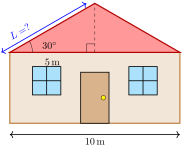
3. Constructing a Mabati Roof.

A family in Machakos is building a house with a mabati (iron sheet) roof that makes an angle of \(30^\circ\) with the horizontal. If the width of the house is \(10\,\text{m}\text{,}\) and the roof is symmetric, find the exact length of one side of the roof (from the edge to the peak).
Solution.
Since the roof is symmetric, each half-span is \(\frac{10}{2} = 5\,\text{m}\text{.}\)
In the right triangle formed by half the roof:
Using cosine:
\begin{align*} \cos\,30^\circ \amp= \frac{\text{adjacent}}{\text{hypotenuse}} = \frac{5}{L}\\ L \amp= \frac{5}{\cos\,30^\circ}\\ \amp= \frac{5}{\frac{\sqrt{3}}{2}}\\ \amp= \frac{10}{\sqrt{3}}\\ \amp= \frac{10\sqrt{3}}{3}\,\text{m} \end{align*}
Each side of the mabati roof is exactly \(\frac{10\sqrt{3}}{3}\,\text{m}\text{,}\) which is approximately \(5.77\,\text{m}\text{.}\)

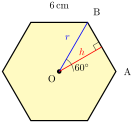
4. Dimensions of a Hexagonal Beehive Frame.

A beekeeper in Baringo is building frames for beehives. Each frame has a regular hexagonal shape with sides of length \(6\,\text{cm}\text{.}\) Using trigonometry, find the exact values of:
  1. The distance from the center of the hexagon to any corner.
  2. The distance from the center to the middle of any side.
  3. The total width of the hexagon (measured across two opposite corners).
Solution.
A regular hexagon can be divided into 6 equilateral triangles. The angle at the center for each triangle is \(\frac{360^\circ}{6} = 60^\circ\text{.}\)
a) Distance from center to corner:
Since each triangle is equilateral, the distance from the center to any corner equals the side length:
\begin{equation*} r = 6\,\text{cm} \end{equation*}
b) Distance from center to middle of a side:
Drawing a line from the center to the middle of a side creates a right angle. This line, half a side, and the line to the corner form a right triangle with a \(30^\circ\) angle at the center.
\begin{align*} h \amp= r \times \cos\,30^\circ\\ \amp= 6 \times \frac{\sqrt{3}}{2}\\ \amp= 3\sqrt{3}\,\text{cm} \end{align*}
The distance from the center to the middle of any side is exactly \(3\sqrt{3}\,\text{cm}\text{,}\) which is approximately \(5.20\,\text{cm}\text{.}\)
c) Width across opposite corners:
The width across opposite corners is twice the distance from center to corner:
\begin{equation*} \text{Width} = 2r = 2 \times 6 = 12\,\text{cm} \end{equation*}
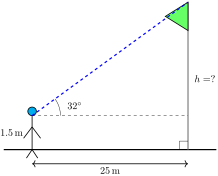
5.

A student stands \(25\,\text{m}\) away from the base of a flag pole. The angle of elevation from the student’s eyes to the top of the flag pole is \(32^\circ\text{.}\) If the student’s eyes are \(1.5\,\text{m}\) above the ground, find the total height of the flag pole.
Answer.
Height above eye level: \(h = 25 \times \tan\,32^\circ = 25 \times 0.6249 = 15.62\,\text{m}\)
Total height of flag pole: \(15.62 + 1.5 = 17.12\,\text{m}\)

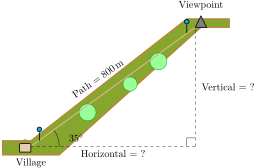
6.

A footpath leads from a village in the Taita Hills to a viewpoint at the top. The path is \(800\,\text{m}\) long and makes an angle of \(35^\circ\) with the horizontal. Find:
  1. The vertical height gained by a hiker walking from the village to the viewpoint.
  2. The horizontal distance traveled.
Answer.
  1. Vertical height gained: \(h = 800 \times \sin\,35^\circ = 800 \times 0.5736 = 458.9\,\text{m}\)
  2. Horizontal distance: \(d = 800 \times \cos\,35^\circ = 800 \times 0.8192 = 655.4\,\text{m}\)

7.

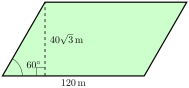
A farmer in Nyandarua owns a piece of land in the shape of a parallelogram. The longer sides measure \(120\,\text{m}\) and the perpendicular distance between them is \(40\sqrt{3}\,\text{m}\text{.}\) If one interior angle is \(60^\circ\text{,}\) find the total length of fencing needed to enclose the land.
Answer.
First, find the length of the shorter sides using trigonometry. Let \(s\) be the length of a shorter side.
Using sine: \(\sin\,60^\circ = \frac{40\sqrt{3}}{s}\)
\(s = \frac{40\sqrt{3}}{\sin\,60^\circ} = \frac{40\sqrt{3}}{\frac{\sqrt{3}}{2}} = 40\sqrt{3} \times \frac{2}{\sqrt{3}} = 80\,\text{m}\)
The perimeter of the parallelogram is:
Perimeter = \(2 \times 120 + 2 \times 80 = 240 + 160 = 400\,\text{m}\)
The farmer needs \(400\,\text{m}\) of fencing to enclose the land.

8.

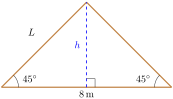
A carpenter is building an isosceles triangular roof truss. The base of the truss spans \(8\,\text{m}\) and the two equal sides each make an angle of \(45^\circ\) with the horizontal base.
  1. Find the exact height of the truss at its peak.
  2. Find the exact length of each sloping side.
Answer.
  1. The height can be found using the half-base (4 m) and the angle:
    \(h = 4 \times \tan\,45^\circ = 4 \times 1 = 4\,\text{m}\) (exact)
  2. The sloping side length:
    \(L = \frac{4}{\cos\,45^\circ} = \frac{4}{\frac{\sqrt{2}}{2}} = 4\sqrt{2}\,\text{m}\) (exact)
    The exact length of each sloping side is \(4\sqrt{2}\,\text{m}\text{,}\) which is approximately \(5.66\,\text{m}\text{.}\)

9.

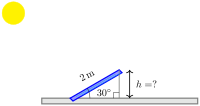
A solar panel measuring \(2\,\text{m}\) in length is installed on a flat roof. For optimal sunlight absorption, it should be tilted at an angle of \(30^\circ\) to the horizontal. Find the exact height of the upper edge of the panel above the roof.
Answer.
Using sine: \(h = 2 \times \sin\,30^\circ = 2 \times \frac{1}{2} = 1\,\text{m}\) (exact)

10.

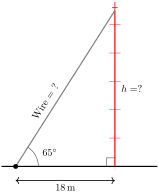
A Safaricom mobile network tower in Kitale is held in place by a wire attached to the top of the tower and anchored to the ground \(18\,\text{m}\) from the base. If the wire makes an angle of \(65^\circ\) with the ground, find:
  1. The height of the tower.
  2. The length of the wire.
Answer.
  1. Height: \(h = 18 \times \tan\,65^\circ = 18 \times 2.145 = 38.6\,\text{m}\)
  2. Wire length: \(L = \frac{18}{\cos\,65^\circ} = \frac{18}{0.4226} = 42.6\,\text{m}\)

11.

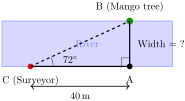
A surveyor needs to find the width of the Tana River. She stands at point A on one bank and sights a mango tree at point B directly across the river. She then walks \(40\,\text{m}\) along the riverbank to point C and finds that the angle ACB is \(72^\circ\text{.}\) What is the width of the Tana River?
(Top-down view)
Answer.
In the right triangle ACB, angle ACB = \(72^\circ\text{,}\) and AC = \(40\,\text{m}\text{.}\)
\(\tan\,72^\circ = \frac{\text{width}}{40}\)
Width of Tana River = \(40 \times \tan\,72^\circ = 40 \times 3.078 = 123.1\,\text{m}\)

Challenging Problems.

The following problems require more advanced problem-solving skills and often involve setting up and solving simultaneous equations.
12.
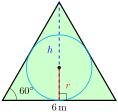
A gardener is designing an equilateral triangular flower bed with each side measuring \(6\,\text{m}\text{.}\) Give all answers in exact form.
  1. Use trigonometry to find the exact height of the triangular bed.
  2. Find the exact area of the flower bed.
  3. Find the exact radius of a circular fountain that could be inscribed in the triangular bed (touching all three sides).
Answer.
  1. Using half the base (3 m) and the \(60^\circ\) angle:
    \(h = 3 \times \tan\,60^\circ = 3 \times \sqrt{3} = 3\sqrt{3}\,\text{m}\) (exact)
  2. Area = \(\frac{1}{2} \times \text{base} \times \text{height} = \frac{1}{2} \times 6 \times 3\sqrt{3} = 9\sqrt{3}\,\text{m}^2\) (exact)
  3. The inscribed circle radius \(r = \frac{\text{Area}}{s}\) where \(s\) is the semi-perimeter:
    \(s = \frac{6 + 6 + 6}{2} = 9\,\text{m}\)
    \(r = \frac{9\sqrt{3}}{9} = \sqrt{3}\,\text{m}\) (exact)
The exact answers are: height \(= 3\sqrt{3}\,\text{m}\text{,}\) area \(= 9\sqrt{3}\,\text{m}^2\text{,}\) radius \(= \sqrt{3}\,\text{m}\text{.}\)
13.
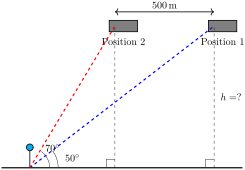
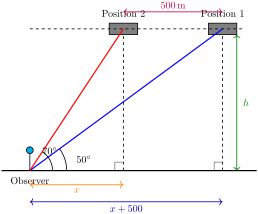
An airplane is flying at a constant altitude. A person on the ground observes the airplane at an angle of elevation of \(50^\circ\text{.}\) After the airplane has flown \(500\,\text{m}\) directly toward the person, the angle of elevation becomes \(70^\circ\text{.}\) Find the altitude of the airplane.
Hint.
Let the horizontal distance from the person to position 2 be \(x\text{.}\) Then the distance to position 1 is \(x + 500\text{.}\) Use \(\tan\,70^\circ = \frac{h}{x}\) and \(\tan\,50^\circ = \frac{h}{x+500}\text{.}\)
Answer.
From \(\tan\,70^\circ = \frac{h}{x}\text{,}\) we get \(h = x\tan\,70^\circ\text{.}\)
From \(\tan\,50^\circ = \frac{h}{x+500}\text{,}\) we get \(h = (x+500)\tan\,50^\circ\text{.}\)
Equating: \(x\tan\,70^\circ = (x+500)\tan\,50^\circ\)
\(x(2.747) = (x+500)(1.192)\)
\(2.747x = 1.192x + 596\)
\(1.555x = 596\text{,}\) so \(x = 383.3\,\text{m}\)
Therefore: \(h = 383.3 \times \tan\,70^\circ = 383.3 \times 2.747 = 1053\,\text{m}\)