Subsection 2.9.4 Midpoints of Vectors

Learner Experience 2.9.6.

Work in groups
What you require: Graph paper

(b)

Choose any starting point on the graph and label it as Point \(A\text{.}\) write down its coordinates.

(c)

From Point \(A\text{,}\) move \(6\) units to the right parallel to the \(x\) axis and mark this new location as Point \(B\text{.}\) Write down its coordinates.

(d)

Draw a directed line from point \(A\) to Point \(B\) to represent \(\overrightarrow{AB}\text{.}\)

(e)

Find the midpoint of \(\overrightarrow{AB}\) and label it as Point \(M\text{.}\)

(g)

Think of a way to determine coordinates of Point \(M\) without manually counting the units.

(h)

Discuss and share your findings with the rest of the class.

Key Takeaway 2.9.40.

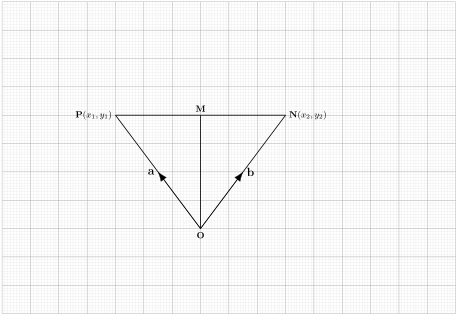
Consider the cordinates of point \(P\) given as \((x_1,y_1)\) and point \(N\) given as \((x_2,y_2)\) and \(M\) is the midpoint of \(\mathbf{PN}\) as shown in figure below.
Figure 2.9.41.
\begin{align*} \mathbf{OM} \amp = \mathbf{OP} + \mathbf{PM} \\ \amp = \mathbf{a} + \frac{1}{2} \mathbf{PN}\\ \amp = \mathbf{a} + \frac{1}{2} (\mathbf{b} - \mathbf{a})\\ \amp = \mathbf{a} + \frac{1}{2}\mathbf{b} - \frac{1}{2}\mathbf{a}\\ \amp = \mathbf{a} - \frac{1}{2}\mathbf{a} + \frac{1}{2}\mathbf{b}\\ \amp = \frac{\mathbf{a} + \mathbf{b}}{2} \end{align*}
But \(\mathbf{a} = \begin{pmatrix} x_1 \\ y_1 \end{pmatrix}\) and \(\mathbf{b} = \begin{pmatrix} x_2 \\ y_2 \end{pmatrix}\)
Thus, midpoint \(\mathbf{M} = \left( \frac{ x_1 + x_2 }{ 2}, \frac{ y_1 + y_2 }{ 2}\right)\)

Example 2.9.42.

Find the coordinates of the midpoint \(M\) of \(\textbf{AB}\) given the following points \(A(6,1), \,\, B(4,3)\text{.}\)
Solution.
To determine the midpoint \(M\) of \(\overrightarrow{AB}\) , we apply the midpoint formulae as follows.
\begin{align*} \text{Midpoint } \amp = \left( \frac{x_1 + x_2}{2}, \frac{y_1 + y_2}{2}\right) \\ \amp = \left(\frac{6 + 4}{2}, \frac{1+3}{2}\right)\\ \amp = \left(\frac{10}{2}, \frac{4}{2}\right)\\ \amp = \left(5, 2\right) \end{align*}
Thus, the coordinates of the midpoint \(M\) is \((5,2)\)
Example 2.9.43.

The points \(PQR\) are on a straight line, given point \(Q(-3,5)\) is the midpoint of \(PR\text{.}\) Find the coordinates of \(P\) if \(R(-10,15)\text{?}\)
Solution.
We apply the midpoint formulae as follows.
Midpoint \(= (\frac{x_1 + x_2}{2} , \frac{y_1 + y_2}{2})\)
\((-3,5) = (\frac{x_1 - 10}{2} , \frac{y_1 + 15}{2})\)
\((x_1,y_1) = (4,-5)\)
The point \;\(P(4,-5)\)

Exercises Exercises

1.

Find the coordinates of the midpoint of \(\mathbf{PQ}\) in each of the following cases:
  1. \(\displaystyle P\, (-5,6), Q\, (3,-4)\)
  2. \(\displaystyle P\,(1,βˆ’3), Q\,(5,7)\)
  3. \(\displaystyle P\, (-2,4), Q\, (6,0)\)
  4. \(\displaystyle P\, (a,b), Q\, (c,d)\)
Answer.
  1. \(\displaystyle \left( \frac{-5+3}{2} ,\frac{6-4}{2}\right) = (-1,1)\)
  2. \(\displaystyle \left( \frac{1+5}{2} ,\frac{-3+7}{2}\right) = (3,2)\)
  3. \(\displaystyle \left( \frac{-2+6}{2} ,\frac{4+0}{2}\right) = (2,2)\)
  4. \(\displaystyle \left( \frac{a+c}{2} ,\frac{b+d}{2}\right) = \left( \frac{a+c}{2} ,\frac{b+d}{2}\right)\)

2.

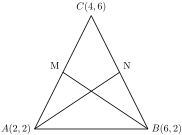
In the figure below, \(ABC\) is a triangle where \(M\) and \(N\) are midpoints of \(\overrightarrow{AC}\text{,}\) \(\overrightarrow{AB}\) respectively.
Triangle \(ABC\) has vertices at points \(A(2,2)\text{,}\) \(B(6,2)\) and \(C(4,6)\text{.}\) Determine the coordinates of \(M\) and \(N\text{.}\)
Answer.
  1. \(\displaystyle M = \left( \frac{2+4}{2} ,\frac{2+6}{2}\right) = \left( \frac{6}{2} ,\frac{8}{2}\right) = (3,4)\)
  2. \(\displaystyle N = \left( \frac{6+4}{2} ,\frac{2+6}{2}\right) = \left( \frac{10}{2} ,\frac{8}{2}\right) = (5,4)\)