Skip to main content
Contents
Search Book
Search Results:
No results.
Read aloud Readability settings Prev Up Next \(\newcommand{\N}{\mathbb N} \newcommand{\Z}{\mathbb Z} \newcommand{\Q}{\mathbb Q} \newcommand{\R}{\mathbb R}
\newcommand{\lt}{<}
\newcommand{\gt}{>}
\newcommand{\amp}{&}
\definecolor{fillinmathshade}{gray}{0.9}
\newcommand{\fillinmath}[1]{\mathchoice{\colorbox{fillinmathshade}{$\displaystyle \phantom{\,#1\,}$}}{\colorbox{fillinmathshade}{$\textstyle \phantom{\,#1\,}$}}{\colorbox{fillinmathshade}{$\scriptstyle \phantom{\,#1\,}$}}{\colorbox{fillinmathshade}{$\scriptscriptstyle\phantom{\,#1\,}$}}}
\)
Subsection 2.8.7 Volume of Spheres
Curriculum Alignment
Strand
2.0 Measurements and Geometry
Sub-Strand
Specific Learning Outcomes
Calculate the volume of prisms, pyramids, cones, frustums and spheres. Explore the use of the surface area and volume of solids in real-life situations.
Teacher Resource 2.8.47 .
To assist your teaching, we have prepared lesson resources, aligned with this textbook and the CBC. The Lesson Plan links to syllabus learning outcomes and provides suggest time allocations. The Step-by-Step Guide provides more detailed guidance on how to teach the content, including suggested questions to ask learners, and possible answers.
Learner Experience 2.8.48 .
\(\textbf{Orange Peeling Experiment}\)
♦ An orange (or any round fruit)
Cut the orange in half and carefully peel the skin off in small sections.
Try flattening the peels and arrange them to see how they approximate a circle’s area.
♦ When you peel an orange and flatten the pieces, you can see that the peels cover a large area.
♦ This helps visualize why increasing the radius increases the overall amount of space the fruit takes up (its volume).
Cutting the Orange into Sections.
♦ If you cut an orange in half, you can see its cross-section.
♦ If you keep slicing it into smaller spheres, their individual radii determine their volumes.
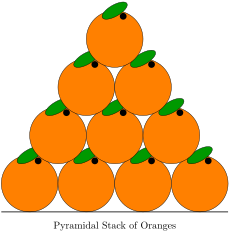
Why do you think oranges or tomatoes or apples etc. are stacking in pyramidal stacks in the market?
♦ Oranges in a fruit market are often packed in pyramidal stacks because spheres fit together efficiently.
♦ The larger the radius, the more space each orange occupies, which directly affects storage and packaging.
♦ The radius is the most important factor in determining the volume of a sphere.
♦ If the radius doubles, the volume increases by
\(2^3 = 8\) times!
♦ This explains why a slightly bigger orange holds significantly more juice compared to a smaller one.
\(\textbf{Key Takeaway}\)
A sphere is a perfectly round object.
Example 2.8.49 .
A sphere has a radius of 6 cm. Find its volume.
\begin{align*}
\text{V} =\amp \frac{4}{3} \times \pi r^3\\
= \amp 3.142 \times \frac{4}{3} \times (6)^3\\
= \amp \frac {864}{3} \times 3.142 \\
= \amp 904.9 \, \text{cm}^3
\end{align*}
Example 2.8.50 .
A football has a radius of 9 cm. What is the volume of the ball?
Solution .
\begin{align*}
\text{V} =\amp \frac{4}{3} \times \pi r^3\\
= \amp 3.142 \times \pi\frac{4}{3} \times (9 \,\text{cm})^3\\
= \amp 3054.02\, \text{cm}^3
\end{align*}
Example 2.8.51 .
A planet has a radius of 1000 km. What’s it’s volume?
Solution .
\begin{align*}
\text{V} =\amp \frac{4}{3} \times r^3\\
= \amp 3.142 \times\frac{4}{3} \times (1000)^3\\
= \amp 4,189,333,333 4.19= \ 10^9\, \text{km}^3
\end{align*}
Checkpoint 2.8.52 .
Checkpoint 2.8.53 .
Exercises Exercises
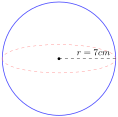
1. A solid sphere has a radius of
\(7\) cm. Find its volume.
2. A bowl is in the shape of a hemisphere with a diameter of
\(12\) cm. Find the volume of the bowl.
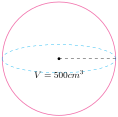
3. A sphere has a volume of
\(500 \;\text{cm}^3\text{.}\) If the radius is doubled, what will be the new volume?
4. A raindrop is modeled as a sphere with a radius of
\(0.2\) cm. If a storm produces
\(1,000,000\) raindrops, what is the total volume of water in liters?
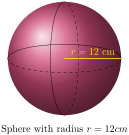
5. A basketball has a radius of
\(12\) cm, while a tennis ball has a radius of
\(4\) cm. How many tennis balls can fit inside the basketball, assuming no empty space?
Answer .
\(27 \;\text{tennis balls}\)