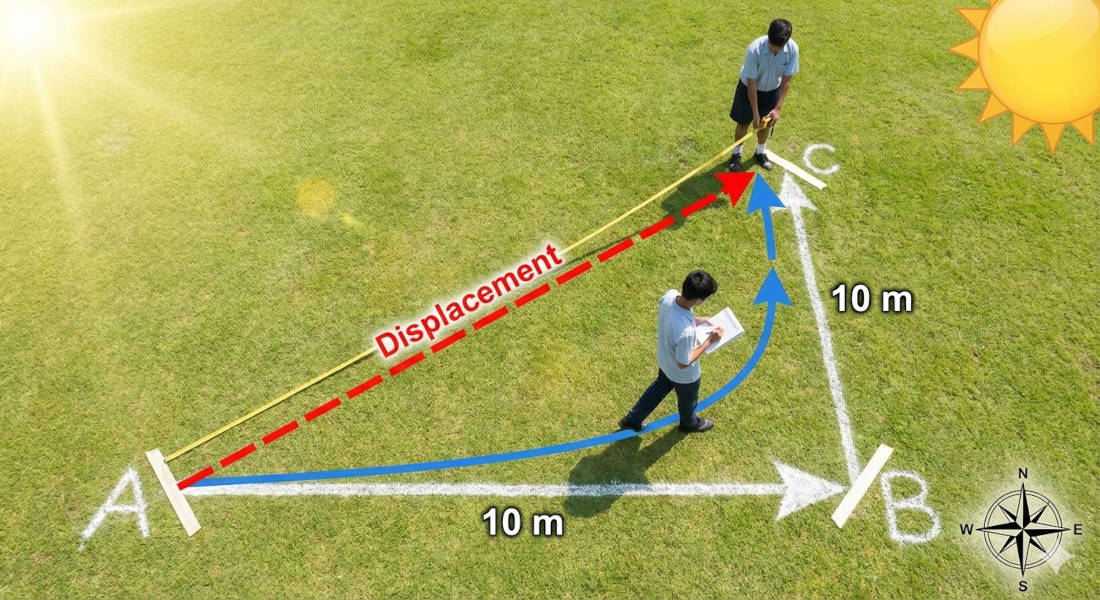
Subsection 2.10.1 Distance and Displacement

Learner Experience 2.10.1.

Work in Groups
What you need
What to do
  1. Mark three points on the ground:
  2. One student to walk:
  3. Another student to go directly from A to C (diagonal path).

(b)

Compare the distance and displacement for both paths taken by the students.

Exploration 2.10.2. The School Journey: Distance vs. Displacement.

Suppose you travel from home to school, but along the way you pass through the market. Do you think the total distance you travel is the same as your overall change in position?
Run the animation below and investigate your ideas by following the guiding questions below.

Instructions.

Click Start Journey and carefully observe both the motion of the car and the numerical values displayed. You may click Restart at any time to return the car to Home and begin the investigation again.

  • Tracking the Route: As the car travels from Home to the Market and then turns toward School, how does the Distance Traveled change? Why does it continue increasing even after the car changes direction?
  • Comparing the Two Measures: When the car reaches School, compare the final values of Distance Traveled and Displacement. Which is greater? What does this tell you about how each quantity is measured?
  • Understanding Displacement: The blue dotted line represents displacement. What does this line measure that the red path does not?
  • The Shortcut Question: If you could travel directly from Home to School in a perfectly straight line, which value would represent that trip: distance, displacement, or both?
  • Making a General Rule: Based on what you observed, can displacement ever be greater than distance? Explain your reasoning.
Figure 2.10.3. Interactive Animation: Traveling from Home to School

Key Takeaway 2.10.4.

Distance is the total length of the path travelled by an object, regardless of direction.
Distance tells us how much ground has been covered.
Distance depends on the path taken.
Displacement is the straight-line distance from the starting point to the ending point, along with the direction.
Displacement tells us how far and in what direction an object is from its starting point.
Displacement depends only on the initial and final positions.
Distance is always greater than or equal to displacement.
Real-life examples where displacement is more useful than distance:
  • Navigation systems like GPS: Displacement gives the straight-line distance and direction to the destination, which is more useful than the total distance traveled.
  • Sports events: In events like long jump or javelin throw, displacement measures how far an athlete has moved from the starting point in a specific direction.

Example 2.10.5.

A person walks \(3\) m east, then \(4\) m north. What is the distance travelled and the displacement from the starting point?
Solution.
\begin{align*} \text{Distance travelled} =\amp 3 \, \text{m} + 4 \, \text{m}\\ =\amp 7 \, \text{m} \end{align*}
Displacement can be found using the Pythagorean theorem:
\begin{align*} \text{Displacement} =\amp \sqrt{(3 \, \text{m})^2 + (4 \, \text{m})^2}\\ =\amp 5 \, \text{m} \end{align*}

Example 2.10.6.

A learner walks \(5\) m east and then \(3\) m west. What is the distance travelled?
What is the displacement from the starting point?
Solution.
\begin{align*} \text{Distance travelled} =\amp 5 \, \text{m} + 3 \, \text{m}\\ =\amp 8 \, \text{m} \end{align*}
\begin{align*} \text{Displacement}=\amp \text{Final Position - Initial Position} \\ =\amp 5 \, \text{m} - 3 \, \text{m}\\ =\amp 2 \, \text{m east} \end{align*}

Example 2.10.7.

A student jogs \(100\) meters east and then \(100\) meters west. What are the total distance and displacement?
Solution.
\begin{align*} \text{ Distance} =\amp 100 \, \text{m} + 100 \, \text{m}\\ =\amp 200 \, \text{m} \end{align*}
\begin{align*} \text{Displacement} =\amp \text{Final Position - Initial Position} \\ =\amp 100 \, \text{m} - 100 \, \text{m}\\ =\amp 0 \, \text{m} \end{align*}

Example 2.10.8.

A person walks \(3\) m west, then \(4\) m south. Find the total distance traveled and the displacement.
Solution.
\begin{align*} \text{Distance} =\amp 3 \, \text{m} + 4 \, \text{m}\\ =\amp 7 \, \text{m} \end{align*}
\begin{align*} \text{Displacement} =\amp \sqrt{(3 \, \text{m})^2 + (4 \, \text{m})^2}\\ =\amp 5 \, \text{m} \end{align*}
The displacement is \(5 \, \text{m}\) in a south-west direction.

Exercises Exercise

1.

A car travels \(60\) km north and then \(80\) km east. What is the total distance travelled and the displacement from the starting point?
Answer.
Distance travelled \(= 140 \, \text{km}\text{.}\)
Displacement \(= 100 \, \text{km}\text{.}\)

2.

A student walks \(5\) m east and then \(3\) m west. What is the distance travelled and the displacement from the starting point?
Answer.
Distance travelled \(= 8 \, \text{m}\text{.}\)
Displacement \(= 2 \, \text{m east}\text{.}\)

3.

A person walks \(6\) meters north, then \(8\) meters east. Calculate the distance and displacement.
Answer.
Distance \(= 14 \, \text{m}\text{.}\)
Displacement \(= 10 \, \text{m}\text{.}\)

4.

A student runs around a rectangular park of length \(60 \, \text{m}\) and width \(40 \, \text{m}\) and returns to the starting point. Find the distance and displacement.
Answer.
Distance \(= 2(60 \, \text{m} + 40 \, \text{m}) = 200 \, \text{m}\text{.}\)
Displacement \(= 0 \, \text{m}\text{.}\)

5.

Can the displacement of an object be greater than its distance? Explain why or why not.
Answer.
No, the displacement of an object cannot be greater than its distance. This is because distance is the total length of the path traveled, while displacement is the straight-line distance from the starting point to the ending point. The straight-line distance (displacement) can never exceed the total path length (distance).